

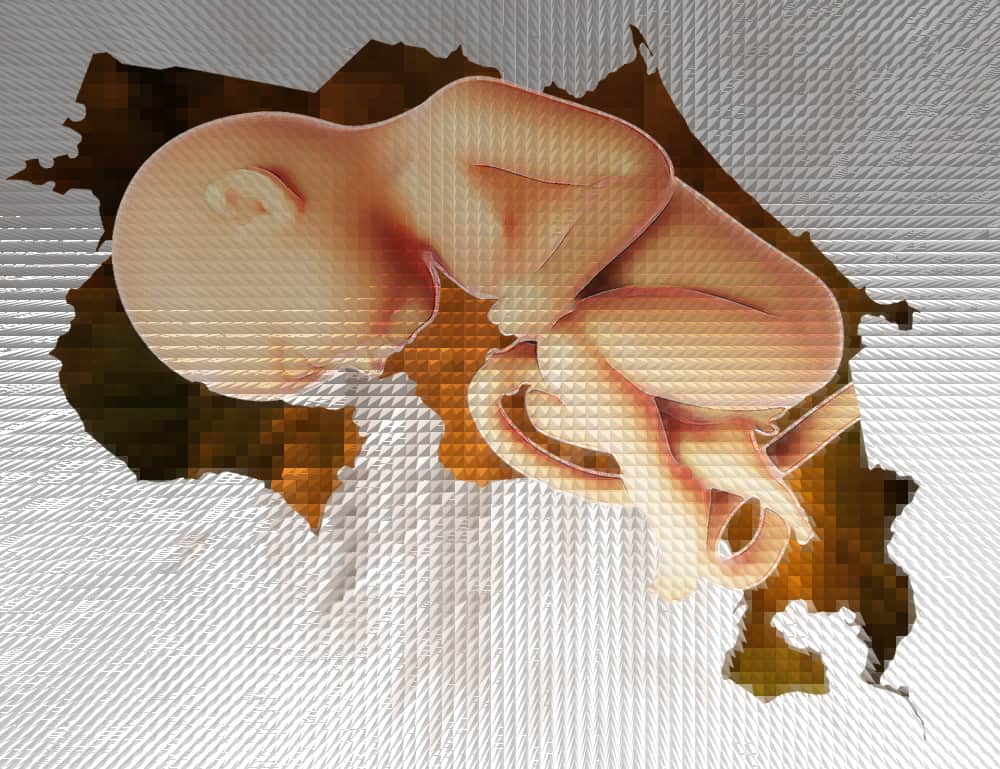
Last week, National Liberation Party presidential candidate Johnny Araya tried to claim the mantle of family values, accusing opposition candidate Luis Guillermo Solís of having a different position than that of his own Citizen Action Party.
While the abortion question could prove combustible in Costa Rica, Araya is not well positioned to strike the match. In large part, this is because both candidates have the same policy on abortion: It should be legal only to save a mother’s life or protect her health.
Araya’s attack on Solís for having a personal opinion that differs from what he thinks best as president may well backfire on the former San José mayor.
As recently as four years ago, Araya also had a different opinion, stating that he was open to discuss a revision of Costa Rica’s abortion law. He has only of late changed his mind, in the heat of an uphill battle to win the April 6 presidential runoff.
It is possible that Solís’ answer regarding his personal beliefs about abortion might actually win over many voters, regardless of their beliefs. Asked if he supported abortion in the case of rape, Solís answered clearly that although he had no plans to change the law if elected president, as a father he would find it painful to compound the hurt of a daughter who had been raped by forcing her to bear a child conceived in such a violent and abusive way.
No matter what one’s position on abortion is, the honest concern of a father trying to imagine his daughter’s pain in such a situation is honorable in its empathy. The sincere attempt to imagine how a law might affect others is exactly the compassion and intelligence missing in Araya’s newfound absolutism on the abortion question.
This debate also has given us further insight into how each candidate might govern. Solís, open to the opinions and concerns of others, shows compassion for those most affected by abortion, but recognizes that most citizens might not share his personal views. His style demonstrates leadership through education. It shows the pedagogical open-mindedness of a university professor inviting listeners to step out of their ideological comfort zones and imagine the pain of an individual or family forced by law to carry a rapist’s progeny to term. It does not force them to accept a position that is not their own.
Most importantly, his answer acknowledges something that recent presidents have had difficulty understanding: There are important differences between the private interests of a person and the public interests of the office of president.
Araya’s style of governance appears altogether different. Apart from seeming to be crafted simply to win votes, Araya’s attack on Solís for having a personal opinion or private interest distinguishable from what he might do as head of state is a gift wrapped up as an accusation.
Reminiscent of French King Louis XIV’s declaration of “L’état, c’est moi,” Araya’s attitude of “the state is me” conflates public and private interest and leads inevitably to a president believing that the state, its contracts and its laws are his personal property to do with what he and his party see fit. The inability or unwillingness to separate the private interests of a person from the public responsibility of the officeholder could be interpreted as a foundation for the clientelism and cronyism of recent PLN administrations. It also is a practice of governance rejected by 70 percent of voters in the first round and one that has tainted the reputation of the once historic PLN.
Rather than berate Luis Guillermo Solís for his response to the abortion question, Johnny Araya would do well to congratulate him for it. A previous U.S. presidential candidate, Adlai E. Stevenson, once said, “Those who corrupt the public mind are just as evil as those who steal from the public purse.” It is regrettable that Araya has made the former his presidential campaign strategy, and that in recent years his party has made the latter their form of public administration.
Gary L. Lehring is a professor of government at Smith College, Northampton, Massachusetts. He is on sabbatical in Costa Rica. His opinions are his own and do not necessarily reflect the opinions of The Tico Times.





