

MATAGALPA – Jorge Centeno’s coarse fingers seek out the shiny package’s opening with an inexperience that his seasoned and calloused hands belie.
With a bit of help, he opens the glossy Chicago-made packaging and pulls out a sun-dried banana, which he harvested on his modest organic farm before it was processed and packaged for export. He smells the limp fruit cautiously before chewing and swallowing it with a grin and a chuckle.
Like most Nicaraguans, Centeno had never tasted solar-dried organic fruit, which is just one of a plethora of value-added products that comprise Nicaragua’s $42 million annual organic food sector – from solardried mangos to passion fruit jams to artisan chocolates.
Over the years, Nicaragua’s ecology and workforce have both sustained scars from the practices of its big-agriculture industries.
Some 5,000 former banana farmers from Nicaragua and other Central American countries say they were left sterile and poisoned by hazardous banana-industry chemicals such as nemagón, while widespread agricultural activity has reduced Nicaragua’s tree cover to less than half its reach of half a century ago.
The organic food industry is not only easier on Nicaragua’s workers and biodiversity, but it’s also diversifying this tropical country’s agricultural sector and improving its food security. The trendy market, which has shown a 10 percent annual growth rate, is also giving the bulk of organic producers – most of whom are coffee farmers – a more stable market to sell their goods at higher prices.
Nicaragua has more farmland dedicated to organic production than any other Central American country – about 70,000 hectares, or 8 percent of productive farmland, according to a report released last month by the Inter-American Institute for Agricultural Cooperation (IICA).
Coffee is by far the leading organic product in Nicaragua, accounting for 80 percent of all organic farming. Cacao, sesame and honey occupy distant second, third and fourth places.
IICA’s representative in Nicaragua, Gerardo Escudero, says the organic sector here is ready to explode. “It’s my interpretation that (organic production) is entering into the pores of society and there’s a push for clean production,” the Mexican-born Escudero told The Nica Times in a phone interview.
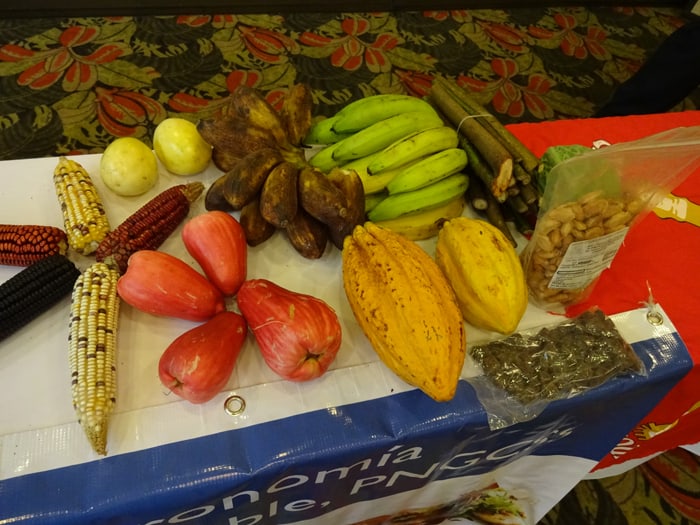
The bulk of Nicaragua’s organic crops are produced in the northern highlands on small farms like Centeno’s, which is a smorgasbord of organic mangos, bananas, cacao and other tropical fruits.
Like Centeno, most Nicaraguans have never tasted the country’s processed organic food. But that is changing. While 96 percent of organic production was exported six years ago, today some 30 percent of it is staying in Nicaragua for domestic consumption, according to the IICA report.
Now, a handful of organic exporters that have set up shop in Nicaragua are organizing in hopes of making even greater inroads into the local market. Their goal is to persuade supermarket giants La Colonia and La Unión to dedicate a section solely to Nicaraguan organic products, while also devising an organic farming policy to propose to the National Assembly in order to stimulate this growing sector.
“The idea is to contribute to the protection of the environment,” said Dominique Ruegsegger, Swiss co-founder of Jinotepebased Finca Santa Clara, which makes organic spreads, jams and teas.
Ruegsegger’s Finca Santa Clara is one among a group of value-added organic producers that are organizing here in hopes of coordinating market insertion in Nicaragua and lobbying for a government policy to stimulate the environment-friendly sector.
Organic chocolate producers Momotombo and Castillo de Cacao, Managua restaurant Ola Verde, Hibiscus tea company, the cooperative Nicaraocoop, organic noni producer Nicanoni and solar-dried fruit producer Sol Simple are among those involved in the organic movement.
“There has been a huge organic push here,” said William Burke, owner of the organic solar-dried fruit company Sol Simple. “We’re trying to find out about other producers who have organic products with value-added.”
Burke’s is one of four companies in Nicaragua selling solar-dried fruit, and he plans to export about $500,000 – or 90 percent of his product – to the United States this year. The other 10 percent will be sold in Nicaragua, he said.
After Burke buys organic fruit from producers such as Centeno, he employs single mothers to process them in his hybrid solar-powered dryer in Carazo before exporting them or marketing them here.
Creating an Alternative
The organic market has given coffee producers an alternative that tends to be less susceptible to the volatile price fluctuations of the commodity, says Adrian Arauz, president of CEEOSEMAC, a Matagalpa-based cooperative of 300 coffee producers, about a third of whom produce organically.
“When prices fall, certified organic producers have more of a guarantee that their prices will maintain themselves,” said Arauz.
Many organic producers switch over to traditional production when organic prices are low or traditional prices are high, he said. But overall, the organic prices tend to be higher than conventional coffee prices.
As a result, it’s becoming an increasingly attractive niche in the countryside, where the majority live in extreme poverty and conditions are ripe for organic production.
The average organic producer in Nicaragua makes about $5,600 a year, about double the U.S. average Nicaraguan income level.
By obtaining organic certification, producers here give potential consumers the guarantee that their product is, indeed, organic, explains Burke. Producers can then market the product abroad at a higher price than traditional agricultural exports.
He markets his solar-dried fruits mostly in California and is looking to market them in U.S. college towns in other states. The U.S. market, Nicaragua’s most important for organically produced foods, has surged over the past decade.
Organic food alone is now a $40 billion annual industry, 16 percent of which is produced in Latin America, according to IICA.
The Peruvian organic certifier BioLatina periodically visits the organic plantations where Burke purchases his produce, to certify their production practices. BioLatina is now one of a half dozen organic certifiers active in Nicaragua, according to Escudero.
Though coffee is the main organic crop, IICA has been certifying and training other organic producers as well. The group is in the process of helping 1,000 honey and cacao producers attain certification for export.
The Institute has even made a push to certify more than 100 organic meat producers, with limited results.
With support from the Austrian government, the Institute has been a key player in drafting a bill to support organic agriculture, which Nicaragua’s Mesa Organica, an association of organic producers, plans to propose to legislators in 2009.
The legislative proposal would provide tax incentives for organic producers and dedicate government resources to train farmers in organic techniques.
If such a proposal is approved, it would put Nicaragua’s organic sector a step ahead of many other countries, where organic sectors have developed without such government backing. The growth potential is great, Escudero said. “Nicaragua is one of the least certified, but has the most capacity and room to develop,” he said.





