

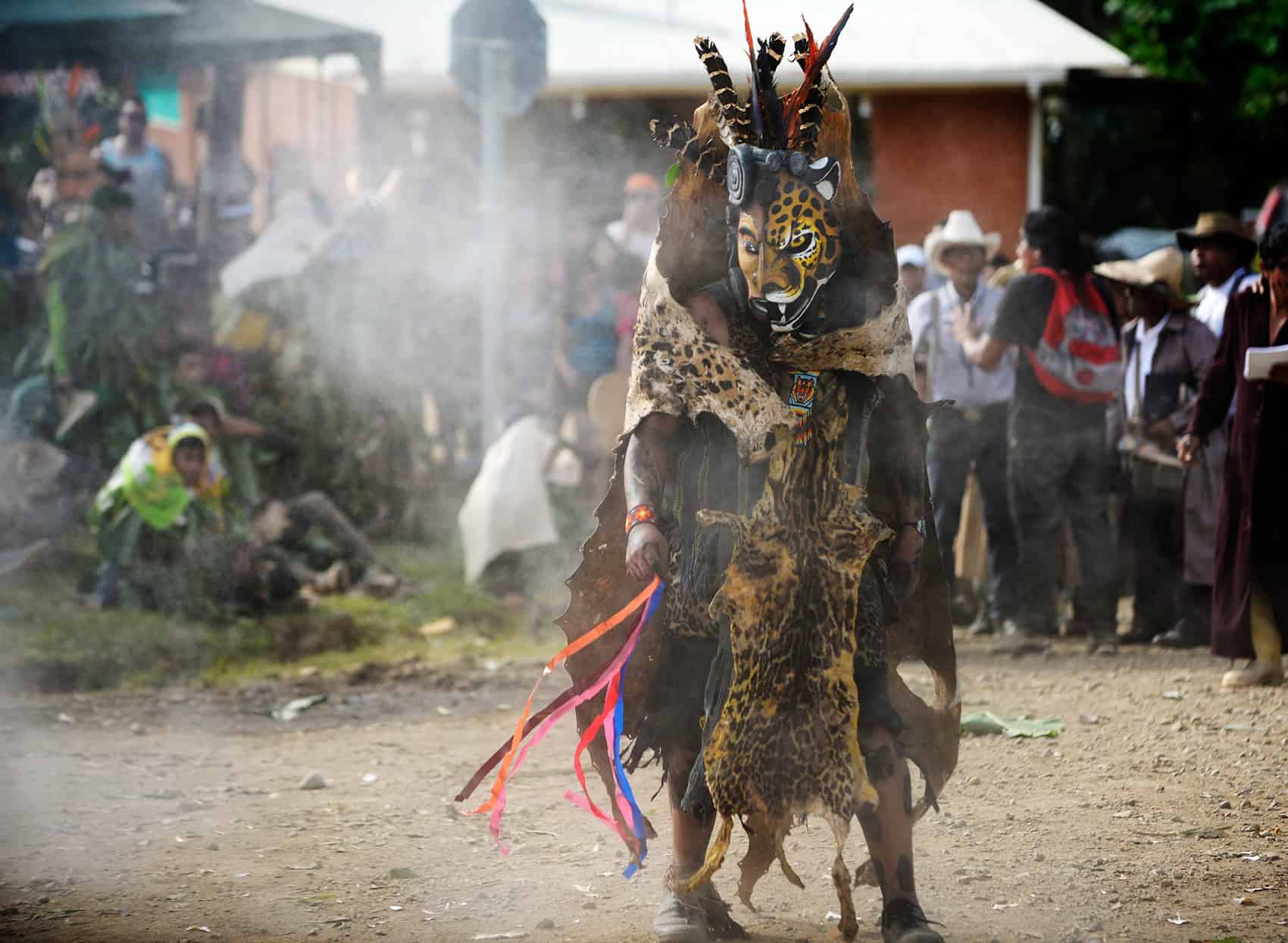
Long after Costa Rica’s Spanish conquest, the fight is still being played out in the Indigenous community of Rey Curré. The weapons are carved wooden masks, a bull costume, drums, conch shells and the collective memory of the Brunca people. Known as Cagrú Rojc, or the Juego de los Diablitos, the ceremony is one of Costa Rica’s most important surviving Indigenous traditions.
Its central story is simple but powerful: the masked diablitos represent the Brunca people, while a charging bull represents the Spanish invaders. Over several days, the two sides fight repeatedly through the yards and pathways of the community. The word “devils” can be misleading.
The diablitos are not meant to represent evil. They are the Indigenous defenders of the story, resisting an outside force determined to overpower them. That distinction is at the heart of Cagrú Rojc. The ceremony does not end with conquest. It ends with survival. The celebration begins at midnight with the Nacencia, or birth of the diablitos.
Participants traditionally climb a nearby hill, where the sound of conch shells, drums, flutes and calls announces their arrival. From there, the ritual moves into the community itself. The bull eventually enters the game and begins charging the diablitos. The confrontations are physical. Participants provoke the bull, are chased, struck and knocked to the ground, then get up to face it again.
There is no fixed theatrical script. The community knows the characters, rules and sequence, and the tradition is recreated from one generation to the next. Homes become part of the ceremonial space. Participants move through the village, where families traditionally offer food and chicha, a fermented Indigenous drink often made with corn and other local ingredients.
Tamales, music and communal meals are not side attractions to the event. They are part of the network of traditions that Cagrú Rojc brings together. So are the masks. Brunca artisans traditionally carve them primarily from balsa wood, although other woods are also used. Some remain natural while others are painted with elaborate faces, animals and elements of the surrounding environment.
The masks have evolved artistically over time, but they continue to occupy a central place in the ceremony and in Brunca cultural identity. The story reaches its climax with the Tumbazón. The bull knocks down the diablitos, briefly appearing to have won. Then the Diablo Mayor rises, sounds the conch shell and brings the fighters back into the struggle.
This time the outcome changes. The diablitos pursue and capture the bull. It is dragged away and symbolically killed before the bull structure is burned. The final fire reverses the historical balance of power. In the story, the Brunca survive, while the invader is defeated.
That ending helps explain why the ceremony remains much more than a festival. Cagrú Rojc acts as a yearly renewal of Brunca identity. Language, food, woodworking, music, oral history, community authority and Indigenous memory all come together during the celebration.
For Rey Curré, that has particular importance. The community has celebrated its modern version of the Juego de los Diablitos since 1979, usually during the last weekend of January or the first weekend of February. The better-known celebration in the neighboring Brunca community of Boruca takes place around New Year’s.
The Rey Curré ceremony therefore does not fall on exactly the same calendar dates every year. Costa Rica formally declared the Juego de los Diablitos of Boruca and Rey Curré part of the country’s Intangible Cultural Heritage in 2017, recognizing the ceremony as one of the country’s most important Indigenous cultural traditions.
But government recognition is not what has kept Cagrú Rojc alive. The community has. People continue carving the masks, preparing the food, teaching the roles, sounding the conch, organizing the procession and repeating a story whose meaning extends well beyond what happened centuries ago.
For the Brunca of Rey Curré, the bull can represent more than one historical enemy. The ceremony carries a broader message about protecting culture, territory and identity against forces that could erase them. Every year the bull returns.
And every year, the Brunca defeat it again.





