

An easement, called a servidumbre in Spanish, is usually a registered right for someone else to use part of a property, whether to cross it, run a water pipe or power line through it, or keep a view open. In Costa Rica, most easements are recorded on the property’s title at the Registro Nacional, they pass to each new owner when the land is sold, and most have no expiry date. Many are harmless. A high-tension power line or an access road through the middle of a lot can block construction or cut the price. That is why you should know what is on the title before you make an offer.
| Servidumbre de paso (right of way) | Lets a neighbor, or the owners of lots carved out of a larger property, cross the land to reach a public road. Watch for traffic, security and who pays to maintain the road. |
|---|---|
| Servidumbre agrícola (agricultural access) | An access road serving parcels subdivided for farming, livestock or forestry. Ask the municipality what you can build on a lot that fronts one before you buy. |
| Servidumbre de agua (water line) | Lets a utility or community water system run pipes, tanks or wells across the property. You can’t build over them. |
| Servidumbre pluvial (storm drainage) | A pipe or channel that carries rainwater across the lot. It has to be kept clear. |
| Servidumbre eléctrica (power line) | Primary, secondary or high-tension power lines. High-tension strips rule out building on that part of the land. |
| Servidumbre de vista (view easement) | Limits how high a neighbor can build. Found mostly in condominiums and planned subdivisions. |
| Servidumbre ecológica (conservation easement) | Protects vegetation or a wildlife corridor, which restricts clearing and building inside it. |
| Where to find them | The title report at the Registro Nacional, under gravámenes y afectaciones, and on the survey plan (plano catastrado) |
| Do they expire? | Only if the deed sets a term. Otherwise they stay on the title until canceled. |
Why easements matter before you buy
Some easements work in the owner’s favor, such as a right of way that gives a landlocked lot its only road access. Others burden the land. Either way, they are much easier to deal with before closing than after it, so check the title as part of your due diligence when buying property in Costa Rica.
How to find out whether a property has an easement
Easements are registered at the Registro Nacional on the property’s title, under gravámenes y afectaciones (liens and encumbrances). They should also be drawn on the survey plan, the plano catastrado, so compare the plan with what you see on the ground. Our guide to Costa Rica real estate measurements explains how to read the plan.
Each easement on the title carries a citation, or cita, that points to the deed that created it. That deed sets out the route, the width, who benefits and any limits on use. You no longer have to visit the Registry to see it. A literal certification of the property can be ordered online through the Registro Nacional at rnpdigital.com or at any Banco de Costa Rica branch, and a copy of the deed behind each easement (a certificación de imágenes) can be ordered online using its cita. Each costs about ₡3,000 (roughly $7), and the bank adds a $6 fee plus VAT at the branch.
When a property is sold, its easements go with it unless they are canceled first. Easements that burdened or served the original property before it was subdivided are usually carried over to every lot cut from it, whether or not they physically cross that lot. They appear on the title as servidumbre trasladada, with no indication of type, so you have to pull the cita to see whether it is a road, a water line or a power line. They rarely come off the title.
Types of easements in Costa Rica
Servidumbre de paso, the right to cross
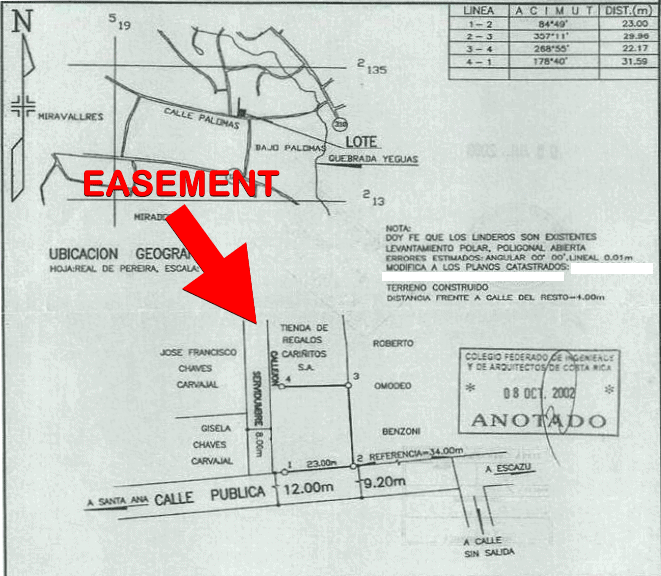
A servidumbre de paso is the right to cross someone else’s land. It usually exists because a property was subdivided and some of the new lots have no frontage on a public road. Neighbors can agree to one and register it, or a court can impose one on behalf of a property with no adequate road access under Articles 395 to 399 of the Civil Code. The owner of the land being crossed gets first say on the route, and if the two sides disagree the judge picks one that balances both properties. The path is normally between 2 and 6 meters (6.5 to 20 feet) wide, and the owner who gains access pays for the land used and any other damage. There is an exception. When a sale, exchange or partition leaves part of a property landlocked, the right to cross the rest is granted automatically with no compensation. A right of way can’t be acquired just by using a path for years.
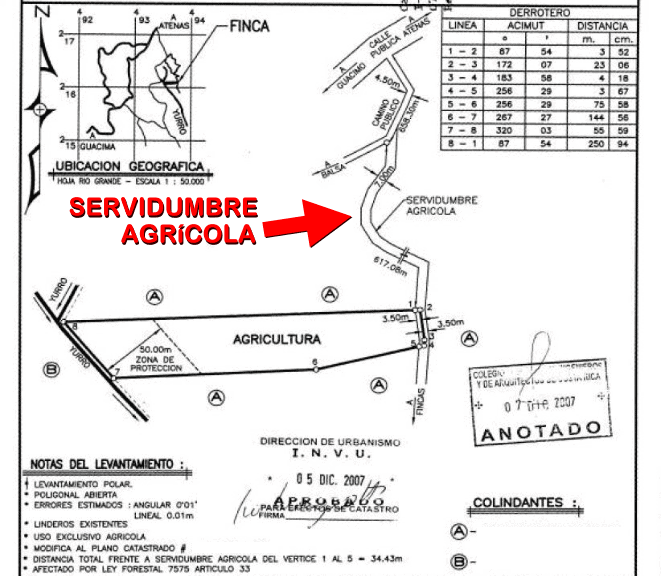
On larger tracts the access road is often a servidumbre agrícola, which serves parcels subdivided for farming, livestock or forestry and was traditionally used to move cattle. You will find many low-density communities built along these roads in Atenas and in coastal areas. National subdivision rules limit how many lots a residential access easement can serve and how long and wide it can be, and treat parcels on an agricultural easement as productive land. Before you buy a lot on one with plans to build a house, confirm with the municipality what it will permit. Our guides to buying land in Costa Rica and the risks of buying a lot in a new development cover the rest of that checklist.
Utility easements
Utility companies usually register an easement when they need to cross someone’s property with a power line, a water line or a sewer line. Most homes rely on septic tanks, and public sewers serve mainly urban parts of the Central Valley and a few towns. The main utilities are ICE (power and telecommunications), CNFL (power), ESPH in Heredia (water, power and sewer), JASEC in Cartago (power), rural electric cooperatives such as Coopelesca and Coopeguanacaste, AyA (water and sewer), municipal water systems such as Cartago’s, and RECOPE (fuel pipelines). Community water systems run by ASADAs also cross private land, and those easements may be registered in favor of AyA or the local association.
Servidumbre de agua and servidumbre pluvial
A servidumbre de agua is the right to run a water pipe across someone else’s property. It can also cover a community’s storage tank or well. In some communities the main water pipe does not run under the road but crosses every private lot along it. Irrigation canals in farming areas are registered as water easements too.
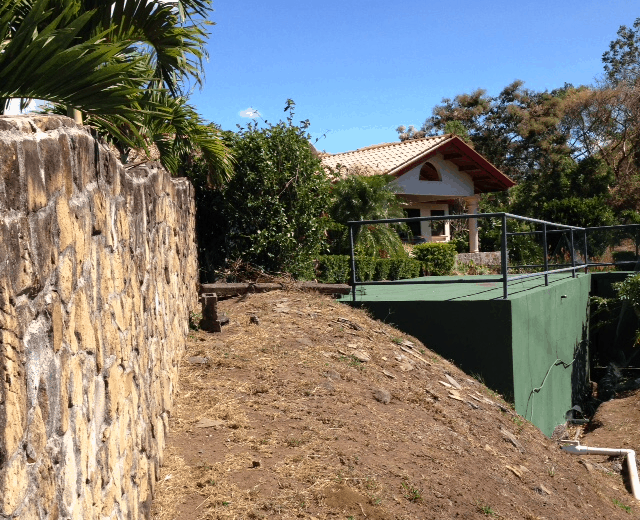
A servidumbre pluvial carries storm water. In some communities, rainwater pipes and drainage channels cross private lots and are registered as easements, and where there is a public sewer the sewer pipes are registered the same way. You can’t block or build over them, which matters on a sloping lot in the rainy season.
Servidumbre eléctrica, power and phone lines
A servidumbre eléctrica, or power easement, covers either primary and secondary distribution lines or high-tension transmission lines. High-tension easements are the restrictive ones. The strip under the lines generally can’t be built on without ICE’s authorization, planted with tall trees, excavated or fenced off, and the deed spells out the exact limits. Phone lines usually run inside the power easement and are rarely registered separately.
Servidumbre de vista, the view easement
A view easement, or servidumbre de vista, is created by agreement and written into the deed. Developers often build them into the deeds or condominium rules when they subdivide and sell lots, which is why you will find view easements mostly in condominiums and master-planned subdivisions. In theory, a very generous neighbor could also grant one to the lot behind, promising never to block the view.
Views are hard to describe in a deed. Most attorneys draft the easement as a building limit instead, for example allowing the neighbor only a one-story home or setting a maximum construction height.
Ecological easements
Some communities register ecological easements to protect nature and wildlife. Nothing inside them may be disturbed, and they are meant to let animals pass through, though animals rarely pay attention to the boundaries.
How to cancel an easement
Under Article 381 of the Civil Code, an easement ends when the right behind it ends, when its term runs out or its condition is met, when the same person comes to own both properties, when the owner who benefits gives it up, or, for private easements, after 10 years without use. Ending it in practice is not enough. To clear the title, the cancellation has to be recorded at the Registro Nacional, either through a notarized deed signed by the person or public entity that holds the easement or through a court order.
It’s best to let your attorney handle this. If you try to do it yourself, you can expect to be sent from one office to another and back until you decide to let it go. Our guide to registering a Costa Rica property title explains how the Registry process works.
Don’t count on anyone telling you
Because easements sit on the public record, a seller may never mention one. Many real estate agents don’t know how to run a title check, and a buyer often depends entirely on the closing attorney, who may not think an easement worth raising.
Before you make an offer, get a title study and look for easements yourself. Then ask your own lawyer, one who doesn’t also represent the seller, to identify every easement and explain what it allows before you sign. The same title check catches the problems described in our guides to avoiding real estate scams in Costa Rica and buying untitled land. Keep your money in a registered escrow account until those questions are answered. Our guide to the closing process and costs shows where the title review fits.
How an easement affects property value
Most easements barely touch a property’s value, but a public utility easement can. Many buyers won’t consider a home near high-tension power lines, whatever the evidence on health effects, which narrows the market when you sell. A right of way that brings neighbors’ traffic past the house can raise security concerns. Some easements add value, such as one that keeps green space between properties or one that gives a lot its only road access.
Putting a number on an easement is hard. When a utility or a court imposes one, the owner is entitled to compensation for the land used and any loss in value, and appraisers set that figure case by case. When you are buying, it is easier to weigh the easement in your offer than to argue about it after you own the land.
Every case is different, so look before you leap. If you are considering buying property in Costa Rica, find out whether any easements exist, understand what they allow and consider carefully how they will affect the property’s value. If you have any doubts, consult a lawyer before you purchase.