

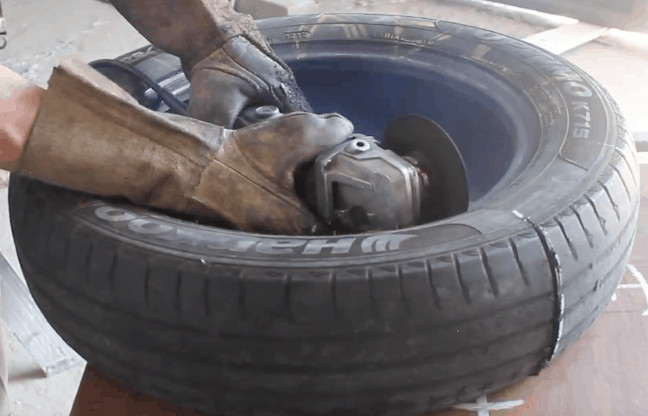
OTTAWA, Canada — Researchers said Thursday they have found a way to fashion a cheap mosquito trap out of old tires that can collect thousands of eggs that may carry the Zika virus.
The contraption is called an “ovillanta,” and consists of cutout tires and a liquid solution that lures Aedes aegypti mosquitoes, which can transmit chikungunya, dengue and Zika.
The females lay their eggs on a wooden or paper strip inside the tire trap. The strip can be removed weekly and the eggs destroyed by using fire or ethanol.
Health experts are hopeful that the trap could help people in remote areas where screens and air conditioning are rare, to reduce people’s contact with the kind of mosquitoes that spread Zika, a virus that has been linked to a surge of birth defects in Brazil.
“We decided to use recycled tires — partly because tires already represent up to 29 percent of the breeding sites chosen by the Aedes aegypti mosquitoes, partly because tires are a universally affordable instrument in low-resource settings, and partly because giving old tires a new use creates an opportunity to clean up the local environment,” said researcher Gerardo Ulibarri of Laurentian University in Ontario.
Researchers tested the traps in the Guatemalan town of Sayaxche over the course of 10 months.
They “collected and destroyed over 18,100 Aedes eggs per month using 84 ovillantas in seven neighborhoods,” the study said.
This was “almost seven times the roughly 2,700 eggs collected monthly using 84 standard traps (made from one-liter buckets) in the same study areas.”
The tire traps were also far cheaper, costing only 20 percent what it would to target adult insects with pesticides, researchers said.
The project was funded by the Canadian government.
Ulibarri collaborated with Angel Betanzos and Mireya Betanzos of the National Institute of Public Health of Mexico, and Guatemala’s Ministry of Health.
The milk-based solution used to attract the mosquitoes was developed by Laurentian University.
Researchers have also released a how-to video for making the traps:





