

The Costa Rican capital will hit a tipping point in its climate within 25 years, where unseen high temperatures will become the new normal, according to a study published by the scientific journal Nature.
The study, conducted by University of Hawaii geography professor Camilo Mora, looked at rising temperatures across the planet, estimating when certain cities and wildlife hotspots would enter what he dubbed an unprecedented climate.
“It’s when the coldest year in the future will be warmer than the hottest year in the past,” Mora told The Tico Times in a phone interview.
The study found that the regions hit first will be in the tropics, some within the next decade. If no action is taken to curb greenhouse gas emissions, Mora’s study estimated a number of Caribbean islands would see the first unprecedented climates in the Latin American and Caribbean region. Kingston, Jamaica, would be first, with an estimated date of 2023. By 2031 change will hit the mainland, with both Mexico City and Panama City heating up with previously unseen temperatures.
In addition to cities, Mora’s study looked at plants and animals, estimating the departure dates for regions with rich biodiversity, such as America’s tropics. The first group will be coral reefs, which will hit their climate departure in 2034.
A number of wildlife groups will hit their tipping point around the same time as cities such as San José, including terrestrial mammals, birds, plants and amphibians. This is due to the rich biodiversity in a region covering southern Mexico to the Amazon in South America.
“For some species, it is going to be a death sentence,” Mora said.
A number of tropical species evolved in a climate with little variability for thousands of years, Mora said. Even a minute temperature shift will create conditions where some species, such as coral, will be unable to adapt.
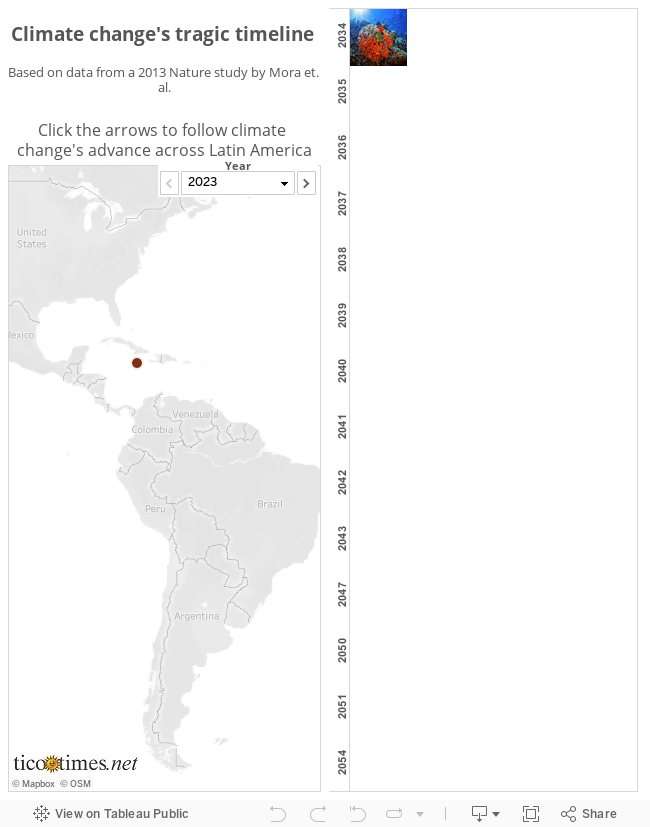
The graphic below shows climate change’s spread according to a scenario where little to no action is taken to curb greenhouse gas emissions. It starts with Kingston, Jamaica, in 2023 and coral reefs in 2034. The story continues below.
Mora, originally from Colombia, looked at 50,000 locations across the planet and their temperature records from 1860 to 2005. Along with the paper’s other authors, Mora pulled data from 38 different climate models, establishing an historic temperature range. Climate models then estimated when certain regions, such as cities, would hit their departure points.
For the wildlife groups, Mora looked at when a “hotspot” would hit the departure point. The study classified hotspots as regions in the top 10 percent of species diversity for that wildlife group.
Mora looked at a second scenario where significant efforts are made to curb emissions such as carbon dioxide. Under this alternate scenario, cities and wildlife around the globe would still experience unprecedented climate by the end of the century. Significantly curbed emissions would push back San José’s climate departure date from 2037 to 2058, according to the study. Kingston would only move ahead five years to 2028. Wildlife such as land mammals would get about 40 more years before seeing record climates in 2079. These alternate scenarios are listed in the graphic above.
The short timeline for climate departure might be shocking — with some cities having as little as 10 years. However, Mora said that some researchers thought his numbers might be too conservative. Mora said that some environments such as the oceans are already subsumed in an unprecedented climate, due to a shift in the ocean’s chemistry.
“Just in the last decade the ocean became a completely different environment with regard to pH,” Mora said.
The study delved into the sociological effects of climate departure. Up to 5 billion people will be living in regions that have entered climate departure by 2050, according to the study. The earliest climate departures will happen in poor tropical countries.
“The fact that the earliest climate departures occur in low-income countries further highlights an obvious disparity between those who benefit economically from the processes leading to climate change and those who will have to pay for most of the environmental and social costs,” the study’s authors wrote.
Mora cited the example of Mexico, one the earliest victims of unprecedented climate in the region. Mora said the loss of agriculture and jobs will create problems for the country’s neighbors. Countries like the United States have already experienced the effects of poor economic conditions in Mexico, such as mass migration, and these events will come again, Mora warned.
Given the short timeline, the social consequences and the harm to wildlife, Mora believed the time for actions by governments is now.
“Solutions have to come from the top down,” Mora said. “There is not enough time to build a groundswell of support and force change. Politicians have to create regulations now.”





