
It was cold at 6 a.m. in the foothills of the Poás Volcano, and when Joaquin and Marvin arrived to pick coffee, they did so in sleeved sweat shirts and campesino hats. Their clothes are for protection as well as warmth. Coffee branches are scratchy and are sometimes home to ants and bugs that bite.
Each man carried a heavy wicker basket, which is tied in place with a belt leaving hands free to pick. An hour later, more pickers arrived. Alba, her daughter-in-law and their dog were followed by Isabel, her daughter and her 3-year-old grandson and his toy truck. The women get a little housework in before heading for the cafetal. Soon there were dozen pickers, men and women, all neighbors.
Three young Ticas looking stylish in improvised picking outfits and carrying baskets called over as they passed on their way to another farm. “¿Como le iba? “ (How’s it going?). “En la lucha” ( In the struggle), Alba called back, and everyone laughed.
Today Joaquin, Marvin and the others will finish up early when Enrique comes with the tractor to haul the day’s take to the recibo, or receiving depot, down the road. They’ll be back in a week or two when the green ones are ripe, and tomorrow they will pick down at Pancho’s where the crop is at its peak.
Ticos are bringing in the year’s coffee crop. Picking coffee is heavy work, a cajuela size basket weighs about 30 pounds when it is full and the beans are dusty and oozing from the inner moist part. The ground is muddy and the slope is steep. But it’s also fun and for housewives, retired workers, part time workers and students. “We talk all day long,” said one picker. They move along the rows of trees, one on each side, singing and helping each other with the harvest.
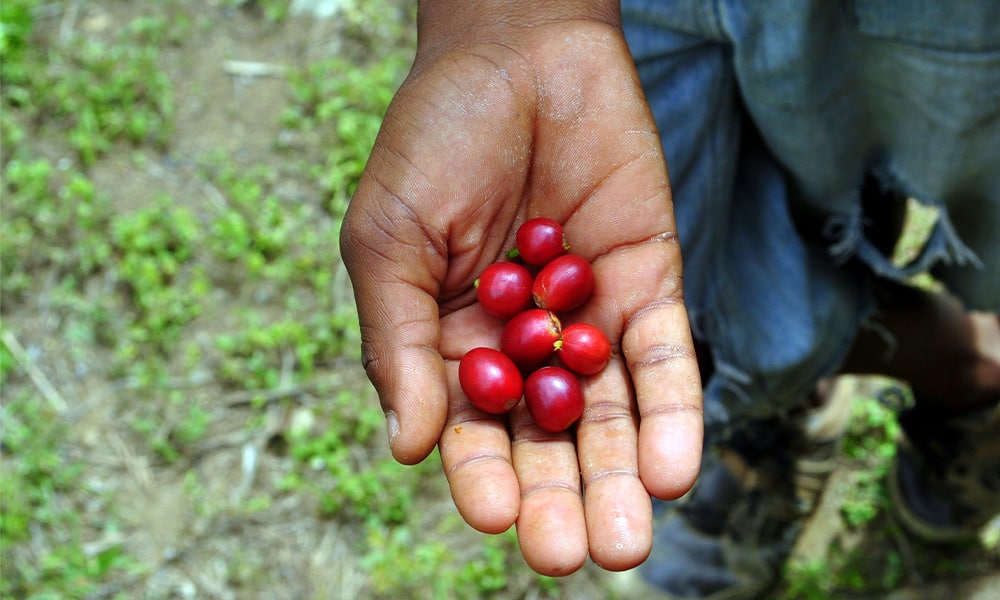
“Look at my guapile!” Someone holds up a double berry bean which represents good luck. Stories are swapped. Jokes are told. Hands help pour coffee from baskets into sacks. And at the end of the day they get paid ₡1,200 a cajuela this year. An experienced picker or a family working together can pick 10 cajuelas a day.
Although the harvest goes on almost all year, it varies with location. In Pérez Zeledón and Turrialba it starts in July, in higher altitudes of Alajuela and Heredia it reaches its peak in November, but the picking season can stretch out to March.
About 70,000 temporary workers are needed to pick all this coffee, and 40,000 are Ticos. Most of the others come from Nicaragua and Panama. The harvest is down this year for the second year in a row, explained Alexis Rojas at the Institute of Coffee, known as ICAFE. “Coffee trees produce in three year cycles, and this year’s crop is at the bottom of the cycle,” she said.
Coffee rust, or royo – a spore spreading disease – has hit every area of Costa Rica, so the downtrend is expected to affect the 2014-15 crop as well. The fungus can be controlled by fumigation and pruning the trees. But coffee is sensitive and once the rust takes hold, it creates bright yellow spots on the underside of the leaves and kills the plants. There are also snails and parasitic vines that can choke a tree. Old branches are pruned back each year and new shoots pulled off to leave only a few to grow strong.
The Institute of Coffee has a research and development section, which develops new strains of trees to make them more resistant, is working with plants from Brazil, which will be tested in different parts of Costa Rica for growth, production and resistance to diseases. It will be a a few years, however, before these are ready for farming.
Back at the plantation, two coffee growers who shall remain anonymous were grumbling about this year’s crop. After paying for fertilizer, sprays, workers and diesel for trucks and tractors, there isn’t much left for the farmer. “Let’s take out the coffee and plant marijuana,” said one. The other agreed. “It pays better and there are no expenses.” They were joking, of course.
Gracias to Alex Rojas and Fabian Echeverria of the Instituto de Café for information on the coffee harvest. This article first appeared in 2013