

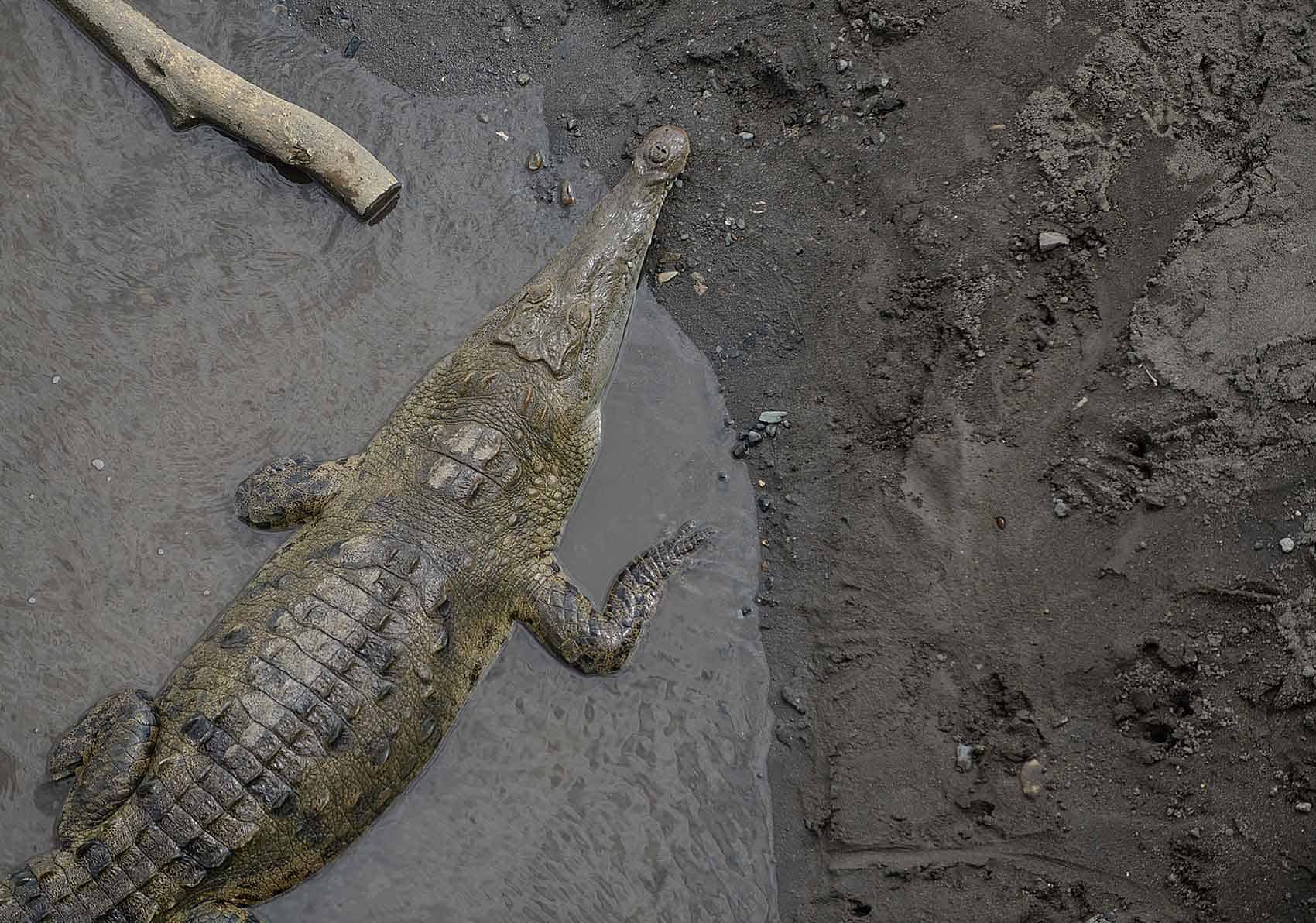
A Tamarindo crocodile suspected of attacking a surfer will remain in its home in the estuary on Playa Grande, officials from Costa Rica’s National Park Service (SINAC) say.
While locals had hoped to remove the problem croc, the estuary is part of a national park and crocodiles cannot be removed without scientific evidence of overpopulation.
“The Tamarindo Estuary that leads into the mangrove forest is a protected area,” said Rotney Piedra, the administrator of Las Baulas National Marine Park, where the crocodile lives.
“We can’t remove the crocodile, but we want to work with the community to manage the issue.”
SINAC met with the Tamarindo Development Association last week to hash out a plan. The meeting was set up after a crocodile left the estuary on March 6 and grabbed hold of a surfer waiting to catch a wave just beyond the river mouth.
The surfer, Val Muscalu, from Canada, was able to free his foot from the croc’s jaws, escaping with a gnarly scar, a story and his life. The attack was the second in the same area in the last two years.
“The first idea was to relocate the crocodile,” Urs Schmid, president of the Tamarindo Development Association, said. “But maybe with these actions we’re taking its behavior will start to change.”
SINAC and the development association agreed on a four-part plan that goes into effect immediately.
According to Piedra, the park administrator, SINAC will focus on preventing attacks by educating the community on crocodile behavior. This week SINAC is putting crocodile warning signs near the popular surf break at the river mouth. According to Schmid, signs had previously been posted but were stolen.
The development association will circulate flyers with a phone number to call in case crocodiles are spotted outside of the river and in the community. Once out of the national park, crocodiles can be relocated if they present a danger to humans.
Piedra said SINAC will also begin a comprehensive study on the river’s crocodile population. The study’s primary purpose would be to determine behavior patterns among the crocodiles that could aid in preventing attacks.
Specifically, SINAC officials want to see if crocodiles frequently leave the estuary at certain times of the day to hunt. Right now, locals believe the crocodile suspected in the attacks only leaves the river in the early morning and late afternoon.
The study would also determine if the river is overpopulated by crocodiles. Two years ago when the last study was done, SINAC officials found that the river contained 70 resident crocs, a healthy number for the river’s size. Piedra said it’s unlikely that the river has become overpopulated since then.
SINAC and the development association also hope to change inappropriate interactions between the community and the crocodiles.
“One concern is that people and tour companies are regularly feeding the crocodiles,” Piedra said. “We see that quite a bit, even in the national park.”
Feeding wild animals has been illegal in Costa Rica for years. Feeding wildlife can cause the animals to rely on humans for food and turn into pests.
But for big predators like crocodiles, feeding can cause the animals to become aggressive.
“Our goal is not to scare people about crocodiles,” Piedra said. “We just want everyone to have all the right information. With just some small changes we can prevent future crocodile attacks.”





