

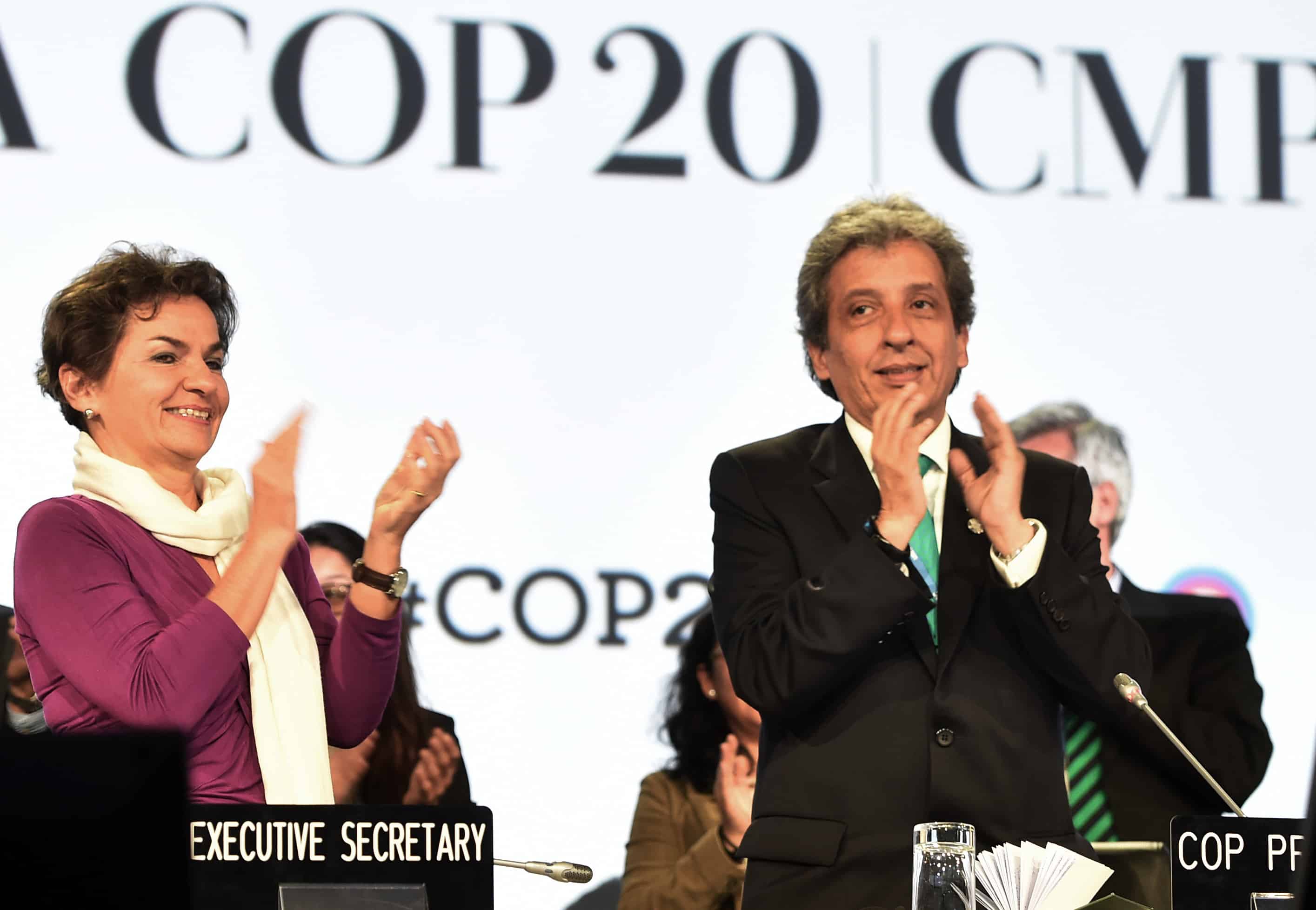
Negotiators faced more months of hard bargaining on a proposed global climate treaty after talks in Lima, Peru, yielded a new pledge to battle global warming but few specifics on how the fight will be waged.
Diplomats hailed an agreement — approved in Sunday’s early hours after an 11-day effort — in which more than 190 countries pledged to take action to stem the growth of greenhouse gases that scientists say are heating up Earth’s atmosphere. But the rancorous talks also highlighted deep divides that will have to be overcome to finalize the proposed treaty, set to be hammered out late next year in Paris.
“It is true that we have a lot of work to do,” French Foreign Minister Laurent Fabius said as the talks in Lima ended early Sunday. “We are discussing technical things, but beyond those technical things are the lives and deaths of billions of people.”
Negotiators announced the accord at 1:30 a.m. Sunday after a contentious session that ran more than 24 hours into overtime. The four-page agreement builds on recent momentum for a global treaty, and, in a key breakthrough, it requires action from developing countries as well as the industrialized world.
“The road to Paris has begun in Lima,” Felipe Calderón, former president of Mexico and chairman of the Global Commission on the Economy and Climate, said after the agreement was gaveled through in a large tent packed with weary delegates. “There is still considerable work to be done. But I am encouraged that countries all around the world are beginning to see that it is in their economic interest to take action now.”
The gains were modest — the requirements to be borne by individual countries were repeatedly watered down to ensure buy-in from a diverse array of nations ranging from established industrial powers of the West, to rising powerhouses such as China and India, to tiny island states such as Samoa and Nauru.
Under the agreement, each country will have to submit early next year a detailed plan for addressing carbon emissions. But a series of compromises Friday and Saturday stripped away specific requirements for cutting pollution and left no provisions for outside verification to ensure the plans are carried out. The softened language was denounced by environmental groups as unacceptably weak.
“The foot-dragging in Lima is out of step with the urgent signs of climate change that are already apparent,” said Nathaniel Keohane, vice president for international climate at the Environmental Defense Fund.
See also: Obama to pledge $3 billion for new UN climate change fund
Western participants in the talks and independent experts said the compromises were necessary to keep the negotiations on track for next year. They noted that major industrial countries producing most of the world’s greenhouse gases — including the United States, the nations of the European Union and China — have committed to substantial curbs on greenhouse gas emissions, cuts that probably will be incorporated into any pact that is approved in Paris.
The Obama administration promised last month to reduce U.S. emissions by 2025 to a level 26 percent to 28 percent below where they were in 2005.
“The major virtue of this agreement is that it applies to both developed and developing nations, outlines the commitment terms and keeps everyone at the table,” said Paul Bledsoe, a former Clinton White House climate adviser. “But the pressure ahead of Paris will be profound, because all the thorniest issues have been left unresolved.”
The Lima meeting, which began Dec. 1, offered an opportunity to settle technical issues underpinning next year’s global agreement, including how costs and obligations will be divided among poorer and wealthier countries. In the past, developing countries, including major emitters such as China and India, were exempted from mandatory cuts in greenhouse-gas pollution.
The talks went into overtime Saturday into overtime Saturday as delegations clashed over demands by developing countries for compensation from industrialized countries for damage from climate change as well as demands for more financial assistance to pay for a transition to climate-friendly energy sources.
See also: 98 percent of Costa Ricans believe in climate change, says UN survey
© 2014, The Washington Post





