

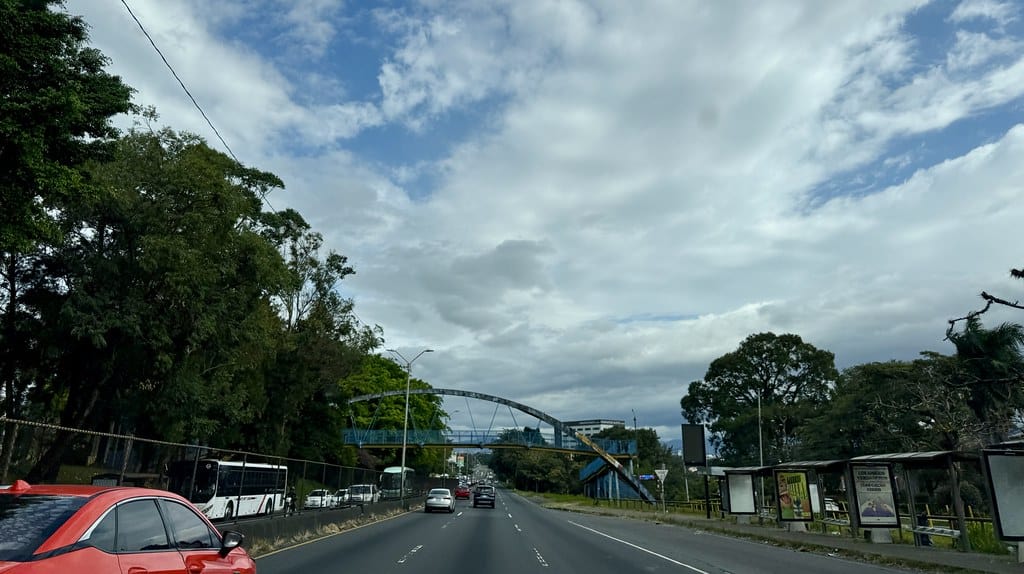
Costa Rica has officially opened international bidding for a $770 million expansion of the highway connecting San José and San Ramón, moving forward with one of the largest and most anticipated road projects after years of delays and changing plans. The Ministry of Public Works and Transport (MOPT) announced yesterday, that construction companies can now submit offers to design and build the improvements along approximately 55.6 kilometers (34.5 miles) of Route 1, one of our busiest highways.
The project covers the General Cañas and Bernardo Soto highways, stretching from the area near La Sabana Metropolitan Park in San José to San Ramón in Alajuela. It also includes a new 4.45-kilometer (2.8-mile) connecting road between Río Segundo and Belén. For thousands of drivers who regularly travel between San José, Alajuela and western Costa Rica, the announcement represents yet another step toward dealing with the traffic congestion that has affected the route for decades.
The highway is a major transportation corridor used by by everyone from commuters, delivery trucks and uses to tourists heading toward Guanacaste and other destinations in the northwestern part of Costa Rica. Government estimates indicate that approximately 170,000 motorists use the route daily, while roughly 582,000 people could benefit from the improvements.
The expansion calls for adding at least one additional traffic lane in each direction along the sections being upgraded. The project also includes improvements to 16 interchanges, new vehicle and pedestrian bridges, bus stops and other infrastructure intended to improve traffic flow and road safety.
Among the planned improvements are 32 vehicle bridges, 20 pedestrian bridges, two railway bridges and the rehabilitation of seven existing bridges. The project also includes approximately 110 bus bays to make public transportation stops safer and reduce interruptions to traffic. One of the more complicated parts of the project involves a proposed 600-meter (1,969-foot) tunnel near the Juan Pablo II interchange and Hospital México. The tunnel is intended to help traffic move through one of the most congested sections of the General Cañas Highway.
The project will be financed through two international loans approved earlier this year. The Central American Bank for Economic Integration is providing up to $600 million, while the OPEC Fund for International Development is contributing financing equivalent to approximately $170 million.
Although the total financing package is valued at $770 million, the amount currently budgeted for the main construction contracts is approximately $687.4 million. The final construction cost will depend on the bids submitted by interested companies. The international bidding process will remain open until April 21, 2027. Technical proposals are scheduled to be opened the following day, with financial offers expected to be reviewed in June.
Government officials hope to select the winning contractors by July 2027 and begin construction during the second half of the year. Transportation Minister Efraím Zeledón said the first section targeted for construction would run between La Sabana and Hospital México, where much of the land needed for the expansion is already available.
The work will be divided into two major contracts covering different sections of the highway. That means separate companies or construction groups could be selected to carry out the improvements. The first phase is expected to concentrate on the sections between La Sabana and Real Cariari, along with the new Río Segundo connecting road. That additional route could eventually help divert traffic while construction continues along other parts of the highway.
Later phases would extend the improvements through Alajuela, Naranjo and San Ramón. If construction begins as planned in 2027 and follows the government’s proposed schedule, the expanded highway could be operating by the end of 2031. However, the contracts allow additional time for design work, construction and the correction of defects, meaning the schedule could change.
One issue likely to attract attention from drivers is the cost of using the improved road. Current plans include three toll collection points along the route. These would be located near Los Arcos, close to the Costa Rica Convention Center; in El Coyol, near the Dos Pinos facility; and between the Grecia interchange and the Rafael Iglesias bridge.
Under the proposed toll structure, a passenger vehicle traveling the entire route from San José to San Ramón would pay approximately ₡1,523 in each direction, or ₡3,046 for a round trip. The highest individual toll would be near Grecia, where light vehicles would pay approximately ₡834.
These amounts are part of the project’s current financial plans and are not final toll rates. They could change before the expanded highway opens. The improvements are expected to benefit residents of San José, Heredia and Alajuela, as well as businesses that depend on transporting goods between the Central Valley and other parts of Costa Rica.
The project could also improve connections to Juan Santamaría International Airport, one of the most important transportation hubs. For tourists traveling from San José toward Guanacaste, the expanded highway could eventually reduce congestion along part of the trip. However, the actual savings in travel time will depend on how traffic patterns change once the improvements are completed.
The San José–San Ramón expansion has a long history of setbacks. Earlier plans involved private concessions and a financing arrangement with the Bank of Costa Rica, but those approaches were eventually abandoned. The government has now adopted a publicly financed model, with contractors responsible for designing and building the improvements and maintaining the infrastructure during the contract period.
The bidding process will follow the procurement rules of the Central American Bank for Economic Integration rather than Costa Rica’s usual public purchasing procedures. Despite the latest progress, motorists should not expect immediate relief from congestion. The main construction contracts have not yet been awarded, and major roadwork is still at least several months away.
For now, the publication of the bidding documents marks an important step toward completing a highway expansion that successive governments have promised for years. The next major milestone will come in April 2027, when Costa Rica learns which international construction companies are competing to build the project.





