

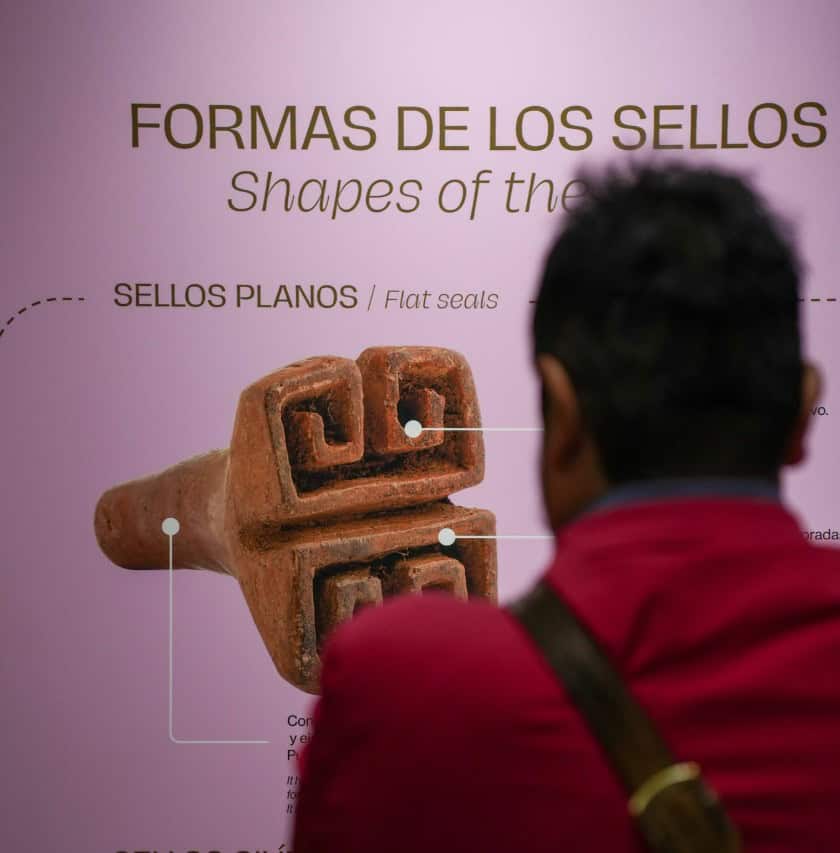
A new exhibition at the Museums of the Central Bank of Costa Rica is inviting visitors to view pre-Columbian stamps not simply as decorative objects, but as an early form of visual communication. Repetir para recordar. Sellos precolombinos, or Repeat to Remember: Pre-Columbian Stamps, opened July 22 beneath the Plaza de la Cultura in downtown San José. The temporary exhibition brings together more than 70 archaeological objects, including clay stamps and ceramic figures.
Unlike postal stamps, these objects were handheld tools used to press repeated images onto different surfaces. They were made in flat and cylindrical forms and carried geometric patterns, spirals, human figures and animal designs. Researchers once believed the objects were used mainly to decorate the body. A study of more than 300 stamps from the museum’s archaeological collection now suggests their purpose was much broader.
The findings indicate that pre-Columbian communities also used the stamps to mark textiles and ceramic vessels. Their repeated designs may have communicated a person’s identity, social position, community membership and cultural beliefs. Some stamps appear to have served as molds for producing other ceremonial objects. Others may have functioned almost like personal signatures associated with people of high rank.
The oldest examples found in Costa Rica date to approximately 500 B.C. and come mainly from the Central Caribbean and North Pacific regions. Archaeologists have recovered stamps from living areas as well as burial sites, where they were placed among funeral offerings. The exhibition grew from research led by archaeologist and curator Priscilla Molina Muñoz.
Museum collection specialists manually traced the impressions produced by the stamps, using conservation methods that allowed them to document the patterns without damaging the objects. Those impressions help visitors understand what the designs would have looked like after being transferred to skin, cloth or pottery.
They also reveal the technical skill required to carve patterns into soft clay while creating an image that could be repeated clearly. Cylindrical stamps could have been rolled to produce continuous bands, while flat stamps were pressed directly onto a surface. The size of each object may have depended on where its design was intended to appear, including smaller areas of the face, wrists or ankles.
The exhibition connects those ancient practices with familiar modern tools such as signatures, trademarks, official seals and repeating textile patterns. The comparison presents the stamps as part of a much longer human effort to communicate identity, authority and belonging through images.
A curator-led tour with Molina is scheduled for August 8. Additional educational activities are expected to be announced through the museum’s social media accounts. The Museums of the Central Bank are located underground beneath the Plaza de la Cultura, between Avenida Central and Avenida 2 on Calle 5.
The museum is open from 9 a.m. to 4:30 p.m. Monday through Sunday. Admission is ₡3,000 for Costa Rican citizens and residents and ₡1,000 for resident students. Foreign visitors pay ₡8,800, while foreign students pay ₡6,950. Children under 12 enter free





