

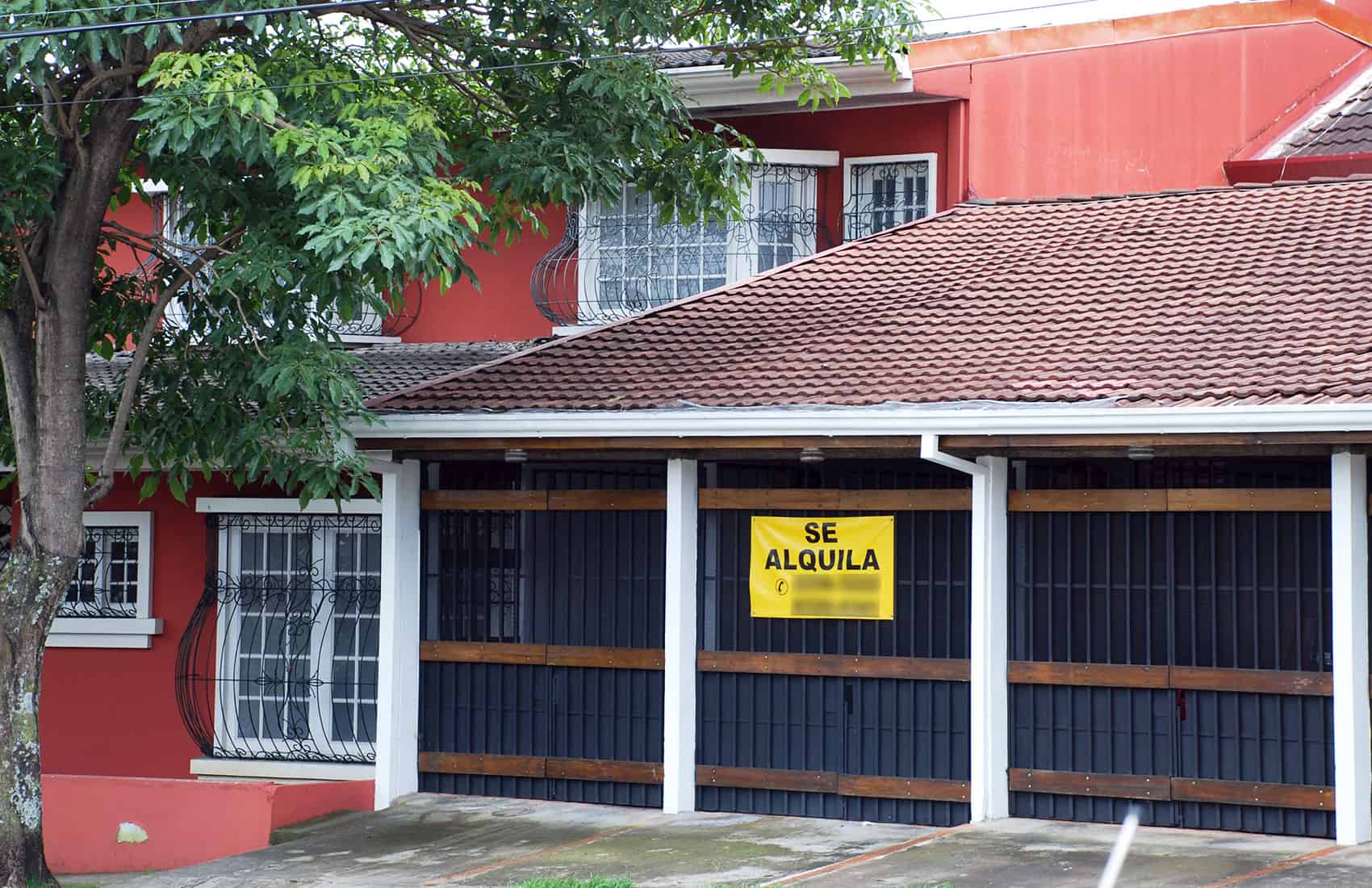
More than eight out of every 10 Costa Rican households that rent would face serious income barriers if they tried to finance even a relatively modest home, according to a new study showing how far property prices have moved beyond many local salaries. The report, Balance and Trends in the Housing Sector 2025, estimates that 81.4% of renter households face either complete exclusion from formal home financing or significant restrictions because of their income. That represents approximately 279,890 families.
The study was produced by the University of Costa Rica’s Graduate Program in Architecture, the Federated College of Engineers and Architects and the organization Gestionando Hábitat. It was released on August 20 but keep in mind the figure does not mean banks have rejected mortgage applications from 81.4% of renters.
Instead, researchers compared household incomes with the financial requirements for purchasing a model home priced at ₡76.5 million, or approximately $170,000. That amount corresponds to the maximum price used in the study for a property classified as social-interest housing.Researchers reviewed financing conditions offered by 26 institutions authorized under Costa Rica’s national housing finance system. They then compared those conditions with the average incomes of households currently renting.
The first major obstacle is the down payment. Depending on the lender, buyers could be asked to provide between 5% and 20% of the purchase price. For the model property, that would mean finding between ₡3.8 million and ₡15.3 million, or roughly $8,500 to $34,000.
Legal fees, property valuations, bank commissions and other closing expenses could add another ₡1.5 million to ₡3.1 million, approximately $3,300 to $6,900. Even buyers who qualify for financing covering 95% of the property could still need between ₡6 million and ₡7.3 million, or $13,300 to $16,200, before completing the purchase.
Monthly payments create another hurdle. Financing about ₡72.7 million over 30 years would produce estimated payments ranging from nearly ₡393,000 to ₡585,000 a month, or approximately $870 to $1,300, depending on the interest rate. Under the study’s most flexible calculation, households would need monthly incomes ranging from approximately ₡786,000 to ₡1.17 million to keep the mortgage payment below half of their income.
Using a more cautious limit of 35%, the required income increases to between ₡1.12 million and ₡1.67 million, or about $2,500 to $3,700 a month. Households in Costa Rica’s two lowest income groups fall below those requirements. Families in the middle group might qualify only under the lowest interest rate and most flexible debt limit. Even households in the fourth income group would not automatically qualify under the more cautious calculation.
Previous debts can make the situation worse since banks consider credit card balances, vehicle loans, personal loans and other obligations when deciding how much a household can borrow. Independent and informal workers may face an additional obstacle if they cannot document their income through tax returns, bank records or official payment receipts.
The problem is not limited to obtaining a mortgage. The study also found a large gap between local incomes and the prices being asked for homes in the Greater Metropolitan Area. Researchers examined 4,338 houses and apartments offered for sale and 1,824 rental properties, using listings collected by the UCR Real Estate Observatory in late June 2026.
They found that 47% of the properties for sale were priced beyond the estimated purchasing ability even of households in the country’s highest income group. For rentals, 56% of the properties in the sample exceeded the estimated spending limit for that same group. Among the lowest 60% of households, only 17% of the homes for sale and 6% of the rentals analyzed were considered financially accessible.
The researchers cautioned that cheaper homes advertised through informal channels or without real estate agents were probably underrepresented. The percentages therefore describe the properties in the study’s sample, not every home available across the region. Even with that limitation, the findings point to a widening mismatch between property prices, household earnings and the amount banks are willing to lend.
For many Costa Rican families, renting is no longer simply a lifestyle choice. It is the only realistic option. Foreign residents may have different incomes, savings or access to financing, particularly if they buy with cash. However, the report helps explain why property prices that appear reasonable to some international buyers remain out of reach for much of the local population.





