
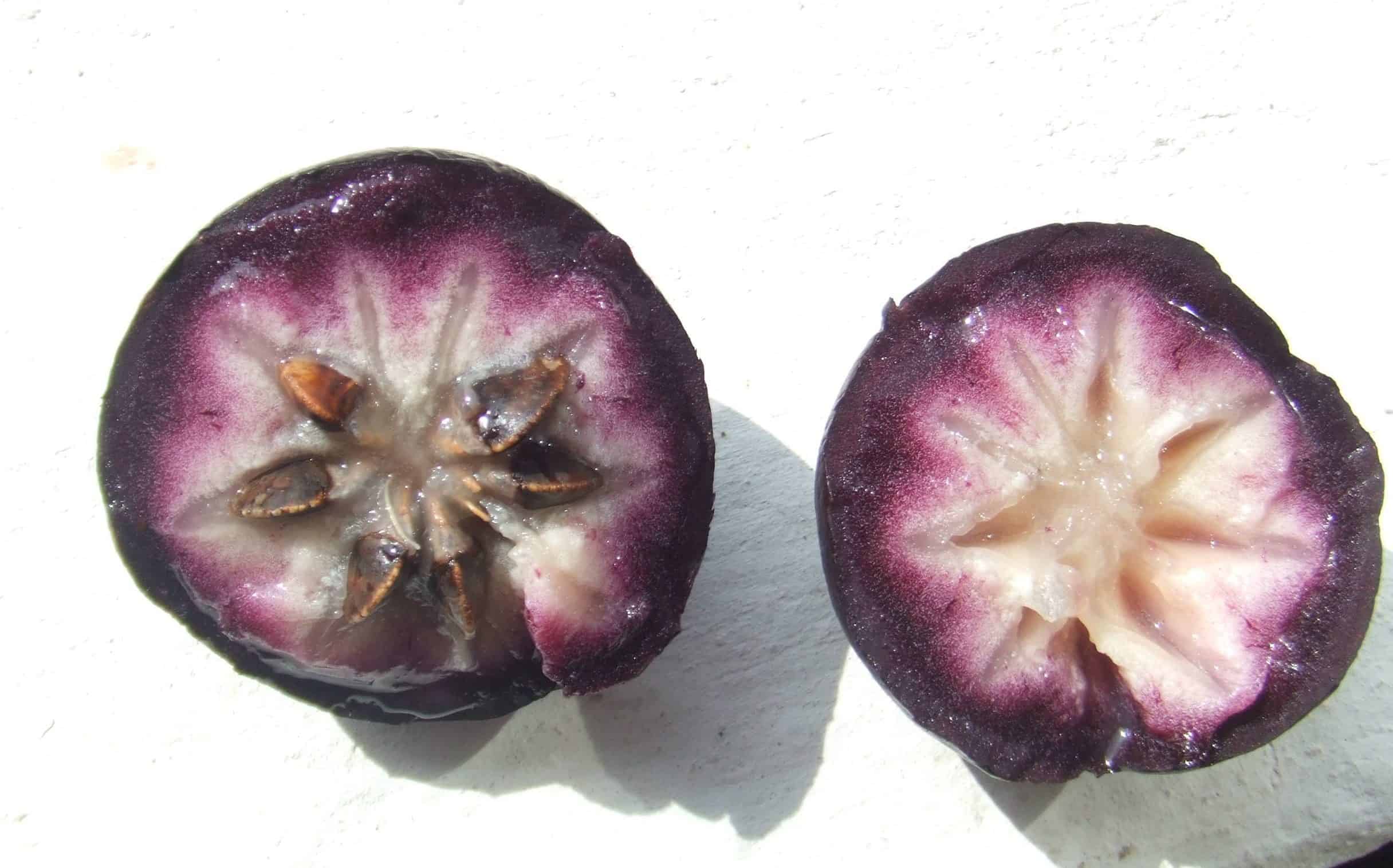
At the end of the dry season in April and May, citrus fruits, mangos and avocados are just beginning to form young fruits here in Costa Rica. There is a fruit tree, however, that produces an abundance of delicious fruit at this time. It’s called caimito in Spanish, and is inappropriately known as star fruit in English, which is confusing, as star fruit is also the name for the carambola fruit (Averrhoa carambola).
Caimito (Chrysophyllum cainito) is a member of the sapote family, along with the zapote mamey (Pouteria sapota) and the zapadillo or chicle tree (Manilkara zapota). All these trees are native to Mesoamerica and produce delightful fruits in the warmer regions of the country.
The caimito is a large tree from eight to 30 meters tall, with alternate, elliptic, evergreen leaves that are green on top and golden-brown underneath. For this reason, the tree is also known as golden-leaf tree.
There are two distinct varieties of trees. One produces fruits that have a green skin, while the other produces purple-skinned fruits. Both have soft, white, milky, sweet pulp surrounding six seeds in the center and, when cut through transversely, look like a pointed star.
The skin of the fruit contains sticky, white latex, which can be avoided by spooning out the pulp. The sweet pulp can be added to fruit salads or blended fruit drinks. In Jamaica, caimito is mixed with fresh fruit and coconut water, then frozen and served as an iced fruit salad. Caimito fruit is a good source of calcium, phosphorus, vitamin C and niacin.
Leading nurseries carry caimito trees, or caimito fruits can be found in local markets and the seeds planted to start seedling trees. Plant one seed per pot or plastic nursery bag in fertile potting soil. When the seedling trees are several months old, they can be transplanted to permanent sites.
Caimito trees produce their first harvest in five or more years. It is best to harvest the fruit by cutting the stem from the tree with a pair of clippers. Pick only the ripest fruit, which contains less of the sticky latex. Because of their large size when mature, the trees need eight or more meters of space between other trees and ornamentals.
Caimito does well in a wide range of soils but does not tolerate poorly drained soils. The trees rarely require fertilizer, but a complete, well-balanced, natural fertilizer will greatly improve performance in poor soils. Fruit flies can damage the fruit, particularly in older trees. Spraying periodically during the harvest with natural insecticides, such as neem, rotenone or pyrethrin, will control this problem.
Author Ed Bernhardt in 09