
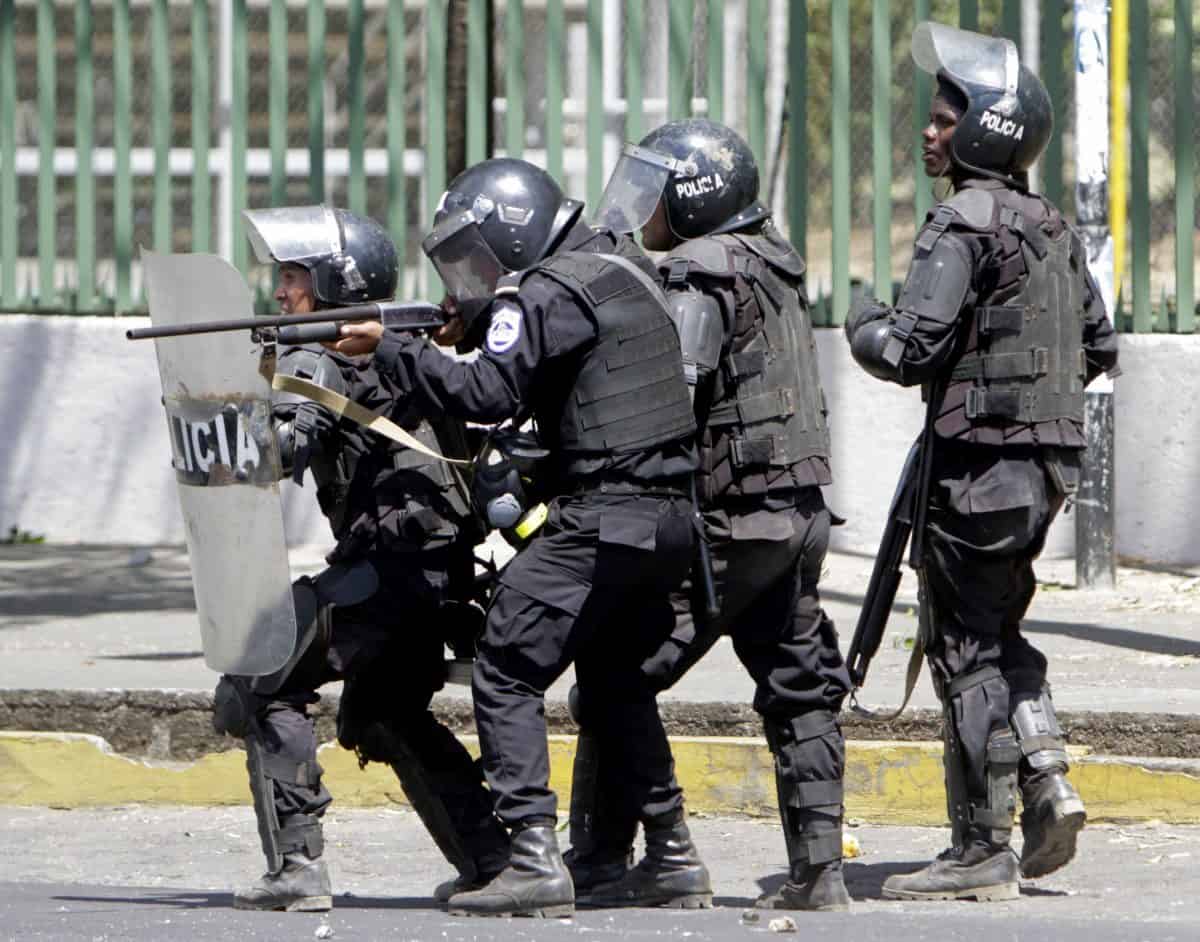
Nicaraguans living in exile in Costa Rica and the United States gathered this weekend to demand justice for victims of the 2018 protests and international pressure to end the government of Daniel Ortega and Rosario Murillo. Hundreds attended religious services and public acts on the eighth anniversary of the repression that began in April 2018 and left more than 300 people dead. Events took place in San José and in U.S. cities including Miami, Los Angeles, Charlotte, Indianapolis, Washington and New York.
“No democracy or peace exists without justice,” said a relative of one victim who asked not to be named. She read a statement during a homily at the San Francisco church in San José, where thousands of Nicaraguans have taken refuge. Relatives of the dead attended the service, among them Claudia Vargas, widow of retired army major Roberto Samcam. She holds the Ortega government responsible for his killing last June in Costa Rica.
Outside the church, families placed dozens of photographs with the names of those killed. Exiled Nicaraguan media reported parallel activities in the listed U.S. cities. In Miami, Auxiliary Bishop of Managua Silvio Báez, who lives in exile in the United States, spoke at Santa Ágatha church. He recalled that a criminal dictatorship responded to the April 2018 protests with violence, repressing and killing hundreds of Nicaraguans.
At that event, several organizations signed a 13-point proclamation. They asked the Organization of American States, the United Nations, the United States and the European Union to support a democratic transition in Nicaragua. The Inter-American Commission on Human Rights issued a statement on the anniversary. It condemned ongoing human rights violations in Nicaragua and called on the government to restore the rule of law, stop repression, release political prisoners immediately and end impunity.
Under the Ortega-Murillo government, hundreds of thousands of Nicaraguans have gone into exile. The list includes politicians, intellectuals, religious leaders, students, social activists and journalists. Some were expelled in recent years and stripped of their Nicaraguan nationality.
Ortega and Murillo have described the 2018 demonstrations as a U.S.-backed coup attempt. The United States and other governments view the Ortega administration as a dictatorship and have imposed sanctions on Ortega, Murillo, their children, military officers, police commanders and other officials.
Ortega, now 80, first governed Nicaragua in the 1980s. After years in opposition, he won the presidency again in 2007 and has held power since through elections widely questioned by the international community. The weekend commemorations kept the focus on memory and accountability. Families and organizations repeated the same message across borders: the victims of 2018 have not been forgotten, and the demand for justice remains.