

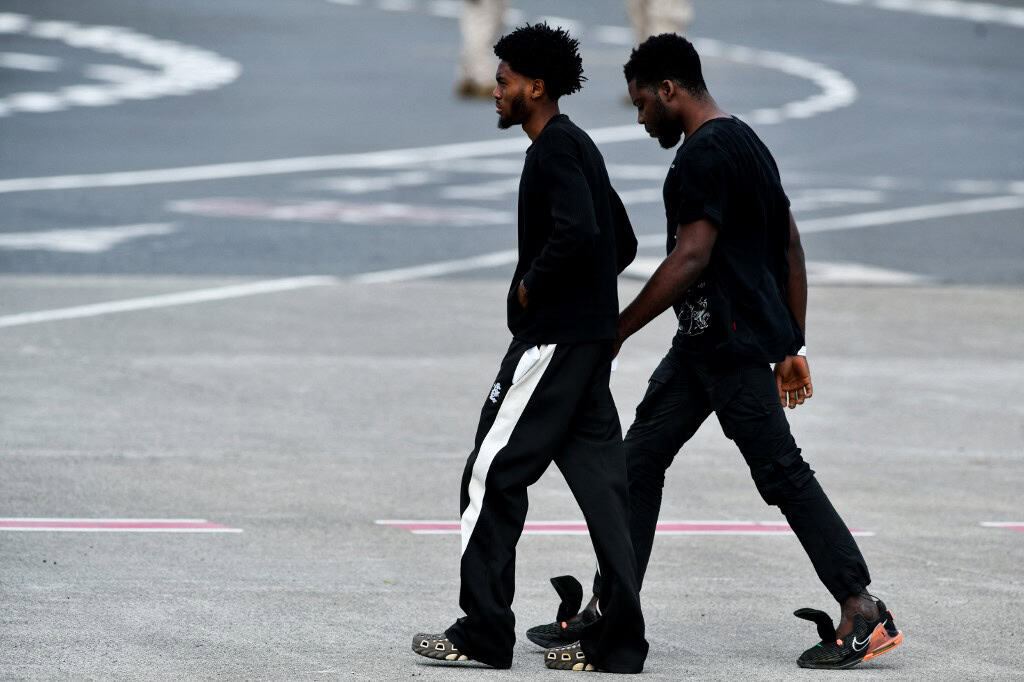
Costa Rica received its second group of deportees from the United States on Friday confirming that a controversial third-country removal program is now operating on a recurring basis rather than as a one-off test. A flight carrying 30 people landed at Juan Santamaría International Airport in Alajuela, according to the General Directorate of Migration and Foreigners (DGME).
The group included 22 foreign nationals and eight Costa Ricans. Among the third-country deportees were eight Brazilians, three Romanians, three Uzbeks, two Chinese nationals, two Azerbaijanis, one Indian, one Vietnamese, one Belarusian, and one Irish citizen described by Costa Rican authorities as elderly. One of the Romanian deportees was a minor.
The arrival follows the first flight under the new agreement, which touched down on April 11 with 25 third-country nationals from Albania, Cameroon, China, Guatemala, Honduras, India, Kenya, and Morocco.
The program stems from a memorandum of understanding signed in late March by Costa Rican President Rodrigo Chaves and then-U.S. Homeland Security Secretary Kristi Noem, acting in her new role as Special Envoy for the Shield of the Americas initiative. Under the deal, Costa Rica has agreed to accept up to 25 third-country deportees per week from the United States, with the option to exceed that figure at its own discretion.
Washington must provide Costa Rican authorities with a manifest 48 hours before each flight, including each deportee’s name, sex, date of birth, nationality, and criminal record where available. San José reserves the sovereign right to accept or reject any individual case and has said it will not receive people facing documented risk of persecution in their home countries.
How deportees are processed
On arrival, migrants pass through immigration control and receive primary care from the Professional Migration Police, working alongside the Red Cross and the International Organization for Migration (IOM). Translators walk each deportee through the process and health checks are carried out.
Deportees are then transferred to a hotel for an initial seven-day period, during which they are offered three options: enrolment in the IOM-managed Assisted Voluntary Return program to go back to their country of origin, application for legal residency in Costa Rica under humanitarian categories, or a request for refugee status. Those who choose to leave the country independently must notify migration authorities and specify whether they require humanitarian support or will fund their own travel.
The elderly Irish deportee, for example, will be offered assistance to return to Ireland through the IOM programme but may also apply to remain in Costa Rica on humanitarian grounds, officials said.
The agreement has drawn sharp criticism from human rights organisations. The American Friends Service Committee and other advocacy groups have argued that the programme leaves migrants stranded in a country where most have no ties, no language connection, and limited legal recourse.
Critics have also pointed to Costa Rica’s 2025 experience, when around 200 deportees sent from the United States were held for months at a detention facility near the Panamanian border before the Constitutional Chamber of the Supreme Court ordered their release.
The Chaves administration has framed the new arrangement as a humanitarian partnership rather than a detention operation, with deportees housed in hotels rather than secured facilities. President Chaves leaves office in less than two months due to constitutional term limits, raising questions about how the incoming government will manage the programme.





