

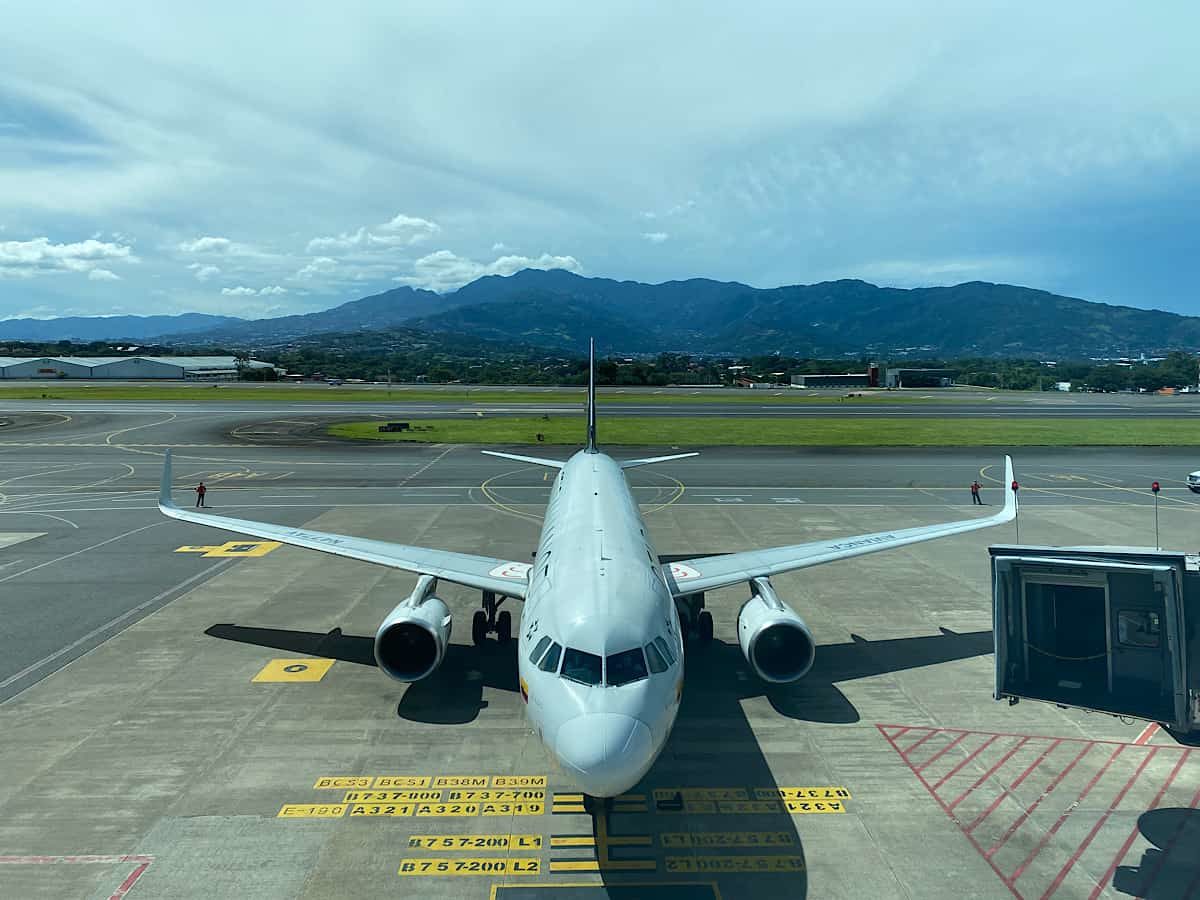
A traveler who was pulled off a flight to Mexico after boarding because of a government records error has won compensation from the Costa Rican State, in a ruling that doubles as a practical warning for anyone in the country with a court-related travel restriction: verify your status and carry your paperwork before you reach the airport.
The case ended with the State ordered to pay ¢713,731 — ¢450,000 for moral damages and ¢263,731 for proven material losses — after courts found that authorities, not the airline, were responsible for the man missing his trip. The final figure was lower than what an initial ruling had granted, a difference that came down to a single point of evidence the passenger could not prove.
The lesson for travelers is that anyone subject to a court-imposed restriction to leave the country, particularly in pension-related cases, should confirm the restriction’s status before traveling, carry printed and digital copies of any authorization to exit, and keep every receipt tied to a disruption. A verbal assurance carries no weight at a immigration checkpoint. If the official system shows an active restriction, the trip can stop there, regardless of what a court may have already approved on paper.
The dispute dates to August 2017, when the passenger was scheduled to fly to Mexico for a same-day business meeting. He had a pension-related impediment preventing him from leaving Costa Rica, but the beneficiary of the pension had requested a temporary lifting of the restriction so he could travel, and that permission was granted. The authorization, however, was never properly reflected in the system used by airport authorities.
The man arrived at Juan Santamaría International Airport and boarded his flight. Minutes before departure, Migration officers removed him from the aircraft because their records still showed an active impediment. He was held for nearly four hours while officials reviewed the situation. By the time the error was corrected, his flight had departed and his 1 p.m. meeting in Mexico was lost. He later bought another outbound ticket and continued his trip, but the business appointment was gone.
He argued that he had been publicly humiliated by being taken off the plane in front of other passengers, that he lost a business opportunity, and that he was forced to spend additional money because of the mistake. The dispute first reached the Constitutional Chamber through a habeas corpus claim, where the court found his freedom of movement had been violated because the judicial office handling the pension case failed to process the lifting of the impediment in time. The matter then moved to the contentious-administrative courts to determine the amount the State would pay.
The passenger sought ¢15 million for moral damages, ¢35 million for economic losses and legal costs. A lower court partially accepted the claim, ordering the State to pay ¢450,000 for moral damages and ¢544,402 for economic losses tied to two additional airline tickets. The State challenged only the economic portion. In the final ruling, the court accepted that the passenger had proven the need to buy a new outbound ticket, valued at $424, but found he had not proven the need for a second return ticket because his original return flight was still available later that same day. The economic award was reduced accordingly to ¢263,731, while the moral-damages figure stood.
The outcome turned on a distinction that matters for any traveler weighing a complaint. The airline was not found responsible; airport authorities acted on the information available in the official system, and the court placed fault squarely on the State’s failure to correctly process the lifted restriction.
Costa Rica’s Judiciary allows people to check whether they have an active restriction through its online services or mobile app, which can show whether a restriction exists, the case number and the court office involved. Broader claims, such as lost business opportunities, require evidence directly linking the harm to the error. As this case shows, a missed flight caused by an official mistake can lead to compensation in Costa Rica — but the amount will depend entirely on what the traveler can prove.





