

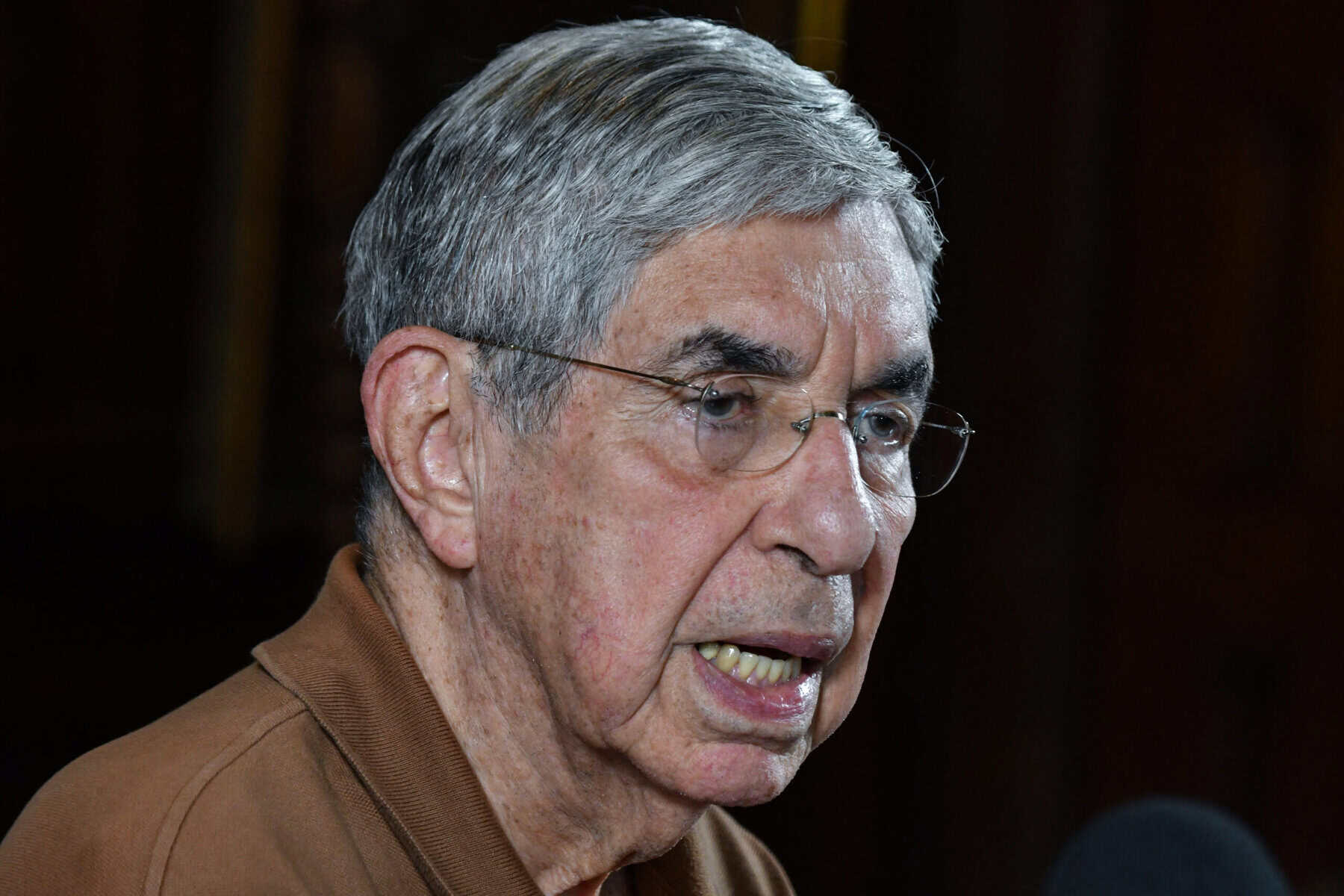
Former President and Nobel Peace laureate Óscar Arias has accused Costa Rica of surrendering its foreign-policy independence to the United States, telling a San José television program that it “sold itself” for the leverage Washington holds over which members of the political class keep an American visa.
The remarks aired on the program La Reacción in an interview conducted by journalist Danilo Chaves. Pressed by the interviewer on whether Costa Rica had sold itself for very little, Arias framed the wave of visa revocations in recent years as a bargaining chip that has eroded national autonomy.
He described the arrangement as trading the country’s standing for the “toy” of a president being able to tell Washington to strip the visa of one figure after another — a deputy, a magistrate, a former president, the president of the Legislative Assembly — adding sardonically that the only name still missing from the list was the bishop of San José.
The tone marked a shift for Arias. In April 2025, when the U.S. State Department revoked his own visa, he had said he did not believe the Costa Rican government bore any responsibility for Washington’s decisions, calling it a matter for the United States alone. In the interview he went further, suggesting the revocations have served domestic political ends and arguing that the United States dictates terms to any country that allows it to.
Arias also contended that aligning with one global power at the expense of another has been a strategic error, pointing to the cooling of relations with China. He held up El Salvador’s president, Nayib Bukele, as a leader who has managed to maintain ties with both Washington and Beijing, citing the Chinese-financed national stadium in San Salvador as evidence that a country can pursue beneficial relationships without geopolitical exclusivity. Costa Rican foreign policy, he said, should prioritize balance and autonomy rather than leaving itself exposed to measures such as visa revocations.
The revocations Arias referenced have accumulated over more than a year and have touched a widening circle of public figures. Reporting listed Arias himself; his brother, former Legislative Assembly president Rodrigo Arias Sánchez; former independent deputy Johana Obando Bonilla; magistrate Fernando Cruz Castro; and directors of the newspaper La Nación among those affected.
Arias’s own revocation came weeks after he compared U.S. President Donald Trump to a Roman emperor on social media; U.S. Embassy staff, he said at the time, attributed the move to his close ties with the Chinese government. Costa Rica established diplomatic relations with China in 2007, during Arias’s second term.
The close alignment with Washington took shape under former President Rodrigo Chaves Robles, whose administration excluded Chinese firms from the country’s 5G rollout following U.S. pressure, and it has continued under current President Laura Fernández Delgado. Trump recently sent Fernández a gift, a gesture read in San José as a reaffirmation of the bilateral relationship. Successive Costa Rican governments, the U.S. Embassy and the State Department have all declined to discuss individual cases or give reasons for specific revocations.
Whether the current administration will respond directly to Arias’s characterization remains to be seen. For now, his intervention reopens a debate that has run beneath Costa Rican politics since the first revocations landed: how much of its traditional diplomatic independence a small country can retain when access to the United States has become a lever in its own internal disputes





