
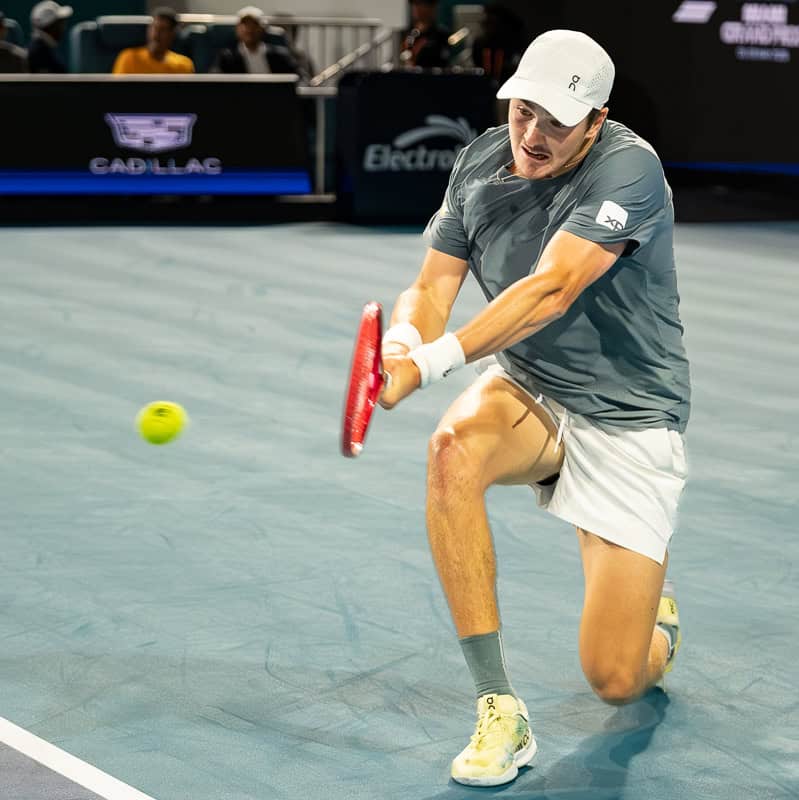
Brazil’s Joao Fonseca saw his breakout run at the Monte Carlo Masters come to an end Friday, but not before the 19-year-old pushed Alexander Zverev deep into a three-set quarterfinal and delivered another sign that he is becoming one of the most important young players to watch in men’s tennis. Zverev advanced 7-5, 6-7(3), 6-3 to reach the semifinals, ending a week that still marked a major step forward for the Brazilian.
Fonseca arrived in the quarterfinals after defeating Matteo Berrettini 6-3, 6-2 for the first Masters 1000 quarterfinal of his career. ATP Tour said he became the first Brazilian man to reach a Masters 1000 quarterfinal since Thomaz Bellucci in Madrid in 2011, and the youngest man to make the last eight in Monte Carlo since Rafael Nadal and Richard Gasquet in 2005.
Against Zverev, Fonseca showed again why expectations around him keep growing. He stayed with the world No. 3 for two hours and 40 minutes, raised his level in the second set to force a decider, and repeatedly hurt the German with his forehand. Monte Carlo’s official tournament report said Fonseca finished with 20 forehand winners, but his 46 unforced errors, compared with 34 from Zverev, proved costly in the end.
Even in defeat, the week was a landmark one for Fonseca. His run in Monaco confirmed that his recent performances against top players were not a fluke and showed that his game is already dangerous on clay. Zverev had said before their meeting that the surface may be the Brazilian’s best, and Fonseca’s shot-making and confidence backed that up throughout the tournament.
While Fonseca exited, the tournament’s other two headline names also moved on. Jannik Sinner defeated Felix Auger-Aliassime 6-3, 6-4 to reach the semifinals and extend his Masters 1000 winning streak to 20 matches, while Carlos Alcaraz cruised past Alexander Bublik 6-3, 6-0 for the 300th tour-level win of his career.
Sinner will next face Zverev, while Alcaraz takes on Monaco’s Valentin Vacherot in the other semifinal. But for Brazil, the bigger takeaway from this stage of the tournament may be Fonseca himself. He did not leave Monte Carlo with the trophy, or even a semifinal place. He left with something else: proof that he can make deep runs at the biggest events and push elite opponents on one of the sport’s most demanding surfaces.
At 19, that matters. Brazil has been waiting for its next major men’s tennis figure, and Monte Carlo offered the clearest evidence yet that Fonseca may already be on his way.