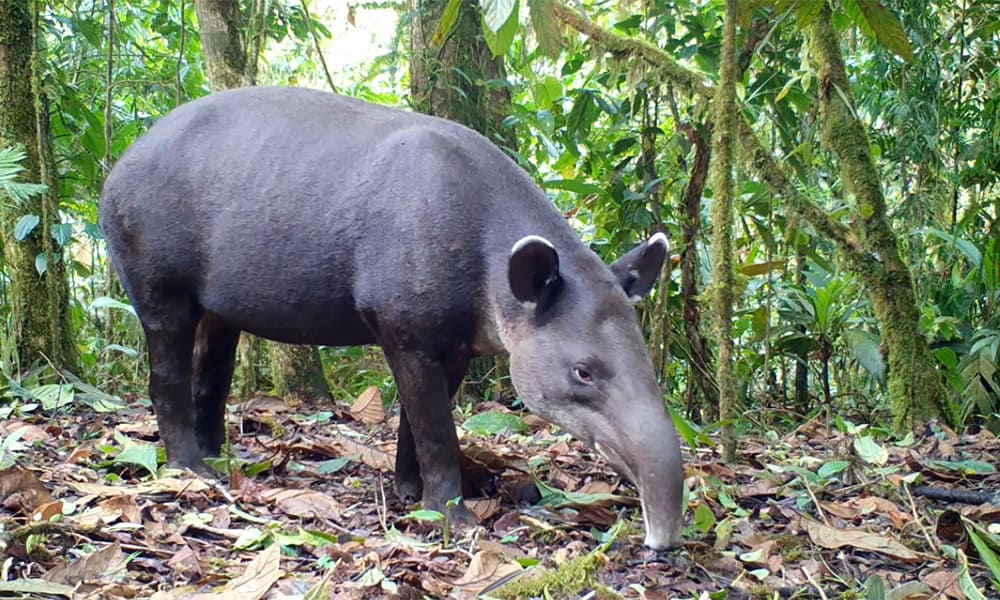
Today we discuss a creature that’s very close to my heart, the Baird’s tapir. It’s an enormous, elephant-nosed, whistling, puddle-pooper. What’s not to love? Baird’s tapir (Tapirus bairdii) is known as a danta in Spanish. The Baird in the English name comes from Spencer Fullerton Baird, an American naturalist who became the first curator of the Smithsonian Institute. He also has his name featured on a mess of other species including a pocket gopher, a beaked whale, and a rat snake. Good for him.
Tapirs are the giants of Costa Rica’s forests. They’re approximately six feet long from tip to tip, about four feet tall, and weigh anywhere from 400 to well over 600 pounds. A six-foot-long, several hundred-pound animal is appreciably large for anyone that takes time to consider it. I think they seem particularly large to me because of my use of camera traps. Almost every species I’m trying to record in Costa Rica is the size of a small dog. When you’re used to recording collies and something the size of a large pony shows up, the difference is noticeable.
In addition to their hefty size, tapirs have other interesting features. The first thing you’ll notice is the elephant-style nose. Technically called a proboscis, this distinctive and flexible snout is used to pluck vegetation and fruit from their environment. Tapirs are water-loving creatures, and their long snouts act as snorkels, allowing them to breathe while almost completely submerged. They also employ these large snoots to make a crazy whistling sound while communicating with one another.
Another defining feature is their feet. Their front feet have four toes a piece, while the back feet have three. If you happen to encounter tapir tracks in the mud, you’d be forgiven for thinking that all their feet only had a compliment of three toes, because the little toe on the front feet is often absent from prints.
Baird’s tapirs are habitat generalists. They can thrive in just about any habitat present in Costa Rica save for city streets. I think it’s common to think of them living in the ‘jungle’ and the more humid forest environments, but they can also be found in cloud forests as well as the dry forests of Guanacaste. Historically, they were found throughout the entire country, but these days they’re most common in undisturbed and protected areas.
As you would expect, an animal of this impressive size must dedicate a significant amount of time to feeding itself. One study found that 70% of the time a tapir was active, it was eating. They need to consume something like 30 pounds of food a day. What they eat depends on the habitat they’re in, but generally one quarter of their diet is made up of fruit, and the rest consists of leaves and stems. After all of that vegetation makes its way through the tapir’s digestive system, it’s deposited in a pile of horse-poop style balls, usually into a puddle or body of water.
When I’m camera trapping in areas with tapirs, I very frequently find their tracks in the mud and round scat floating in pools of water, but I usually don’t get to see them with my own eyes. In fact, I got so excited about the first time I saw a Baird’s tapir I wrote a Tico Times article about it. Since then, I’ve only had one other sighting of an individual slowly crossing a stream.
At this point, I’ve recorded many tapir videos with my camera traps but every time I click play and see that I’ve recorded a new, a very satisfied ‘Yes!’ still echoes through my mind. Take a look at some particularly good Baid’s tapir videos below
About the Author
Vincent Losasso, founder of Guanacaste Wildlife Monitoring, is a biologist who works with camera traps throughout Costa Rica.