
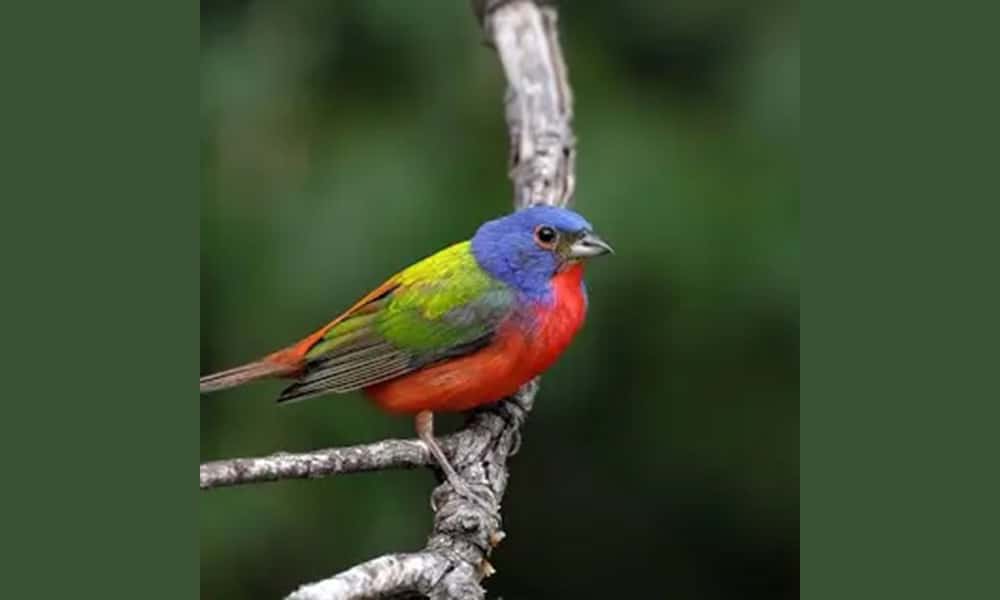
Painted Bunting (Passerina ciris): colorful, unmistakable.
That’s exactly how one of my Costa Rica bird books describes the painted bunting in the little blurb next to the color photos, and I think they hit the nail on the head with that one. The painted bunting, or aptly named in Spanish siete colores, is both colorful and unmistakable.
I’m going to quote some of the more in-depth description from the same book because it gives you a nice idea of the little feathered rainbow that we’re talking about today. ‘Top and sides of head and neck, violet-blue; back yellow-green, rump and upper-tail pinkish-red; shoulder violet; middle coverts, purplish; greater coverts and tertials greenish; rectrices and remiges dusky-purplish; rest of underparts bright red; eye-ring rose-red.’ There’s a lot to love in that description. The take home point is that this little bird is extremely colorful, but the details are fantastic. I have no idea what rectrices or remiges are, but I love that they’re ‘dusky-purplish’ instead of just plain ‘purple.’
If you noticed the little symbol in the first sentence, then you know all of these bright colors belong only to the male painted bunting. As is the case with many of our friends in the bird family, the male is much fancier looking than the female. Even the author that gave us ‘dusky-purplish’ could only come up with ‘olive-green’ and ‘dull grass-green’ to describe the female.
Painted buntings can be found on the Pacific slope of Costa Rica, pushing over to the western Central Valley. Like a few of you Tico Times readers, this bird is not a full-time CR resident. It lives in the southern and eastern United States for part of the year and travels to Costa Rica during the winter months. In general, you can find painted buntings in the thickets and lower levels of secondary growth forests from late October to early April.
They breed between late April and August (outside of Costa Rica). The female weaves a nest amongst thick vegetation and lays three or four eggs. The female cares for the young for a few weeks before they leave the nest. Many times, about 30 days after the first eggs hatch, the female lays a second brood. While you won’t find them caring for their young in Costa Rica, you will find them fluttering about dense thickets looking for fruits, seeds, and insects to eat.
I’ve seen a few painted buntings during the dry season in Guanacaste while checking camera traps under the hot sun. Each time, it’s a wonderful little surprise that I’m sure to tell my wife about when I get home. I record painted buntings with my camera traps in one, and only one situation, when my cameras are surveilling one of the last puddles of water remaining in the parched landscape during the height of dry season.
A few times a year, I’ll record a single male or female, a pair together, or sometimes a whole group of both sexes, splashing around and taking a drink from the puddle. Take a look at a few examples of these videos below.
About the Author
Vincent Losasso, founder of Guanacaste Wildlife Monitoring, is a biologist who works with camera traps throughout Costa Rica. Learn more about his projects on facebook or instagram. You can also email him at: vincent@guanacastewildlifemonitoring.com