

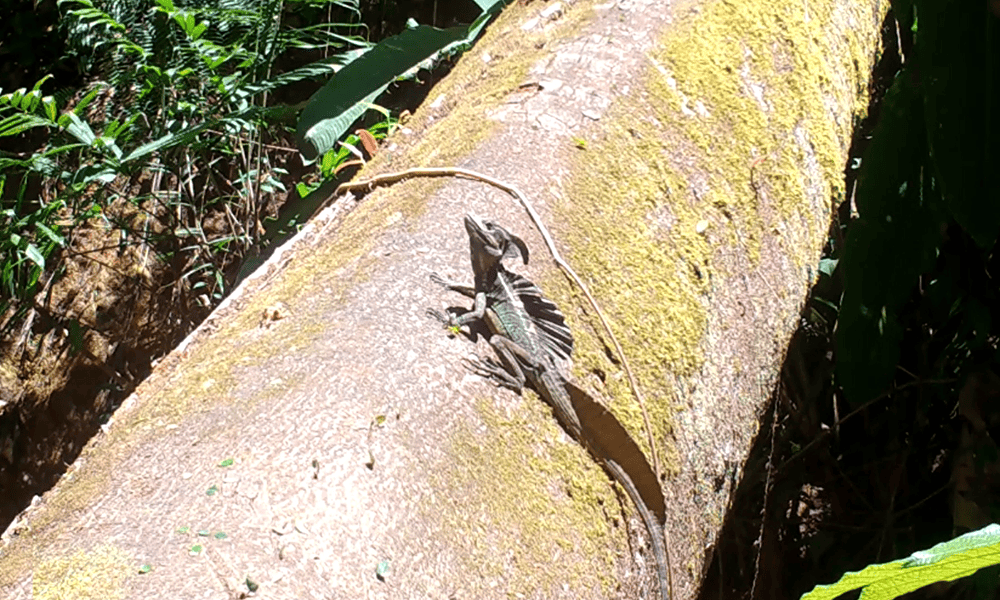
Today, I’m introducing the common basilisk (Basiliscus basiliscus) or in Spanish, basilisco común. And let’s not bury the lede here, this lizard can run on water!
First, let’s discuss the names. I have one book that calls them common basilisks and another that calls them brown basilisks. I turned to the trusty internet to clarify and typed ‘brown basilisk’ into a search engine which prompted it to spit out information about (Basiliscus vittatus) which both of my reptile books call the striped basilisk.
I’m sticking with common basilisk but in these cases, you can’t go wrong with the scientific name. Another name that’s commonly used to describe all three species of basilisk lizards that live in Costa Rica is the Jesus Christ lizard. A named earned from its ability to … run on water!
If you’re not impressed by this animal’s ability to seemingly defy physics and run on top of the surface of water, then this isn’t the article for you. Especially because I’m about to talk about how that works in detail. The magic of their gravity-defying water-running is based on two important factors – their speed and their toes.
Let’s start with the latter. Each basilisk toe comes equipped with a seam of skin that runs along the length of the toe. When the lizard pushes down on the surface of the water, this seam forms a moveable flap that expands against the water, creating a larger surface area.
The force that the lizards put on the downward motion of their flappy-toed feet produces an upward pressure that helps to keep it from sinking. But all of the fancy toe-flaps in the world wouldn’t keep them on the water’s surface if it wasn’t teamed up with speed.
The speed is the component that’s easy to see in person. If you’re walking by a stream in basilisk territory, you’re bound to frighten one into a hasty retreat across the water and then their speed is on full display. They even sound fast with their little feet smacking the water in quick succession. Generally, they’re using the ability to run across the water as a means of escaping predators.
Just a few weeks ago, I was sitting at a little inlet on the beach in Osa and something startled a large common basilisk into attempting to run across a fairly large swath of salt water in order to reach the safety of a patch of mangroves. It made it several meters on the water’s surface, but the distance was too great, and it eventually sank down and swam the rest of the way.
Common basilisks are one of those animals in the food web that eat a lot of different things and get eaten by a lot of different things. Their varied diet includes insects, shrimp, fish, small reptiles, birds, and mammals, as well as flowers, fruits, and buds. They themselves are food for a large number of larger mammals, birds, and reptiles.
I’ve frightened common basilisks into showing off their running skills all along the Pacific coast of Costa Rica while walking through the forest checking camera traps. They frequently trigger my cameras, especially along streams and rivers. Take a look at a few of those clips in the video below and meet the common basilisk.
About The Author
Vincent Losasso, founder of Guanacaste Wildlife Monitoring, is a biologist who works with camera traps throughout Costa Rica. Learn more about his projects at: Instagram and facebook or by email.





