
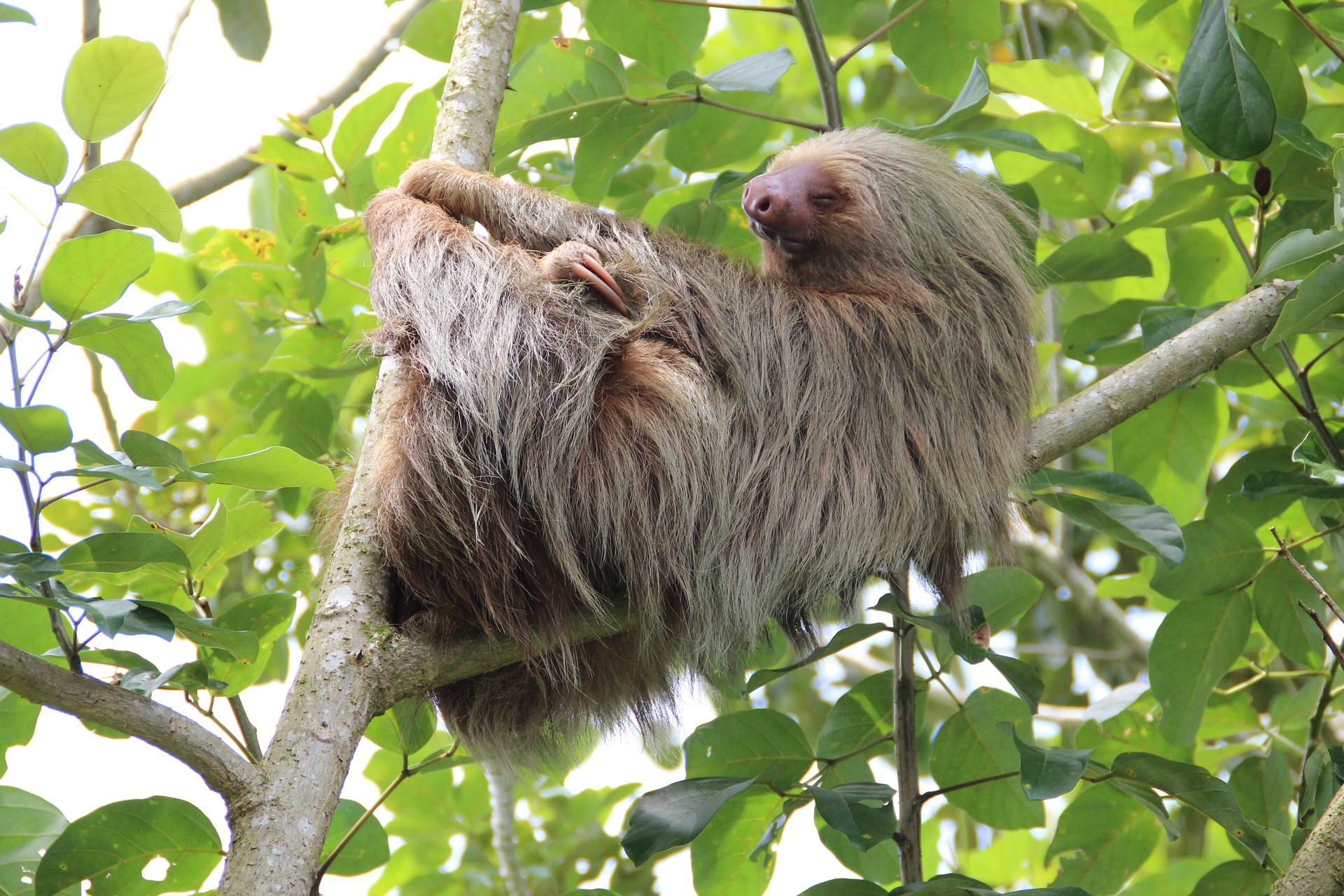
Sloths in Costa Rica have shown to have bacteria in their fur that produce antibiotics that keep pathogens that can make the animal sick at bay. Could this finding have an application in humans?
That is the question researcher Max Chavarría, from the University of Costa Rica, is trying to answer after discovering in the fur of these peculiar tropical mammals a unique biome of insects, fungi, algae and bacteria in a delicate balance that prevents diseases.
“If you look at the fur of a sloth you see movement, you see moths, you see different types of insects (…), we have a very broad habitat and clearly when there is coexistence of many types of organisms there must also be systems that control them,” said Chavarría.
The researcher found that they are “microorganisms capable of producing antibiotics that allow regulating the presence of pathogens in the fur” of the sloths.
“They are bacteria belonging to the order of micrococcales, mainly of the genera Rothia and Brevibacterium,” says the researcher, whose discovery was published in the scientific journal Environmetal Microbiology.
After discovering these antibiotics in sloths, Chavarría wonders whether his discovery could have future uses in medicine to help counteract the resistance to antibiotics that humans develop.
Two species
The sloth is part of the collective imagination in Costa Rica, a national emblem and a natural attraction for tourists. There are two species in the country: Bradypus variegatus or three-toed sloth and Choloepus hoffmanni or two-toed sloth.
They live in the treetops of the jungles of the Caribbean coast of Costa Rica, with a humid and hot climate (between 22 and 30 degrees Celsius).
The population of both species is in “decline” according to the Red List of Threatened Species of the International Union for Conservation of Nature.
There are also sloths in the jungles of Bolivia, Brazil, Colombia, Ecuador, Honduras, Nicaragua, Panama, Peru and Venezuela.
Sanctuary
In this Caribbean area of Costa Rica is the Cahuita sloth sanctuary, created by American Judy Avey and her late Costa Rican husband Luis Arroyo, where sloths injured by people or other animals are rehabilitated.
“We mainly rescue, rehabilitate, study and research sloths”, says the woman, who before arriving in Costa Rica lived in Alaska and did not even know that these mammals existed.
Since they received the first sloth in 1992, which they named ‘Buttercup’, they have taken care of them and cured them. Since then, some 1,000 specimens have passed through this sanctuary located 200 km by road from San José.
Chavarría came to Avey to use in his research some of the sloths that were in rehabilitation for having been electrocuted by high voltage cables, run over by vehicles, attacked by dogs or separated from their mothers when they were small.
“We have never received a sick sloth (…). Some have burns from power lines and their arms are mangled,” says Avey. “But they have no infection (…), that tells us that there is something in the ecosystem of their body,” she adds.
Chavarría cut hair from the backs of 15 specimens of each species to take to the laboratory to examine the samples, culture them and confirm his hypothesis.
Human application
In 2020 Chavarría launched his research and three years later he has already “delimited” 20 “candidate” microorganisms to be identified. But there are still many steps to go before even thinking about human application.
“Before thinking about an application in human health, it is important to first understand the system and the type of molecules involved,” says the researcher, who believes that nature is a natural laboratory.
An example of this is penicillin, discovered in 1928 by the British Alexander Fleming, from fungi that naturally synthesize the molecule that generates antibiotics and which earned its discoverer the Nobel Prize in Medicine in 1945.
The World Health Organization estimates that by 2050 antibiotic resistance could cause 10 million deaths a year. “The search for new strategies to combat antibiotic resistance has been left to academia,” says Chavarría.
“That is why projects like ours can contribute to finding, why not, new molecules that can, in the medium or long term, be used in this battle we have of antibiotic resistance,” he adds.