

BOGOTÁ, Colombia – The interception in Colombia of a plane carrying almost half a metric ton of coca paste bound for Mexico is a sign Mexican drug cartels are switching from importers to manufacturers, according to Colombian police.
Authorities intercepted 490 kilos (1,080 pounds) of the paste, an unrefined form of the drug made by farmers, on Jan. 30 as a Mexico-bound plane prepared to take off from an airport in southern Colombia. The capture, the first of its kind, means that at least one Mexican gang has set up a factory capable of turning the paste into cocaine that can be sold in the U.S., according to General Ricardo Restrepo, head of the Colombian police’s counter-narcotics unit.
“It’s the first time we’ve made that kind of seizure,” Restrepo said in a Feb. 6 interview in Bogotá. “If they’re buying paste, it’s because they have a laboratory there.”
Police found the paste in a Cessna airplane at Ipiales airport in Narino province, close to the border with Ecuador. Intelligence shows it was destined for Mexico’s Sinaloa cartel, according to the police. Discovering coca paste shipments is rare, says Steven Dudley, a director at InSight Crime, a research group that studies organized crime in Latin America.
“We’ve seen some laboratories in Honduras and there are rumors of them being in other places, Mexico being one of them,” Dudley said by telephone from Washington, D.C. “It’s not common, that’s for sure.”
Mexico’s Attorney General’s Office referred questions on cocaine production to the country’s National Security Commission. The commission’s press office didn’t respond to email and phone requests seeking comment.
Pablo Escobar’s Medellín cartel and other Colombian crime gangs imported coca paste from Peru and Bolivia in the 1980s, transforming it into cocaine before exporting it. Mexico could now be traveling down the same road, Restrepo said.
Drug gangs would lose less if a shipment of paste were seized, he said, since its wholesale price is only about a fifth of the value of refined cocaine. A difference in the cost of precursor chemicals such as acetone or the Colombian police’s success in finding and blowing up labs are possible explanations for the change, Restrepo added.
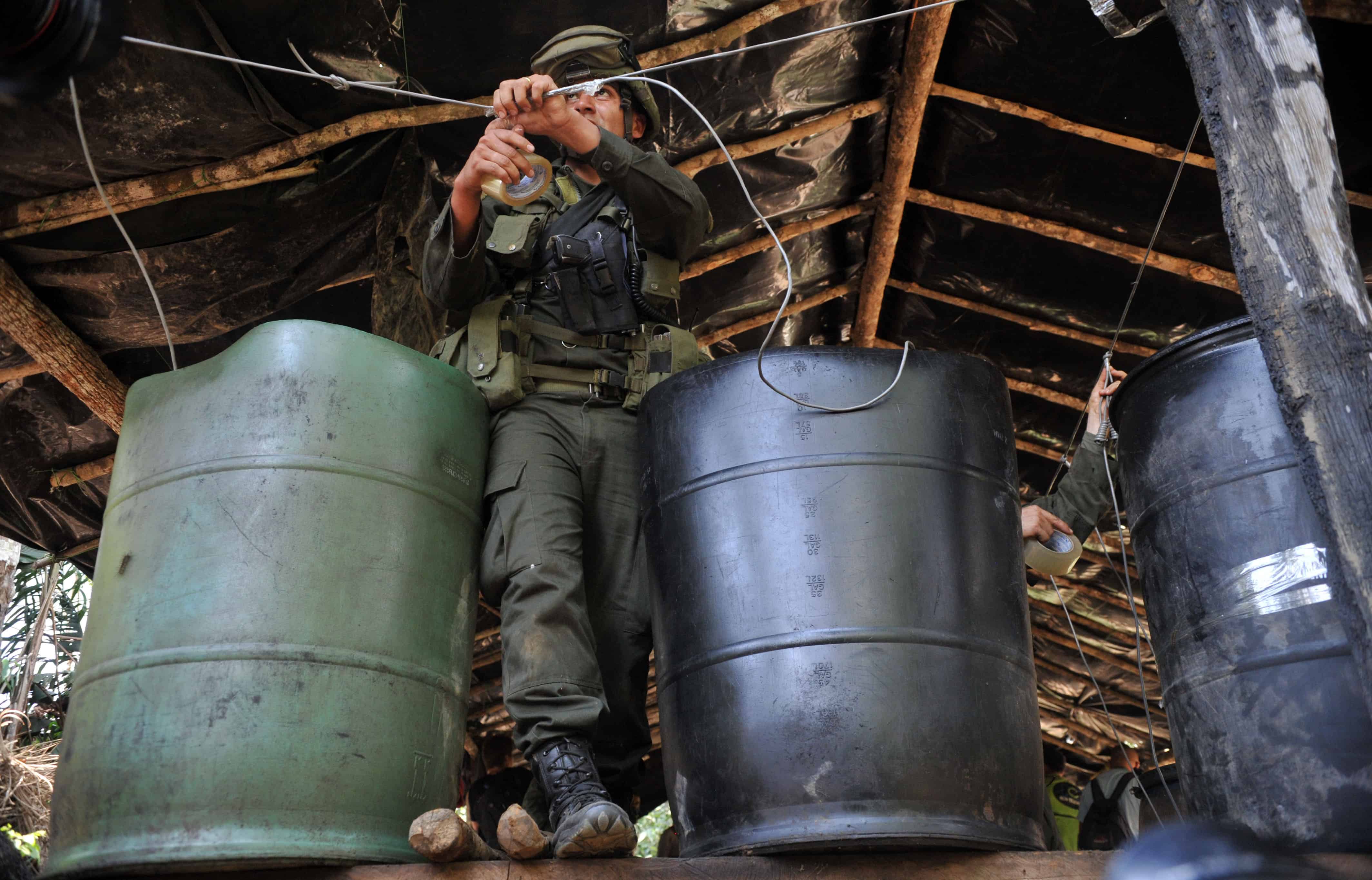
In the 1990s, Colombian coca output soared, often in areas where the presence of Marxist guerrillas made it hard for police to enter. The farmers turn the leaves of their coca bushes into paste in jungle shacks, in a bucket chemistry process using gasoline, caustic soda, sulphuric acid, ammonia and cement. They sell the paste to mafia groups for about $1,250 per kilo, Restrepo said, who process it into pure cocaine in laboratories hidden in the jungle.
The country’s largest Marxist rebel group, the Revolutionary Armed Forces of Colombia, or FARC, currently controls about a quarter of the country’s annual 309 metric tons of cocaine output, according to Restrepo.
The government is holding peace talks with the FARC in Havana in a bid to end a five-decade civil conflict. Negotiators have reached partial agreement on agricultural policy and political representation, with discussion now centering on illicit drugs.
A peace deal will make it easier for security forces to enter some coca-producing regions, although it won’t end the cocaine trade, he said.
“Drug trafficking is going to continue, with or without the FARC,” the counter-narcotics chief said. “The business is constantly changing and mutating. As long as it’s economically productive, drug traffickers will be looking for ways to earn more profits with less risk.”
With assistance from Eric Martin in Mexico City.
© 2014, Bloomberg News





