

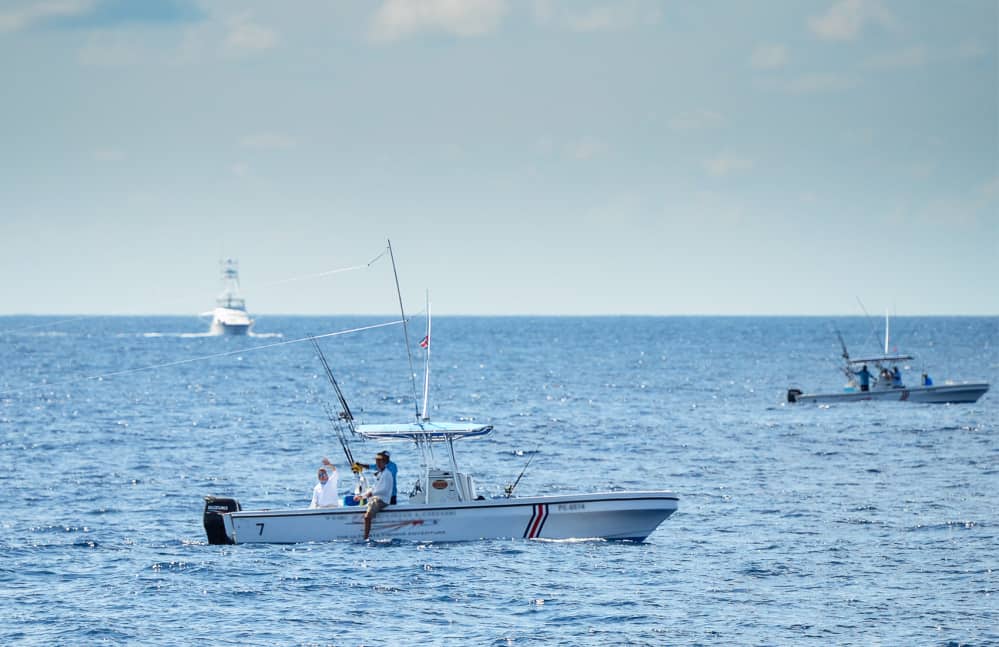
While we have all become prisoners of Covid-19, nature on the other hand is thriving. We are seeing examples all over the world of how quickly nature begins to recuperate when you remove the effects of the human element. The ocean is no different, and we are already seeing how the lack of humans has positively affected Costa Rican waters.
The coastal communities are suffering. With so many fishermen stuck on shore because there is no market for their fish or few tourists coming to fish, they are struggling to meet their living expenses and feed their families.
When the Covid crisis passes, the fishermen will be met with a healthy ocean unlike we have seen in decades. One needs to understand the before-Covid-19 conditions to understand the post-Covid-19 possibilities.
The oceans before Covid
Our ocean was severely exploited. Illegal activities were rampant. By law, nearly 2000 fishing boats were competing for marine resources while all being required by law to fish within 40 miles from shore. Costa Rica territorial waters are 11 times greater than the terrestrial area, yet most fishermen are corralled within 40 miles of the coast. The law was enacted when fish were abundant, the commercial fleet was smaller, and tourist fishing was in its infancy. Tourist fishing has grown to a $500 million yearly industry with commercial longline and artisanal fishing estimated to be nearly the same.
All sectors participated in breaking the rules. This was not a commercial fishermen versus sport fishermen argument; all sectors broke the rules. This wasn’t limited to fishermen but everyone involved in the process of catching fish to getting it to the consumer. Included in this list was illegal unloading, poor inspections, the buying and selling of illegal products, transportation of seafood products without proper permits and the mis-naming of fish products sold to the consumer. Some sport fishermen illegally sold fish products to area restaurants or locals. Sailfish are a big contention. Tourist fishing used sailfish in a catch-and-release fashion to grow the industry. By agreement, it is regulated for the tourist sector activity, but a loophole has allowed it to be exploited by the commercial sector.
Everyone had the same justification. If the other guy is doing it, why not me? This attitude — plus the chances of getting caught or punished if you did get caught — were next to nothing, causing us to end up with an exploited, overfished coastal ocean.
There is a domino effect that put us in this condition. Longliners claimed foreign purse sein boats depleted the ocean of not only tuna but other species caught as bycatch they depend on. Sport fishermen claim that because of competition of resources between the many boats, and the limited area they are required to fish, longliners purposely targeted sailfish.
The first tuna decree in 2014, which moved purse seiners out 45 miles and protected a 200,000 square kilometers of territorial water from their activity has showed us management of the tuna boats works. A study done last year with sport fishing boats inside the 45 miles has shown catches improved for marlin, tuna, dorado but not sailfish. The species that should have improved the most did not improve.
Prospering and Preserving for a Collective Win
Rarely are we given the opportunity to prosper from a devastating event like we are given now. Once an ocean is exploited, it usually takes years if not decades of marine management, fishing bans and lots of money to restore it to a healthy condition. We will have a healthier ocean waiting for us.
In congress right now are two proposed laws pertaining to the tuna purse seine industry: Expediente 21.531 and Expediente 21.316. Both are similar but do have one thing in common: moving the foreign tuna boats out a little further to 60 miles to appease Costa Rican fishermen. National fishermen say that is not enough.
The artisanal, commercial, and tourist fleet have the potential to inject more than $1 billion annually while maintaining a healthy ocean. This can be done by a more in-depth rezoning and not just moving one sector 20 miles. To accomplish this, the national fishing fleet would have to be legally allowed to fish in an expanded area, not all limited to the first 40 miles from the coast
The best scenario would look something like this.
0 to 60 miles: No surface longlines. Area to be used by commercial fishermen using selective arts of fishing like green stick, a method to catch tuna, which has little to no bycatch and does not leave gear in the water for other species like sea turtles to get tangled in while nearing the coast in breeding season. This area also would be used by sport fishermen, and near the coast by artisanal snapper and grouper fishermen.
60 to 200 miles: This will give 140 miles of territorial water to be utilized by medium scale longline vessels, green stick fishermen, and sportfishing boats that have the capacity to travel that far.
200 miles to the limit of territorial waters: Allow purse seine boats to operate in areas not protected by existing polygons. This still gives purse seine boats enough area to meet the demands of the cannery in Puntarenas which is a major source of employment in that coastal fishing community, while reducing the bycatch of coastal species like manta rays and reducing the practice of trapping dolphins in the fishing process.
As a country, we now have a choice to make. When we return to the healthy ocean, we can exploit it again and end up in the same boat, so to speak, as before. Or we can manage it correctly and end the conflicts among fishing sectors, while benefitting the social economic conditions of coastal communities while maintaining a healthy ocean. This type of zoning would accomplish that.
Todd Staley has run sport fishing operations in Costa Rica for nearly 30 years and works in marine conservation. He currently is Communications Director at FECOP, the Costa Rican Fishing Federation (www.fecop.org), serves on the International Game Fish Association’s Central America Council, and oversees the fishing operation at Crocodile Bay Resort. Contact him at wetline@hotmail.com





