

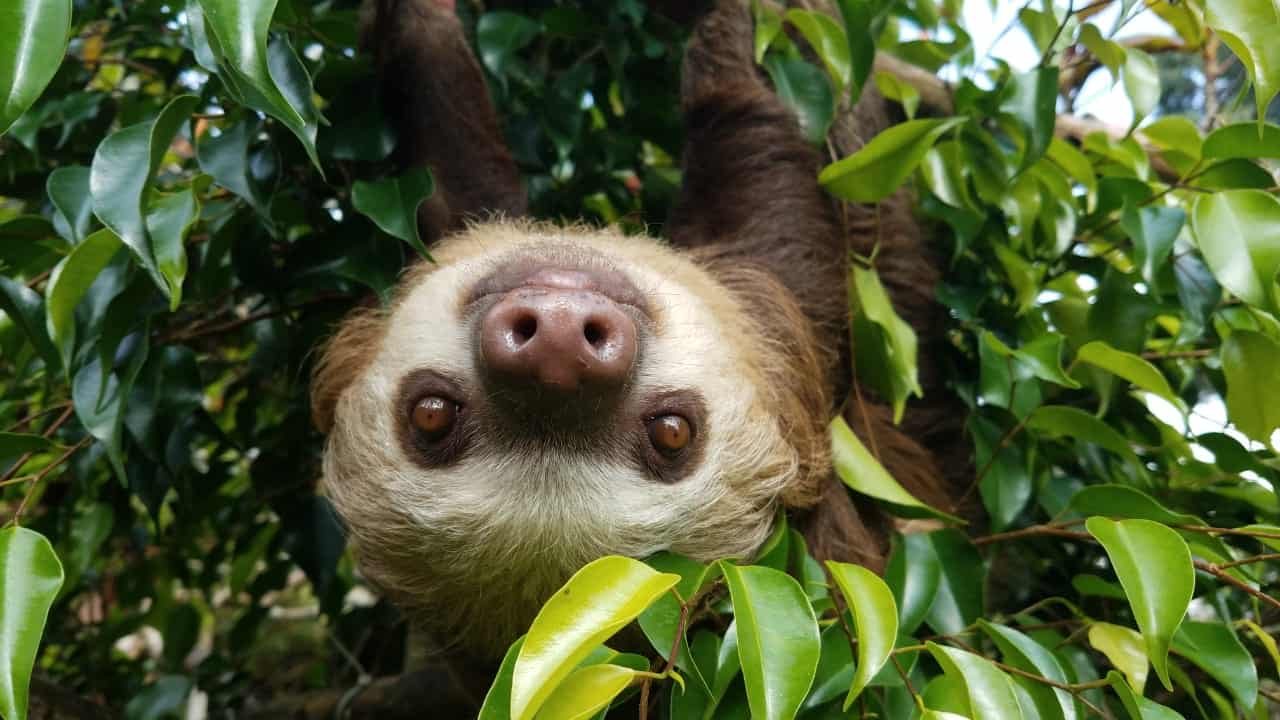
Sloths are split into two family groups: two-toed sloths and three-toed sloths. Here in Costa Rica, we have two species, one from each family group: the Hoffman’s two-toed sloth (Choloepus Hoffmanni) and the Brown-throated 3-toed sloth (Bradypus Variegatus).
Let’s play a game of spot the difference between two-toed and three-toed sloths to learn what makes them so unique.
Fingers and toes
Ok, let’s get the confusing misnomer out of the way first: All species of sloth only have three “toes” on each foot. It is in fact the number of “fingers” that differs between the species. For example, the Hoffman’s sloth has three “toes” on each hindlimb and two “fingers” on each forelimb, but the Brown-throated sloth has three “toes” on each hindlimb and three “fingers” on each forelimb. Moving forwards, let’s refer to them as two-fingered and three-fingered sloths for ease.

Size
Two-fingered sloths are noticeably bigger than their three-fingered counterparts. Hoffman’s two-fingered sloths range between 50 to 75 cm in length and 4.5 to 9 kg in weight. They also have thicker, shaggier fur which emphasizes their larger size. The smaller Brown-throated sloth ranges in size between 45 to 60 cm and 3.5 to 5.2 kgs in weight. Another interesting difference is the length of their limbs. Two-fingered sloths have similarly sized arms and legs, while three-fingered sloths have arms longer than their back legs.
There are also a couple of differences you won’t be able to spot from the outside. The two-fingered sloth has six vertebrae, while the three-fingered sloth has nine. These extra vertebrae allow a three-fingered sloth to turn its head a full 270 degrees, but the two-fingered sloth is limited to only 90 degrees of rotation.
Appearance
Hoffman’s two-fingered sloths have a coat of long, coarse fur which ranges in color from dark brown to pale yellow with much lighter yellow-white fur covering the head. Brown-throated sloths have a grayish-brown fur covering their body with darker brown patches of fur on the throat, the sides of the face, and the forehead. These three-fingered sloths have a paler mask of fur on their face with distinctive black markings like a bandit around the eyes.

Both species of sloth, however, have a very unusual symbiotic relationship with algae. They have specialized hair that encourages algae growth, this gives them a greenish tinge and helps with camouflage up in the treetops.
Diet
The main diet of both species is leaves; they are quite fussy and only eat the fresh, new, juicy leaves. However whilst three-fingered sloths are almost entirely herbivorous, two-fingered sloths are folivores, meaning they could opportunistically eat some animal protein.
Speed
A diet of leaves is not very nutritious, and sloths have to eat lots and lots of leaves to gain their energy. As a result, sloths have a very slow metabolism, this means they expend very little energy each day to survive. They move slowly, digest slowly, and only go to the toilet once or twice a week. Two-fingered sloths that also eat protein gain that extra amount of energy in their diet which allows them to have a faster metabolism and have the ability to move a lot faster than three-fingered sloths, but they still wouldn’t outpace a cheetah!
About the author:
Katie is a 25-year-old Zoologist from the UK. She loves nothing more than hiking in nature with her camera in search of wild creatures. From cute and fluffy mammals to creepy-crawly insects Katie is fascinated by them all. After completing her degree Katie spent 6 months in Costa Rica working with the Toucan Rescue Ranch assisting with their sloth rehabilitation and release programme. Since then she has traveled the world photographing and filming wildlife using social media as a tool to teach others about the wonders of the natural world.

This article was produced by The Toucan Rescue Ranch. The Toucan Rescue Ranch specializes in helping wild animals recover so that they can be reintroduced into the wild.





