

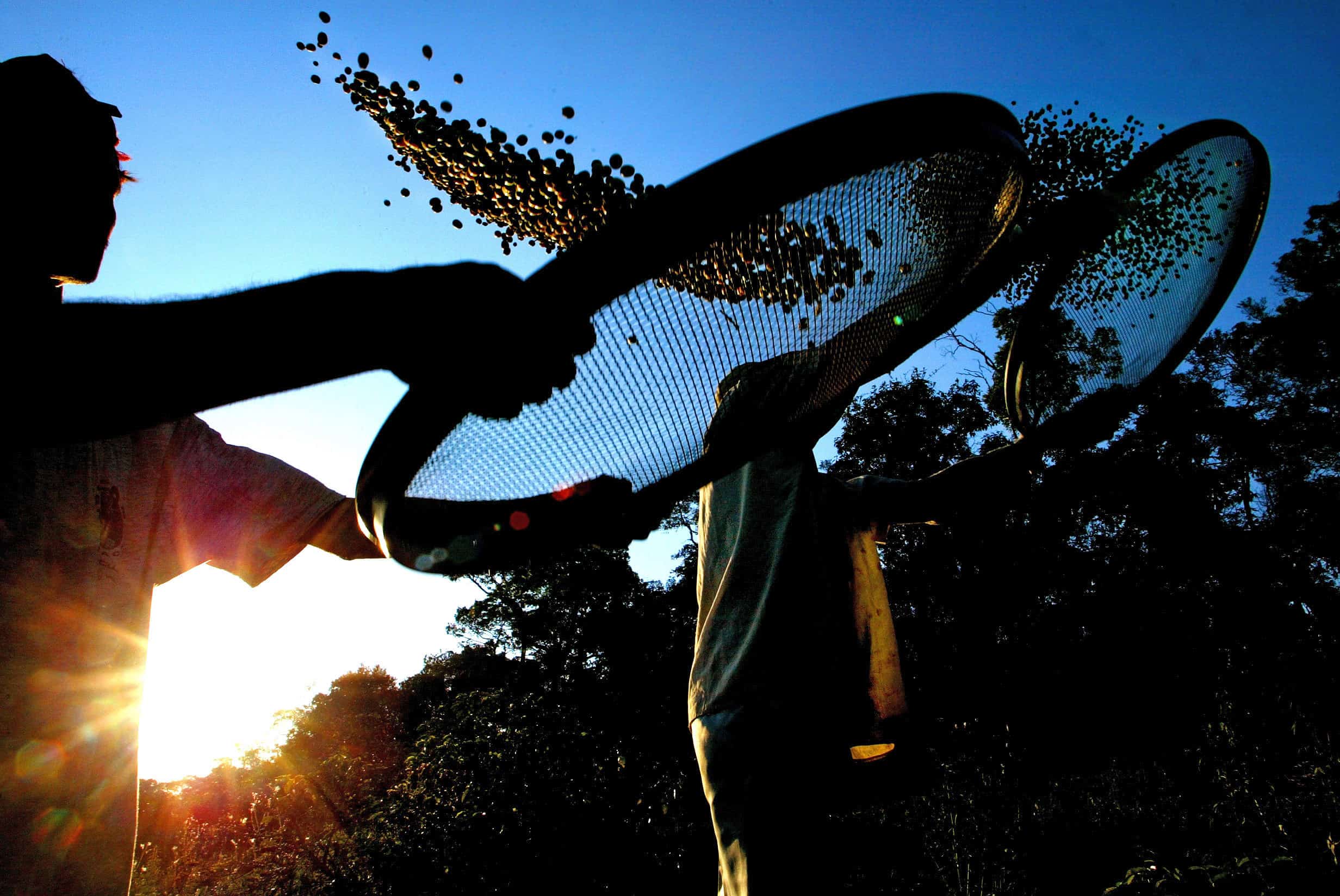
SÃO PAULO, Brazil – When Fabio Miarelli opened coffee cherries at his 220-acre farm in the Sul de Minas region to examine how the beans inside were developing, he found wilted, rubbery granules half the normal size.
Miarelli, 25, estimates the withering of coffee caused by low soil humidity — a phenomenon known as Coracao Negro, or Black Heart — will cut about 30 percent of his output this year.
Black Heart reports are emerging from several farms across the southeast of Brazil as areas that account for a third of the world’s coffee and almost half of sugar shipments endure the driest rainy season in decades — and among the hottest. Arabica, the mild-tasting bean used in premium blends, had its biggest seven-day rally in almost 14 years in New York as a result. Miarelli hopes the price rally will offset his losses.
“We have never seen such a long period with no rain this time of the year,” said Lucio Dias, commercial superintendent at the Cooxupe arabica growers cooperative, responsible for about 10 percent of Brazilian exports of the variety. “We’re going to need time to learn more about the consequences.”
The harm may be irreversible for this crop as parched soil across southeastern Brazil fails to nourish plants at a crucial time for their development. Any amount of rain before the April- to-September annual dry season starts will come too late, Somar Meteorologia’s Marco Antonio dos Santos said.
Plantations endured the driest January since 1954 just when rain was needed the most for tree roots to absorb soil nutrients as the dark brown beans begin to grow inside coffee cherries. Tree branches pruned before the October flowering period aren’t growing, while shoots planted late last year to renew plantations are scorched and dying, Cooxupe’s Dias said.
An atmospheric blockage that’s preventing cold masses from Antarctica from bringing rain to Miarelli’s farm will only start weakening after Feb. 17, Santos, the meteorologist at weather forecaster Somar, said from São Paulo.
Even as some rain resumes little more than a month before the regular dry season starts, it won’t be enough to restore soil humidity to normal levels, Santos said.
“It would be necessary for it to rain way above average in the second half of February and in March to completely replenish humidity levels in the soil, which is not going to happen.” Santos said. “It’s certain that we’re going to have crop losses.”
The impact from the stress that trees are suffering will extend beyond the harvesting season that starts in April, affecting next year’s production too, said Marcelo Pasqua, director of the Guaxupe-based Ribeiro do Vale Cafes Especiais farm that exports premium arabica to the U.S., Italy and Japan.
The rally in past days helped extend a 34 percent increase in arabica prices from a seven-year low on Nov. 6 through yesterday. Arabica for March delivery surged 4.3 percent to $1.416 a pound by 11 a.m. on ICE Futures U.S. in New York. Prices fell as much as 5.8 percent yesterday.
So far, consumers are yet to feel the impact of higher costs, the result of past crop surpluses. Moves in wholesale futures markets often precede changes in retail prices.
In the four weeks ended Dec. 29, U.S. retail prices for ground coffee fell for Folgers and Maxwell House brands by 8.7 percent and 9.8 percent, respectively, helping boost sales during the period by 3.8 percent, according to data from researcher IRI. JM Smucker Co. makes Folgers and Kraft Foods Group Inc. sells Maxwell House. In May, Kraft cut prices on some of its brands, including Gevalia, by 6 percent after a sustained decline in futures, the company said.
The dry spell is also restricting farmers from applying fertilizers because the additives need water in the earth as a vehicle to go up the roots. Most coffee farmers have only made one fertilizer application this season, when by now they should have already made three, Dias said.
João Paulo Rodrigues, whose 230-acre coffee farm last saw rain in December, sent his eight employees on leave because there’s nothing they can do without water. By this time last year, Rodrigues had already contracted the sale of his entire crop. This year, he’s yet to commit a single bag because he doesn’t know how much of his production will be damaged.
“There’s nothing to be done now,” Rodrigues said. “All I can do is wait and wait for rain.”
If Somar’s forecasting models are right, Rodrigues will probably have to wait at least another 10 days.
A strong upper-atmosphere ridge of high-pressure air anchored over Alaska and in the South Pacific near Indonesia is causing weather extremes across both North and South America, Climate Impact Co.’s Scott Yuknis said.
“The hot, dry weather extremes in Brazil have the same connection to the record cold across the U.S. and Canada this year,” said Yuknis, the lead forecaster at Middleboro, Massachusetts-based Climate Impact. “It’s a very dramatic and severe weather pattern. Brazil is in trouble and this dryness may intensify.”
While cold North Pacific waters favor the passage of Arctic fronts dumping snow into North America, warmer South Atlantic waters are helping create hot air pockets that block wet masses from Antarctica into Brazil, Somar’s Santos said.
The dryness in Brazil’s most developed and populous region is also threatening home water supplies and forcing power distributors to pay surging prices in the wholesale energy market because of low reservoir levels. Benchmark cattle prices in Sao Paulo rose to a record this week as heat scorches dry pastures in the top beef-exporting country.
The stress on sugar-cane plants has also led to bets that output for the harvest starting in April will be reduced by the drought. Sugar futures in New York rose 9 percent in the five days through Feb. 5, the longest rally since October.
“Sugar-cane crop losses will be irreversible if it doesn’t rain in the next two weeks,” Jacyr Costa Filho, who heads the sugar-cane division of Tereos, the third-largest Brazilian sugar producer, said yesterday in an interview in Sao Paulo. “It’s a crucial period for development.”
For soybean and corn farmers west of the coffee belt, the dryness is helping speed up the January-March harvesting, though it may delay or discourage them from planting a second, off- season crop.
“We are worried about the dry weather hurting the soybeans that were planted late and also the second crop for corn and soybeans,” Agriculture Minister Antonio Andrade said in a Feb. 3 interview in Brasilia. “Planting may be delayed because of the lack of rain and, if we don’t get enough rainfall, we have the risk of losses.”
Coffee remains the biggest concern.
“People have been spooked because this is typically the time for rains in Brazil,” said Luiz Eduardo de Paula, owner of H. Commcor, a Sao Paulo-based brokerage that trades farm- commodity futures. “We need rains to start now or the effects are going to be catastrophic.”
With assistance from Jeff Wilson in Chicago, Mario Sergio Lima in Brasilia Newsroom and Todd White in Madrid.
© 2013, Bloomberg News





