

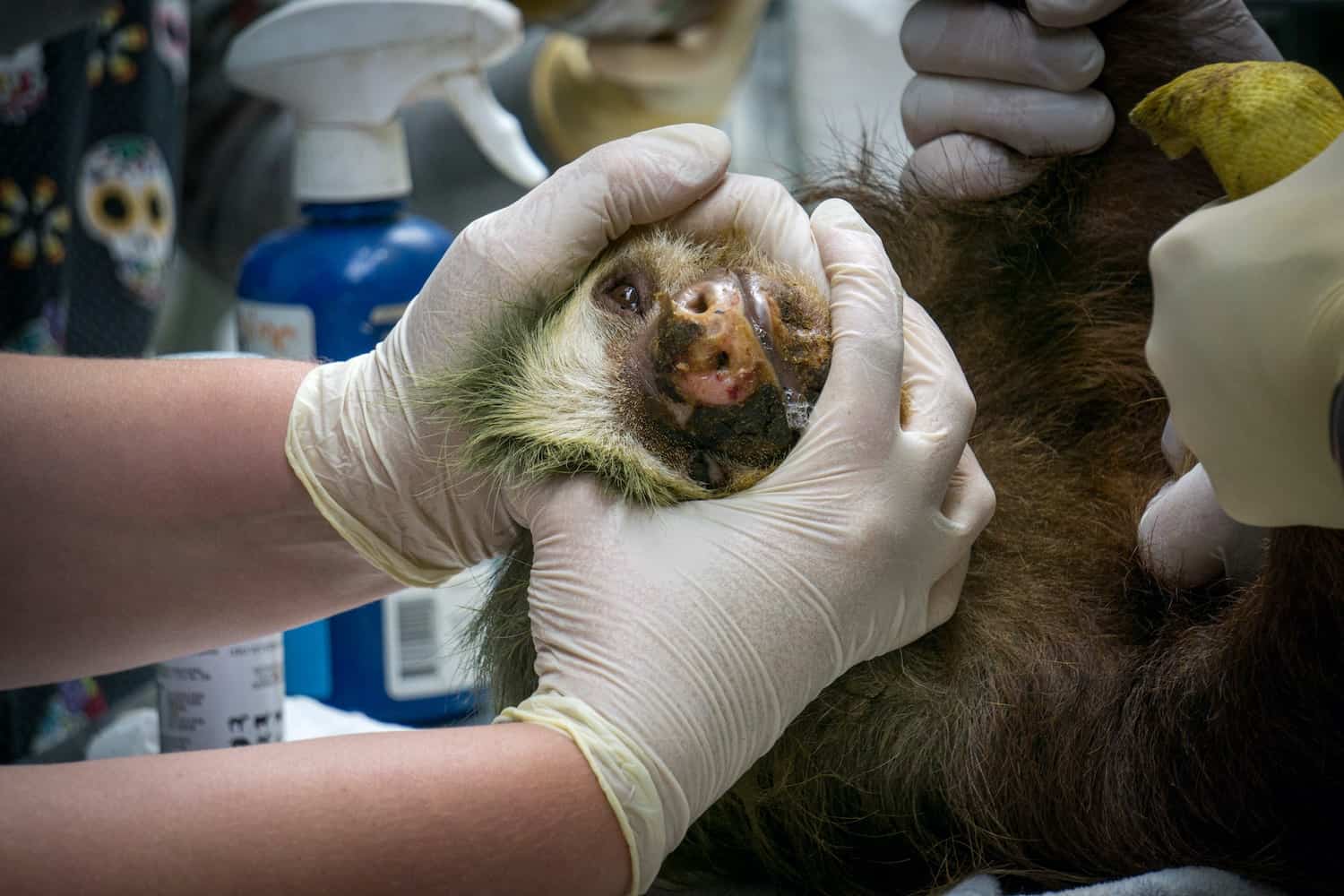
Sometimes, trouble finds itself in the heights of the Costa Rican canopy. Picture yourself slowly moving upside down through your forest environment when all of a sudden the trees run out. You spot some beach almond, but not a single branch connects from your tree to the one that holds the delicious treat. Between you and it lies a black river, concrete, and fast vehicles that prevent you from going to the ground and crossing.
Then you spot it: A thick, gray vine goes from one side of this black river to the other. You want the almond; you’re hungry. You make your decision. But as soon as you touch the sturdy black vine, a sudden pain comes. You let go and fall to the ground, charred and scarred, jolted by things that just don’t belong.
This is the experience that many Costa Rican animals sadly end up facing. Virtually every power line in Costa Rica runs alongside our streets above the ground. This provides a quite easy way for arboreal wildlife to climb onto them, and try to cross the sometimes busy and dangerous streets. These power lines are also commonly badly insulated, using metals like aluminum instead of more heavily insulating materials.
Arboreal animals like monkeys, sloths, squirrels and all sort of critters big and small use power lines as naturally as they would the branches and vines of their natural rainforest. Often, this isn’t really a choice. As we humans develop land and chop up the natural rainforest to make way for urbanization, animals must resort to these to paths to cross between fragmented pieces of rainforest or simply to search for food.
This choice is often deadly, though. While they make their way through the cables, it’s not uncommon for animals to touch to parallel cables, completing a circuit and electrocuting the creature. The results are more often than not horrible. Animals flung to the ground are left with broken bones, singed limbs and harrowing burns, and that’s for those who may survive.
Often, babies survive while still clinging to their charred mother.
Over half of all animals electrocuted in these accidents are sloths. They usually die before they reach the ground, multi-organ failure caused by the electricity being the main cause. If the sloth survives, it faces a long recovery process before it can be released back into the wild.
At this Costa Rica Sloth Rescue Center, electrocutions are the number one cause of adult sloth internments, with some cases of babies that have come in due to their parents dying in power line accidents.
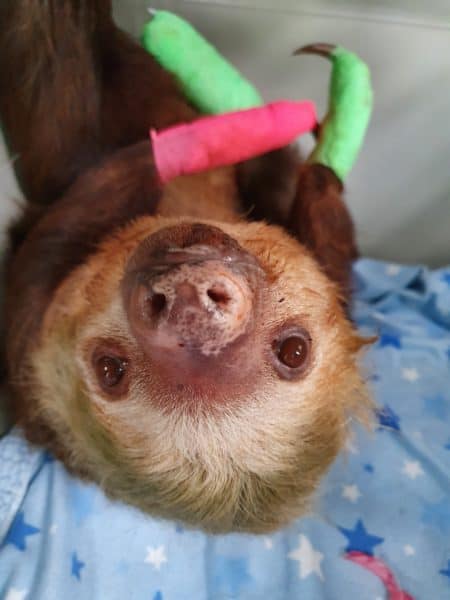
Thankfully, not everything is bad news. Sloths like Neptuna, who have come in due to electrocution, have a good chance of survival once they arrive at rescue centers.
With time, effort, and lots of love, they can still be rehabilitated and released back into the wild. These sloths who have survived against all odds and embark onto a path of recovery usually have a good prognosis.
Things have been changing in the wild as well, with organizations big and small teaming up to raise money to buy new insulations for power lines as well as organizations building natural walkways made of rope to connect separated patches of the rainforest.
— Andrés Sáenz Bräutigam is a Veterinary Medicine Student & TRR Veterinary Assistant & Tour Guide.
The Toucan Rescue Ranch specializes in helping wild animals recover so that they can be reintroduced into the wild.





