
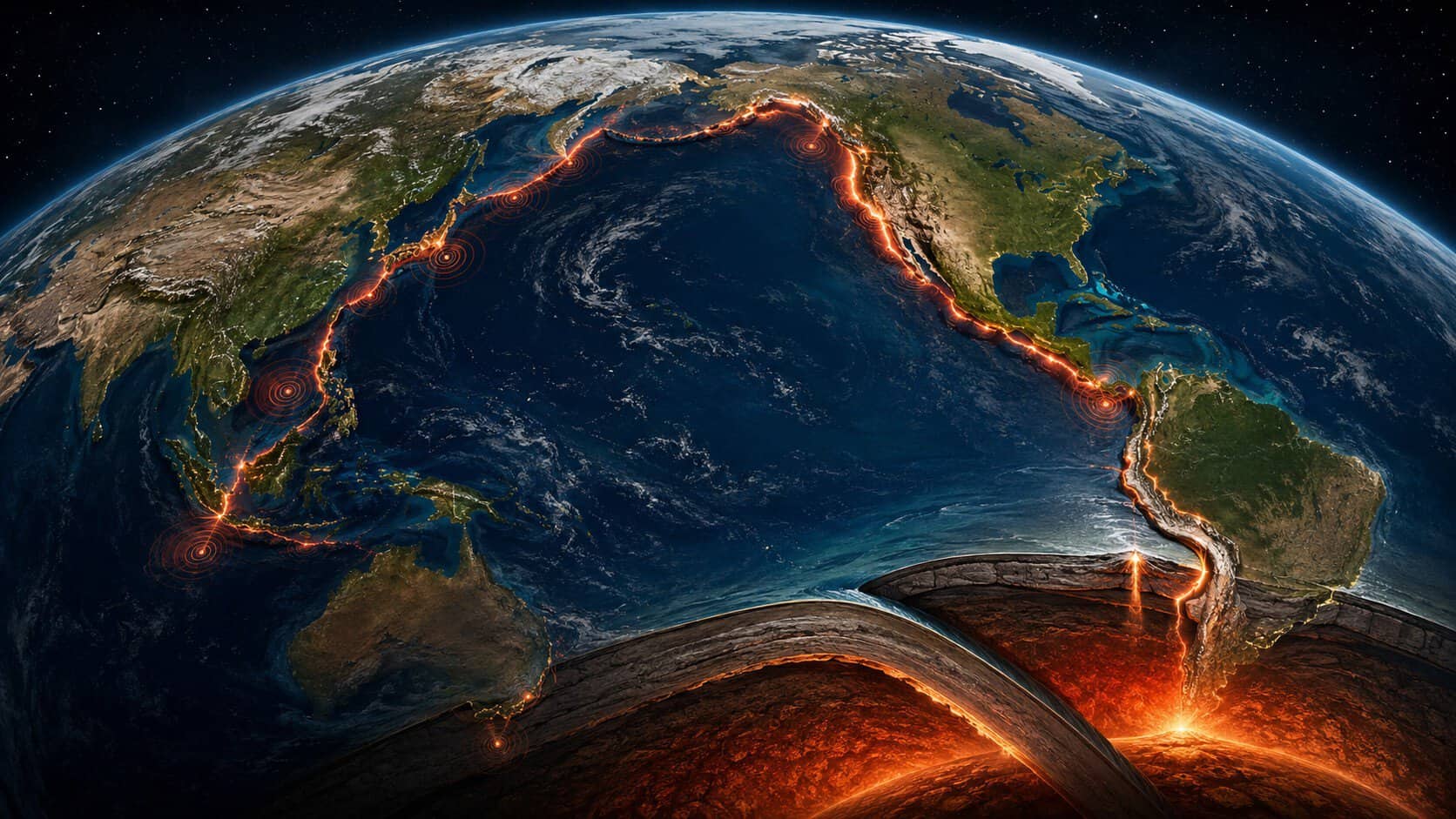
The Ring of Fire–the 25,000-mile horseshoe-shaped belt that runs from Southeast Asia up the Pacific Coast to far Northeast Russia, over to Alaska and down the coast all the way to the tip of Chile– is in a turbocharged state, tectonic plates crashing and subducting, wreaking havoc on the earth’s surface far above.
First Venezuela and now Colombia. Since April, Indonesia, the Philippines, Venezuela, Mexico, Colombia and Indonesia again, all rocked by quakes measuring over 7 on the Richter scale.
Locally, the Colombia earthquake received major notice, partly due to the sheer number of videos showing the quake from all angles as it shook for roughly two minutes, collapsing buildings onto streets full of frightened onlookers who prayed, screamed and moved frantically to avoid being swept up in the debris.
This quake was at a depth of 100 kilometers, meaning that the collision of the plates must have been especially violent. By comparison, the double 7-plus quakes that hit Venezuela days earlier were at only 10 kilometers of depth. These also shook the earth for at least two minutes.
Costa Rica’s 1991 Limon quake was also at a shallow depth of 10 kilometers, but shook for only 10 to 15 seconds. (Generally the shallower the quake the more violent the shaking felt along earth’s surface).
What is most unusual about all of these massive earthquakes is that there is nothing unusual. Globally, the Earth averages about 15 to 20 earthquakes of magnitude 7.0 to 7.9 every year, meaning the frequency in 2026 is tracking completely within normal historical parameters.
Most of these are in the Ring of Fire, which in the world of seismology is the star subject, the center of attention: About 90% of all earthquakes happen within its boundaries including the most powerful and destructive megathrust quakes in history, such as the 9.5 1960 Chile rocker, the 9.2 Alaskan quake of 1964 and the more recent Japan shaker that unleashed a devastating tsunami.
Unlike hurricanes, which can be monitored, tracked and pinpointed as to where they will hit and what their level of destruction will be, earthquakes strike unpredictably, with no warning.
The tectonic plates are huge slabs of Earth’s crust, which fit together like pieces of a puzzle. The plates are not fixed but are constantly moving atop a layer of solid and molten rock called the mantle. Sometimes these plates collide, move apart, or slide next to each other.
Both Venezuela and Colombia sit over the intersection of three main tectonic plates: the South American Plate, the Caribbean Plate, and the Nazca Plate. Costa Rica also sits atop the Caribbean Plate, as well as the Cocos Plate, and is influenced by movements of the distant Nazca Plate.
The earth beneath our feet is in almost constant yet imperceptible motion. Only the past five days has seen over thirty tremors registered in Costa Rica, mostly in the 2.5 to 3.5 range on the Richter scale. OVSICORI, the Costa Rican research institute which observes the earth’s movements via its countrywide seismographic network, correctly predicted the last big one.
The September 2012, 7.6 Nicoya quake had long been monitored by researchers from OVSICORI and the Georgia Institute of Technology, among others, Large earthquakes with magnitudes over 7.5 had hit the Nicoya Peninsula roughly every 50 years, with previous major quakes occurring in 1853, 1900, and 1950.
Using land-based GPS networks, scientists mapped locked patches along the subduction zone fault that were actively storing massive amounts of seismic energy. When the 7.6 earthquake struck, it occurred right in the heart of the specific locked zone that researchers had previously identified and anticipated.
While they continue to dig out of the rubble in Colombia and Venezuela, we can for now be thankful that we have been relatively unscathed over the past decade plus. Live here long enough and you realize that tremors, shakers and quakes are an almost routine part of our existence. That there will be another big one in our future is a given. May the Caribbean and Cocos Plates show mercy in the meantime!
Read more of Don Mateo’s writing from his newly published ebook