

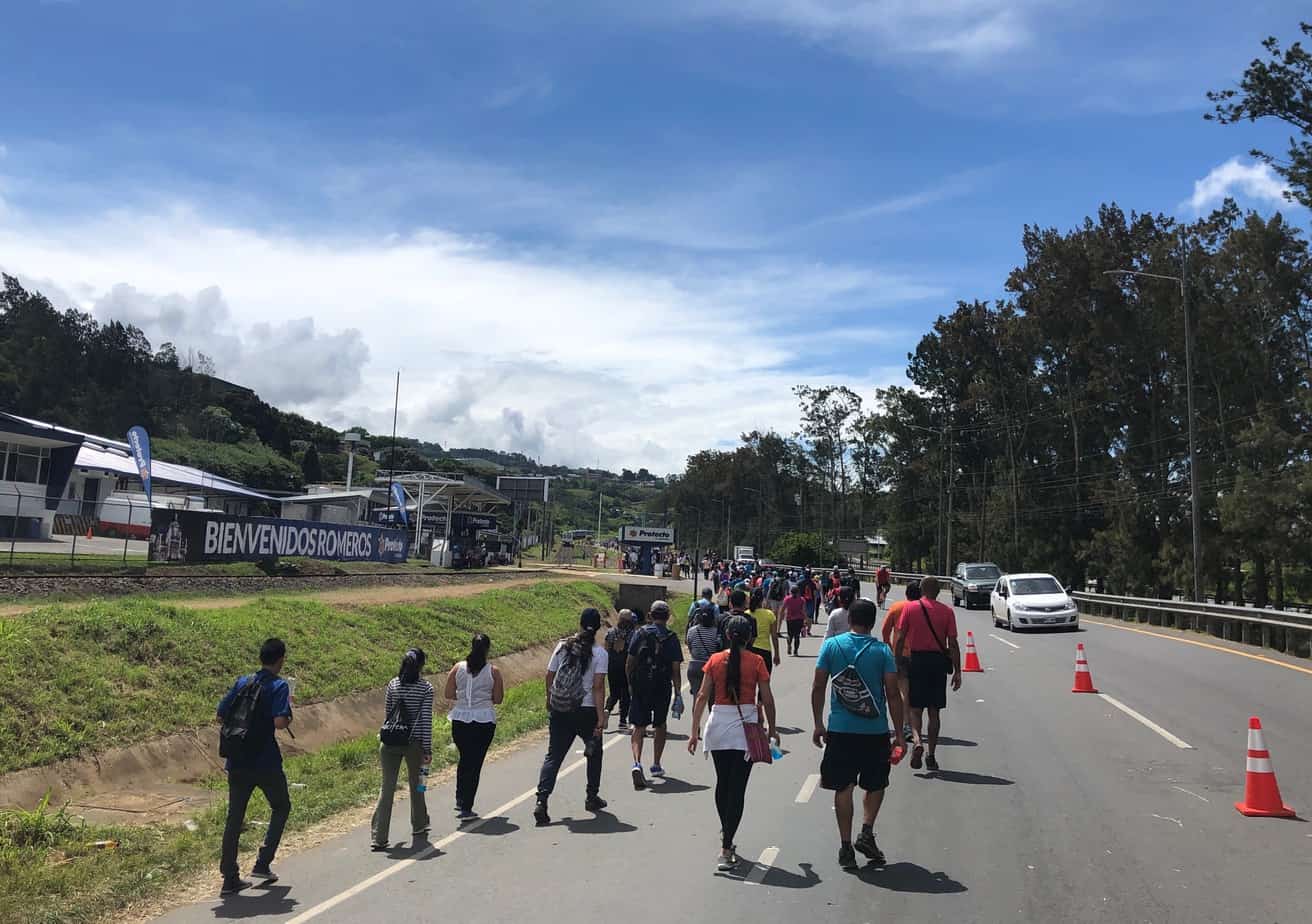
If you drive between San José and Cartago, get ready to lose the road on Saturday. On August 1, Traffic Police plan to close vehicle traffic along a four-kilometer (2.5-mile) stretch of Ruta 2, the Florencio del Castillo, from the Fuente de la Hispanidad in San Pedro east to the antigua Galera. Around 4 p.m., officers expect to open cross traffic through the corridor near the San Pedro de Montes de Oca church so people can get from one side to the other.
Central Cartago gets its own ring of roughly three blocks around the Basílica de Nuestra Señora de los Ángeles, closed to vehicles entirely. The closures can also come earlier than announced. Authorities said they may pull the trigger on any given day depending on how many people are walking, and they have already been doing that: the operation opened on Saturday, July 25, ahead of schedule, because pilgrims started walking early over the Guanacaste Day holiday.
That is the practical shape of the week. Controls are light Monday through Thursday, tighten on Friday, July 31, peak on Saturday, August 1, and stay heavy through the feast of the Virgin of the Angels on Sunday, August 2. From 6 a.m. that Sunday, officers concentrate on the Florencio del Castillo to enforce speed limits, clear cars parked on the shoulder, and stop buses from taking on more passengers than they can seat. The religious calendar runs through Monday, August 3, when Cartago holds the Pasada, so traffic in the city does not return to normal the moment the mass ends.
Two alternate routes are open to you, and the difference between them matters. Ruta 218, running San José–Ipís–Vista del Mar–Rancho Redondo, takes any vehicle: it is wide enough and graded gently enough for buses, trucks and loaded pickups. Ruta 212, through Patarrá, Coris and the industrial park at La Lima de Cartago, is for light vehicles only.
It narrows, climbs and turns tightly in places where a long wheelbase gets stuck or forces oncoming traffic to reverse, which is exactly the kind of blockage that strands everyone behind you for an hour. If you are driving anything larger than a car or small SUV, take 218.
What you should not do is take Ruta 251, the old road to Cartago. That is where police are deliberately funneling walkers for the final stretch between the antigua Galera and Taras, because the speeds are lower and there is somewhere to step off the asphalt. Sending pedestrians there is the whole point of the plan, so driving there puts you in a slow river of people rather than around the congestion.
The operation reaches further than the Cartago corridor. About 150 traffic officers are working Ruta 2, Ruta 1 (the General Cañas), Ruta 27, Ruta 32, Ruta 10, Tibás, Heredia and central Cartago, because pilgrims walk in from Guanacaste, Limón, the Northern Zone and the south, not just from San José.
Expect controls to appear on short notice on roads that have nothing obviously to do with Cartago. If you are driving in from the coasts this week, the areas flagged as most dangerous are Cambronero, El Aguacate, Ruta 27, the Cerro de la Muerte and the Zurquí, where fog, rain and pedestrians combine badly after dark.
The scale explains the disruption. Roughly two million people are expected to reach the Basílica across the period, in a country of about five million. The walk from San José is about 22 kilometers (14 miles), and many start it at night. The Costa Rican Red Cross has assigned about 850 volunteers to eight aid posts between San Pedro and the Basílica, and treated 162 people over the opening weekend alone — 130 at the Basílica post and 29 at Ochomogo, with single cases at San Pedro, El Cristo and Conventillos.
Most of those were medical rather than injuries, and the largest group of patients was over 61. The Ministry of Public Security is deploying 500 Fuerza Pública officers along the route from calle 42 at La Sabana to the shrine, supported by a network of 25 health facilities. Cartago’s municipality has built out the receiving end. More than 500 cameras now cover the pilgrim route from Cristo Rey in El Fierro through the canton center to the Basílica, including the approach used by walkers from Paraíso.
Twenty-four roadside shelters along the way each carry two of those cameras. Between Ochomogo and the Basílica there are 75 rubbish collection points and four recycling drop-offs taking plastic, aluminum and Tetra Brik. On August 1, 2 and 3, the municipality is giving 156 local vendors space at Plaza Mayor, and the newly finished second stage of the Taras linear park adds another place to sit down.
One piece is worth mentioning. INCOFER has not yet published its Romería train schedule for this year. In past years the railway has run continuously between Estación del Atlántico in San José and Cartago from the evening of August 1 until midday on August 2, with departures every 35 minutes and stops at Tres Ríos, UACA, CFIA Curridabat, Ulatina San Pedro and UCR San Pedro. The standard fare on that route is currently ₡710, about $1.55. If you need to get out of Cartago on the night of August 1, watch for that announcement, because the roads will not be an option.
The best thing to do if Cartago is not where you need to be this weekend: do your Cartago errands before Friday, and stay east or west of the corridor over the weekend. If you do have to travel, leave early, leave extra time, and treat every stretch of highway between San Pedro and Taras as a pedestrian zone that happens to have cars in it.





