

Hundreds of bus fares, along with selected taxi, train and toll charges, will shift up or down by a few colones starting July 1, as Costa Rica’s regulator rounds regulated prices to the nearest ₡10 to match the retirement of the ₡5 coin.
The Autoridad Reguladora de los Servicios Públicos (Aresep) confirmed the adjustment, which it says was forced by the Banco Central de Costa Rica’s decision to strip the ₡5 coin of its value as a means of payment on that date. With the smallest coin gone, any regulated fare that currently ends in ₡5 is being recalculated to the closest multiple of ₡10. The change is folded into Aresep’s regular six-month tariff review.
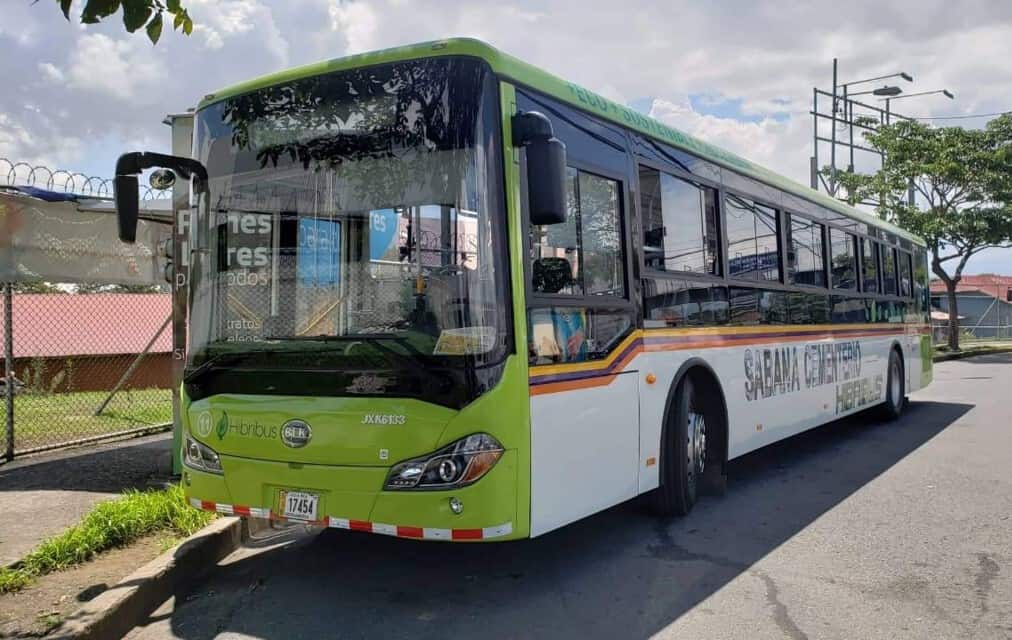
For bus riders — the service that carries most of the population — the impact is mixed rather than a blanket increase. According to Aresep, roughly 48% of bus fares stay exactly the same. Of the rest, about 26.8% (1,288 fares) rise by ₡5, while a nearly equal 24.9% (1,197 fares) actually fall by ₡5. From July, every bus fare will be expressed in multiples of ₡10.
How much a passenger pays will also depend on how they pay. Aresep is keeping a gap between cash and electronic fares to nudge people toward digital payment. The rule it described is straightforward: for cash, a fare is rounded to the nearest ₡10, with amounts ending below ₡5 rounded down and those of ₡6 or more rounded up. By the regulator’s own examples, a ₡484 fare drops to ₡480 in cash, while a ₡486 fare rises to ₡490.
Riders who pay electronically through SINPE-TP avoid the rounding altogether and are charged the exact approved amount — a ₡505 fare, for instance, stays ₡505. Officials have acknowledged that making exact change will become harder for drivers and passengers alike once the ₡5 disappears, even though ₡10 and ₡25 coins remain in circulation. The route-by-route figures take effect once the resolution is published in the official gazette, La Gaceta, and can be checked on Aresep’s website thereafter.
Taxis are largely spared. Aresep says fares for standard sedan and rural red taxis, as well as the orange airport taxis based at Juan Santamaría International Airport, do not change. The only taxi increase falls on the adapted service for people with disabilities, where the base fare, per-kilometer rate and waiting-time charge each rise by ₡5.
The passenger trains and ferry (cabotage) services are also part of the recalibration. Aresep listed increases on several Incofer commuter routes, including Estación del Pacífico–Belén, Indoor Club–Metrópoli III, Estación del Atlántico–Heredia and Estación del Atlántico–Cartago.
Drivers will notice small differences at the tollbooth. On the Florencio del Castillo highway, light vehicles get a ₡5 reduction, and on the Braulio Carrillo route the same ₡5 cut applies to buses and large cargo trucks; all other vehicle categories on both highways stay the same. Aresep had also planned ₡5 adjustments, both up and down, on the General Cañas and Bernardo Soto highways, but those will not take effect because toll collection on those routes is currently suspended by Conavi.
The fare changes are the practical, day-to-day side of a monetary shift that has been building for years. The ₡5 coin has not been minted since January 1, 2020, after the Central Bank determined it cost more to produce than it was worth, and its July 1 retirement makes that exit permanent, leaving the ₡10 as the smallest coin in circulation. Old-design ₡10 and ₡25 coins are leaving alongside it as part of the country’s “new monetary cone,” and they can still be exchanged at banks after the deadline even though shops are no longer obliged to take them.
For anyone who still pays in cash, expect bus and some taxi fares to land on round ₡10 figures from July 1, carry small bills and newer coins, and consider SINPE-TP or a card to pay the exact amount and skip the rounding altogether. The new tariffs take effect once published in the official gazette, La Gaceta.





