

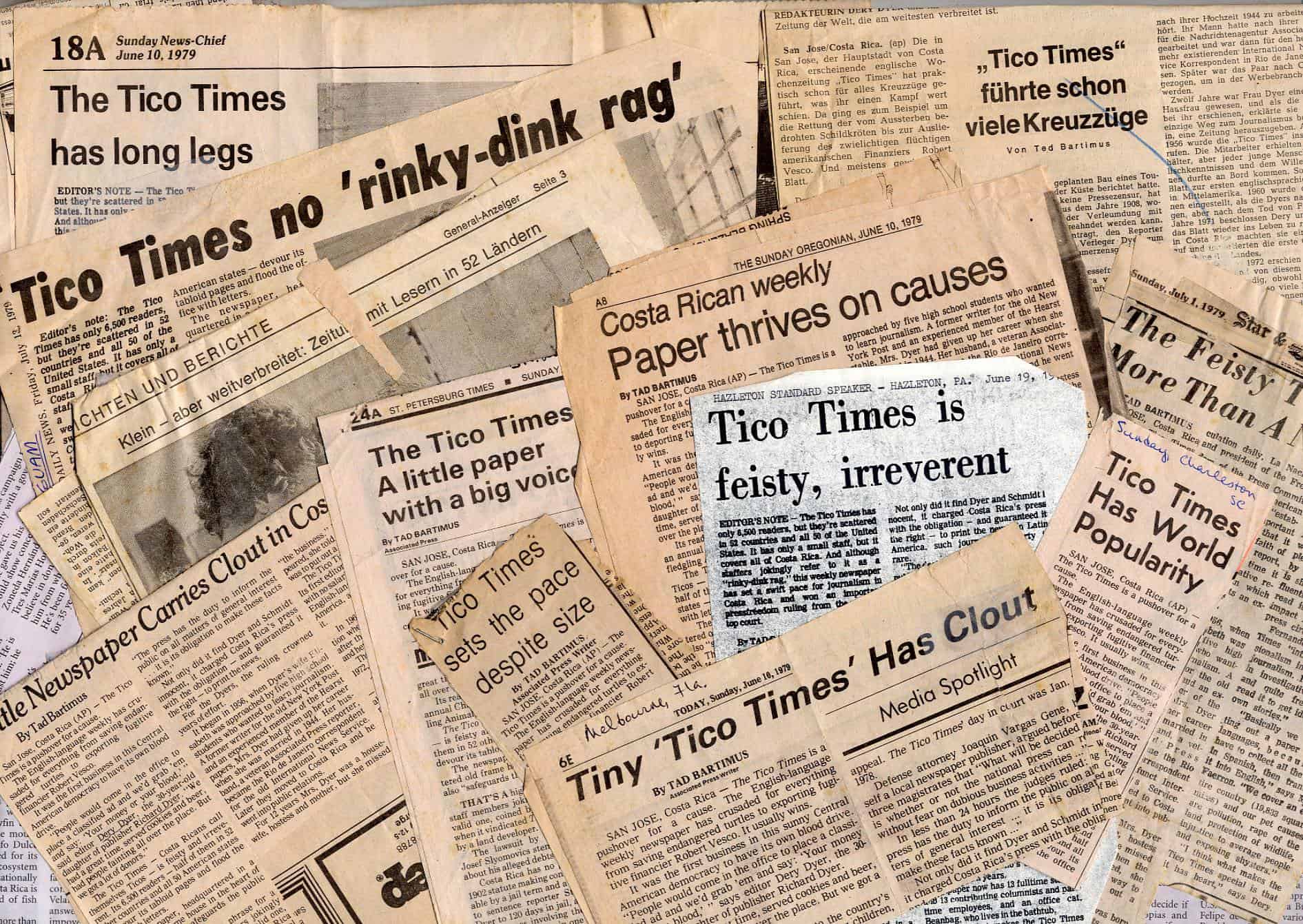
Today, May 18, 2026, Costa Rica’s most enduring English-language voice quietly marks a milestone that few news organizations anywhere in the world ever reach: its 70th birthday. The Tico Times was never supposed to become an institution. It started as a homework assignment. And yet, seven decades later, it remains the go-to source of English-language news in a country that has come to define itself by its openness to the world.
Born in a Classroom, Built by a Community
The story begins in 1956, when a group of senior students at San José’s Lincoln School approached Elisabeth “Betty” Dyer — a veteran journalist from the United States who had traded her career for life as a full-time mother in Costa Rica — and asked her to teach them about journalism. Her answer was characteristically no-nonsense: the best way to learn was to put out a paper.
And so they did. On May 18, 1956, the first edition of The Tico Times rolled off the press at Imprenta Borrasé, priced at just one colón. It was eight pages long, all-volunteer and entirely nonprofit. The inaugural staff included Isabel Moncy, Eleanor Hamer, Sidney Newcomb and a handful of other young idealists. Their first advertisers included Schmidt’s Bakery, the Gran Hotel Costa Rica and Pan American World Airways. Within weeks, the paper had expanded to 12 pages. Within months, it had become a fixture of the expatriate community.
A Pioneer in More Ways Than One
What distinguished the Times from the beginning was not only its language, but also its spirit. It introduced investigative journalism to Costa Rica at a time when the concept was barely known in the region. It was the first newspaper in the country to print color photographs on its front page. It was among the first to treat environmental issues as serious news rather than a niche curiosity.
In the turbulent 1980s, when Central America was gripped by armed conflict and ideological confrontation, San José and, often, the Times became a base camp for international correspondents. The paper covered the wars, the peace negotiations and Costa Rica’s remarkable decision to stay out of it all. When President Óscar Arias won the Nobel Peace Prize in 1987 for brokering the Central American Peace Accords, the world turned to the Times to understand what it meant.
The paper paid a terrible price for its courage. In 1984, reporter Linda Frazier was killed by a bomb during a press meeting near the Nicaraguan border — a loss that haunts the publication’s history to this day. The Times also broke the story on secret airstrips used by Contra fighters and exposed rampant shark finning in Costa Rican waters long before ocean conservation became a mainstream issue. Former publisher Richard Dyer waged a two-decade legal battle against the mandatory licensing of journalists, ultimately winning in 1995. He received the Inter-American Press Association’s Grand Prize for Freedom of the Press in the process.
Resilience Through Reinvention
The road to 70 has not been smooth. The paper suspended publication in 1960 when the Dyer family moved to Chile, only to be reborn in 1972 under Richard Dyer and his daughter Dery, who would go on to lead it for decades. At its peak in the mid-2000s, the Times had more than 60 employees, a circulation of 15,000, and even a sister publication in Nicaragua, The Nica Times.
Then came the crash. The collapse of the U.S. housing bubble dried up the real estate advertising that had kept it afloat. In September 2012, after 56 years of continuous print publication, the paper announced its last print edition and laid off its entire staff. It was a moment of profound loss for the English-speaking community in Costa Rica.
But the Times refused to die. Volunteers kept it breathing online while the business was restructured. By January 2014, a new digital incarnation was live. After the death of owner Jonathan Harris in 2017 brought another brief closure, new ownership stepped in again, relaunching with a mission to support young journalists and celebrate Costa Rica in all its complexity.
Seventy and Still Standing
Today, the Tico Times continues to publish daily at ticotimes.net, covering everything from environmental policy and migration to culture, sports, and the booming expatriate real estate market. It has outlasted print, outlasted the housing boom, outlasted several ownership changes, and outlasted the skeptics who wrote it off more than once.
What keeps it alive is the same thing that launched it: a belief that Costa Rica’s story deserves to be told clearly, independently, and in English, for the diplomats, the expats, the travelers, the researchers, and the Costa Ricans themselves who want a different lens on their country.
At 70, the Tico Times is not just a newspaper. It is a living archive of seven decades of a small, remarkable nation, and proof that a homework assignment, done with enough conviction, can last a lifetime.





