

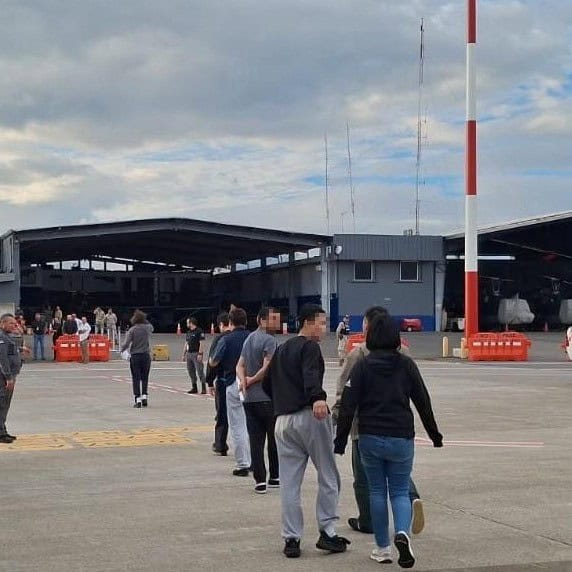
Costa Rica received a fourth flight of migrants deported from the United States on Friday, as our country continues carrying out a bilateral migration agreement signed with Washington in late March. The latest group consisted of 12 foreign nationals: two from Bolivia, one from Chile, six from China, one from France and two from Madagascar. Immigration authorities identified the group as three women and nine men, all adults, and reported no special circumstances at the time of entry. The flight landed at Juan Santamaría International Airport.
After immigration screening, the group was to be taken to a hotel and assisted by the International Organization for Migration. The agency will explain the procedure for enrolling in the Assisted Voluntary Return program, which allows migrants to request support to return to their countries of origin. Authorities said those who meet the requirements may also seek legal stay in Costa Rica.
Friday’s arrival brings the number of people received on these flights to 95 since April 11. The first flight brought 25 migrants. A second flight on April 17 brought 30 people, including eight Costa Ricans. A third flight on April 24 brought 28 people, including 25 foreign nationals and three Costa Ricans.
The transfers are part of a memorandum of understanding signed on March 23 by then-President Rodrigo Chaves and Kristi Noem, the U.S. special envoy for the Shield of the Americas. The agreement allows the United States to transfer foreign nationals who are not U.S. citizens and who are in the country illegally, while Costa Rica processes them under its own migration rules.
Under the arrangement, Costa Rica agreed to receive up to 25 third-country deportees per week, with the United States providing financial support and the IOM assisting with food and accommodation during the first days after arrival. Costa Rica retains the ability to accept or reject proposed transfers.
The Fernández administration has maintained the policy as part of Costa Rica’s broader cooperation with the United States on migration and security. Laura Fernández took office on May 8, succeeding Chaves, and has kept close alignment with Washington as one of the early signals of continuity in foreign policy.
Costa Rican officials have said our country will not force deported individuals to return to their countries of origin. Those who do not choose voluntary return may seek regularization, request asylum if eligible, leave the country on their own, or ask for humanitarian assistance to return.
The government has also said the agreement includes protections against forced return to countries where individuals may face persecution or danger. That protection is part of Costa Rica’s international obligations and is central to the legal handling of people transferred under the program.
The policy has drawn scrutiny from human rights groups and opposition voices because third-country deportations can leave migrants in countries where they may not speak the language, have family ties, or know how to navigate the legal system. U.S. media and rights advocates have also questioned the broader use of third-country transfers as part of Washington’s deportation strategy.
As of now, Costa Rica is treating the arrivals as a managed migration process rather than automatic repatriation. Each person received under the mechanism is expected to go through screening, receive information on available options, and decide whether to pursue voluntary return, legal stay, asylum, or another permitted path.





