
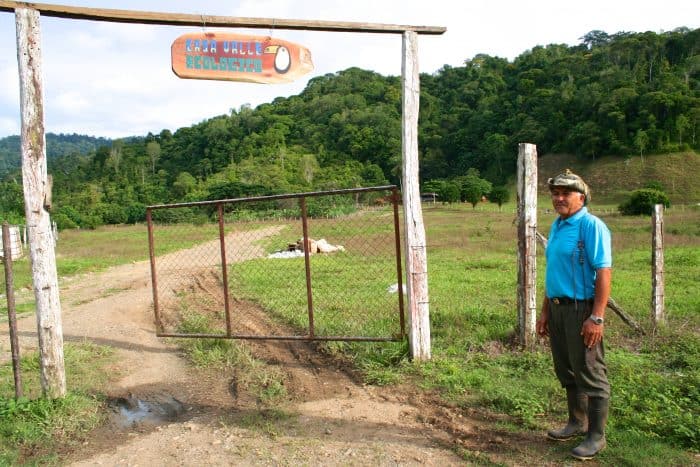
The proposal would create a legal path for some rural properties accessed by agricultural easements to be used for tourism, residential, or recreational projects.
A bill before Costa Rica’s Legislative Assembly could expand what landowners are allowed to do with certain rural properties that do not have direct public road access.
The proposal, known as the Ley de Creación de las Parcelas Turísticas Residenciales Recreativas, or Expediente 23.200, would create a new legal category for qualifying properties and allow them to support tourism, residential, or recreational projects. Under current rules, properties accessed through an agricultural easement, or servidumbre agrícola, are generally limited to farm use, a single home, and related agricultural structures.
The bill faces a four-year legislative deadline, a newly seated Legislative Assembly, and the loss of its principal sponsor. Costa Rica’s new Assembly, sworn in on May 1, has only a few weeks to decide whether to revive the proposal or allow it to be archived.
The bill would create the figura of the parcela turística residencial recreativa and a new right-of-way known as a servidumbre turística, or tourism easement. Supporters say those changes would give owners of former agricultural land in tourism areas a clearer legal path to develop small-scale projects while maintaining environmental limits.
The proposal would allow qualifying owners to develop operations on up to 25% of their land, in multiple structures of up to two stories. The remaining land would remain subject to conservation or other limits established through the law.
Luis Diego Vargas Rodríguez, the bill’s main sponsor and until recently a lawmaker in the Asamblea Legislativa, said the proposal could also benefit municipalities and the national government through additional tax revenue.
“There is an advantage in this bill for municipalities, for the government, in terms of taxes,” Vargas said. “There is clearly a situation in tourist zones, in the hills, by the beaches, where they no longer have an agricultural economy.”
The origins of the proposal go back to concerns over land-use rules for parcelas agrícolas. In the past, owners of those properties could build on 15% of their land. Later, the National Institute of Housing and Urban Planning, known as INVU, raised that cap to 25% but also added a 300-square-meter limit on the principal residence.
Supporters of the bill argue that change sharply reduced the practical construction potential of many properties and created uncertainty because it came through administrative regulation rather than legislation.
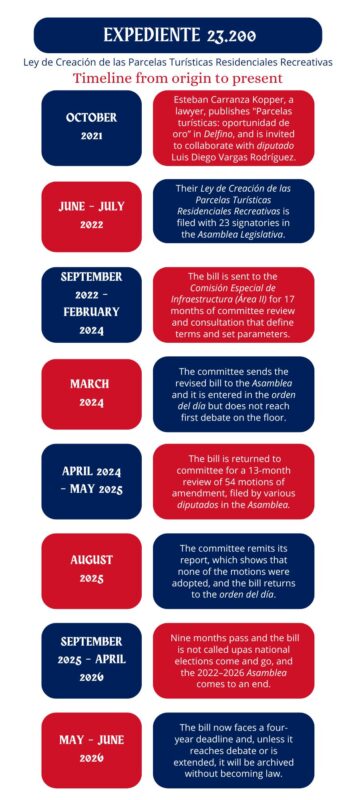
Timeline of Ley 23.200 from its origin in 2021 to its current deadline before Costa Rica’s Legislative Assembly. Graphic courtesy of Julie Pollock.
Esteban Carranza Kopper, a lawyer with RL Abogados, began publicly raising the issue in 2021. In an October 2021 article published by Delfino, titled Parcelas turísticas: oportunidad de oro, Carranza argued that Costa Rica needed clearer rules for landowners in tourism areas where agricultural use was no longer practical.
“Costa Rica has been known for strong legal certainty for investors and residents,” Carranza said.
He said the main objective was to establish legal certainty while encouraging responsible tourism development tied to environmental protection.
“The main objective was to establish legal certainty while promoting responsible tourism development that is aligned with environmental protection, to enable projects in high-potential tourism areas while ensuring conservation through designated protected percentages of land,” Carranza said.
Vargas later invited Carranza to collaborate on a formal bill. The proposal was filed in the Legislative Assembly with 23 signing lawmakers, including Vargas. It proposed adding a new article to Costa Rica’s 1968 urban planning law, along with transitional provisions to guide implementation.
In September 2022, the bill was sent to the Comisión Especial de Infraestructura, where it spent 17 months under review and consultation. The committee developed legal definitions for the parcela turística residencial recreativa and the servidumbre turística. It also set construction parameters, created an approval pathway through Costa Rica’s agricultural ministry, and included a 24-month opt-in period for eligible landowners.
In March 2024, the committee sent the revised bill back to the Assembly. It was entered in the orden del día but did not reach floor debate. The bill was then returned to committee for review of 54 motions of amendment filed by lawmakers.
In August 2025, the committee sent its report back to the legislature. None of the 54 motions had been adopted, and the bill again appeared on the orden del día. Still, it was not scheduled for debate before the 2022–2026 Assembly ended.
The new legislature now takes over the file. Vargas, however, is no longer in Congress. He left the Partido Liberal Progresista to run for vice president on a presidential ticket that did not win. He said he is now lobbying incoming lawmakers to keep the proposal alive.
The proposal has also drawn opposition. The Instituto Costarricense de Turismo has raised objections, and Vargas said some critics view the bill as harmful to agriculture. Supporters counter that the measure is aimed at areas where tourism and residential development have already replaced farming as the dominant economic activity.
Carranza said the immediate step is for lawmakers to approve an extension so the bill remains under discussion.
“This initiative is not about promoting uncontrolled or harmful development,” Carranza said. “On the contrary, it seeks to establish a clear framework for low-impact residential development in zones already having tourism and residential use, a clear, well-defined law to ensure that development is protecting natural resources while enabling orderly growth.”
For landowners with properties accessed through servidumbres agrícolas, the coming weeks could decide whether they receive a 24-month window to seek reclassification or lose the chance under this bill.