

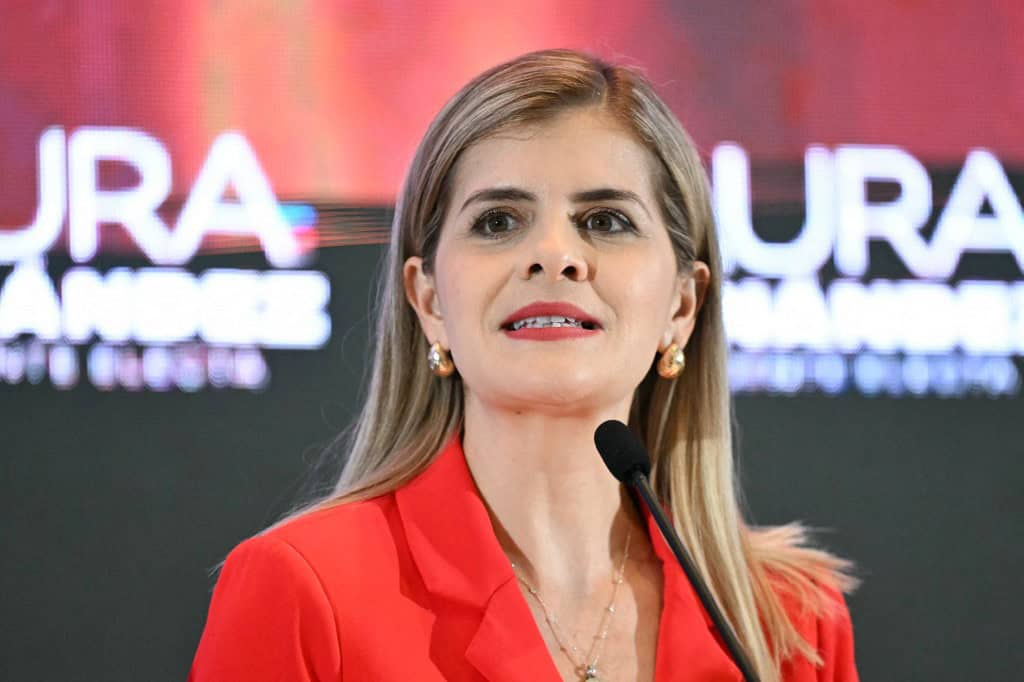
The president-elect of Costa Rica, the right-wing Laura Fernández, announced on Monday an ambitious plan to reform the state, which her critics say points to a concentration of power similar to that of Salvadoran President Nayib Bukele. With 48% of the vote, Fernández won Sunday’s election in the first round and managed to quadruple the number of governing-party lawmakers, which she says will allow her to lay the foundations of a new state.
“The mandate the sovereign people give me is clear. The change will be profound and irreversible,” said Fernández, who rode her campaign on a promise to apply a hard-line approach to resolve the security crisis in what for decades was considered one of the continent’s safest and most stable countries.
The former minister and her mentor, President Rodrigo Chaves, are at odds with the public powers and blame them for the country’s problems, including drug-trafficking violence. The opposition accuses the president of steering the country toward authoritarianism.
At a press conference on Monday, Fernández, who will take office on May 8, announced she will submit a package of constitutional reforms to improve accountability for justices and to address the role of the Constitutional Chamber, among other issues.
“If all institutions operate like a little clockwork, this country would be much better off,” said the 39-year-old political scientist. During the campaign, she proposed removing justices who fail in evaluations of their performance.
Right-wing populists
Her victory strengthens the right in Latin America after recent wins in Chile, Bolivia, Peru, and Honduras. This year there will also be presidential elections in Brazil and Colombia, which are currently governed by the left.
The opposition and analysts believe Fernández’s project aims to consolidate a hegemony similar to Bukele’s, who amassed absolute power and introduced indefinite re-election on the back of the success of his anti-gang war, which NGOs say led to serious human rights violations.
“Right-wing populists want to rule alone. The idea is a concentration of power in the president,” said Constantino Urcuyo, a former lawmaker and a PhD in political sociology from the University of Paris. With an absolute majority in Congress, 31 of 57 lawmakers according to vote projections, Fernández will be able to approve the budget and make sensitive appointments such as the comptroller.
But broader constitutional reforms would require a qualified majority and therefore negotiations with the opposition. If there is no consensus, Urcuyo explains, she could even push for a referendum to convene a constituent assembly to establish her so-called “Third Republic.”
Fernández hopes to replace the model of the country that emerged from the 1948 civil war, which abolished the army and laid the foundations of the welfare state for which Costa Rica is known.
Bukele as adviser
Costa Rica has become a logistics and export hub for drugs headed to the United States and Europe, after previously being a transit point. Under Chaves, the homicide rate reached a peak of 17 per 100,000 inhabitants. Fernández said on Monday she is counting on Bukele to “bring to a successful conclusion” her strategy against drug trafficking.
The president, who spoke with the former minister after her victory, has been advising Chaves on the construction of a prison inspired by his mega-prison for gang members. Bukele reiterated “his commitment” to keep “cooperating” so the country can build the prison project “and many others, where El Salvador is an example,” he said.
“We have to cut the connection of organized crime with the outside world,” so “that prison has to become a reality,” he stressed.
The US, the ally
Fernández also said she will deepen relations with the United States, Costa Rica’s main trading partner, regardless of the global tussle with China. “They are disputes that concern those countries. I will maintain diplomatic relations for the benefit of the people of Costa Rica with all countries,” she said.
In congratulating her, US Secretary of State Marco Rubio expressed confidence that bilateral cooperation will be strengthened on drug trafficking, cybersecurity, and migration. Chaves is a close ally of the United States and last year agreed to receive 200 deported migrants, most of them Asian, and barred Chinese companies from operating Costa Rica’s 5G network over alleged espionage risks.





