

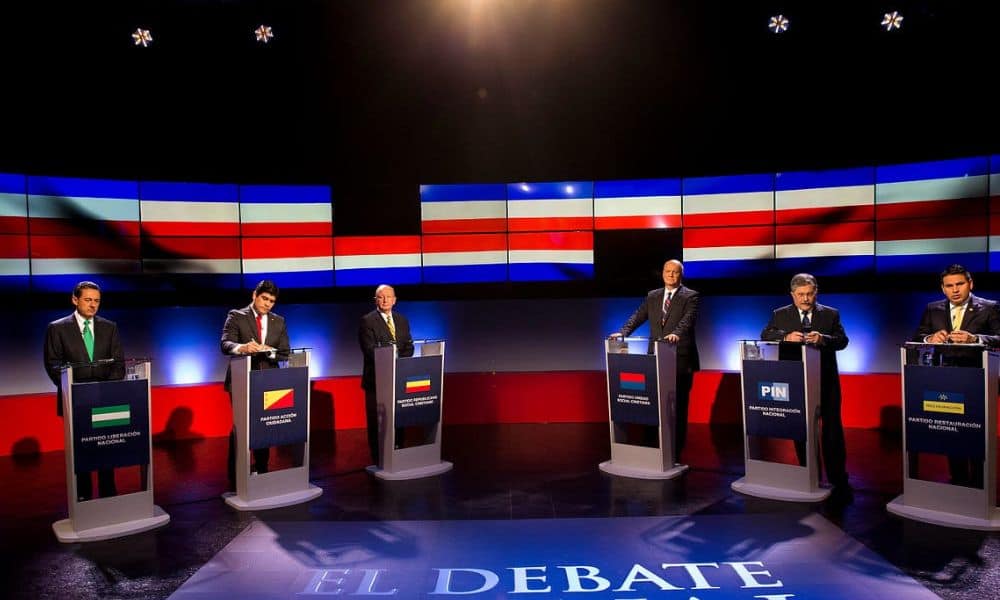
Five presidential candidates faced off in the final televised debate on Thursday night, laying out their visions for tackling Costa Rica’s pressing challenges in security, the economy, and public services. Hosted by Telenoticias on Teletica Canal 7, the event gave Álvaro Ramos of the Partido Liberación Nacional (PLN), Claudia Dobles of the Coalición Agenda Ciudadana (CAC), Ariel Robles of the Frente Amplio (FA), Juan Carlos Hidalgo of the Partido Unidad Social Cristiana (PUSC), and José Aguilar of Partido Avanza a last chance to sway voters before Sunday’s general elections.
The two-hour discussion, moderated by Ignacio Santos, director of Telenoticias, drew sharp lines between the candidates’ approaches. Security took center stage, as Costa Rica grapples with record homicide rates tied to drug trafficking. Ramos called for bolstering police forces and improving intelligence sharing with international partners to curb organized crime.
He stressed preventive measures, like youth programs in high-risk areas, to address root causes. Dobles echoed the need for community-based strategies but pushed for reforms in the judicial system to speed up prosecutions and reduce impunity.
Robles criticized what he sees as overly punitive policies, advocating instead for social investments to fight inequality, which he linked directly to rising violence. Hidalgo proposed stricter border controls and harsher penalties for drug-related offenses, drawing on models from neighboring countries. Aguilar emphasized scientific rigor in policy-making, questioning some current tactics and calling for evidence-based reforms to avoid unintended harm.
On the economy, candidates addressed high unemployment and inflation amid a post-pandemic recovery. Ramos highlighted his experience managing social security, promising tax incentives for small businesses and infrastructure projects to create jobs. Dobles focused on sustainable development, proposing green energy initiatives to attract foreign investment and boost exports.
Robles aimed at redistributive policies, including higher taxes on large corporations to fund public works. Hidalgo favored deregulation to spur private sector growth, while Aguilar stressed innovation and education reforms to build a skilled workforce.
Public services, including health and education, rounded out the exchanges. Dobles drew from her time as first lady under former President Carlos Alvarado, pledging to expand access to primary care and modernize hospitals. Ramos committed to increasing funding for public schools and vocational training. Robles called for free higher education to level the playing field. Hidalgo suggested public-private partnerships to improve efficiency in services, and Aguilar advocated for technology integration to streamline government operations.
The debate unfolded without the frontrunner, Laura Fernández of the Partido Pueblo Soberano (PPSO), who leads polls with around 44% support according to the latest University of Costa Rica survey. Fernández, former chief of staff to President Rodrigo Chaves, has campaigned on continuing his administration’s tough stance against crime, including potential states of emergency in affected zones. Her absence allowed the other candidates to critique the current government’s record, with Robles and Dobles accusing it of eroding democratic institutions.
Polls show Ramos and Dobles trailing in single digits, at about 9% each, followed by Robles at around 4%. With 20 candidates total, no one else polls above 5%. If no contender reaches 40% of valid votes, a runoff between the top two occurs on April 5. Undecided voters remain at 26%, leaving room for last-minute shifts.
The election will also fill 57 legislative seats, where fragmentation could complicate governance. President Chaves, barred from reelection, backs Fernández to extend his agenda, which has prioritized economic reforms and security crackdowns despite criticism over institutional tensions.
For voters, including over 50,000 expats eligible to cast ballots at consulates abroad, the debate clarified stances on issues shaping daily life. Expats in the U.S., Europe, and elsewhere can vote at designated sites, with the Supreme Electoral Tribunal ensuring access. Turnout among this group has historically been low, but rising concerns over security and economic stability may drive higher participation.
As Costa Ricans head to the polls, the choice boils down to continuity under Fernández or a shift toward the opposition’s varied proposals. Results will determine the path for addressing crime surges, economic pressures, and service gaps in a nation long known for stability.





