

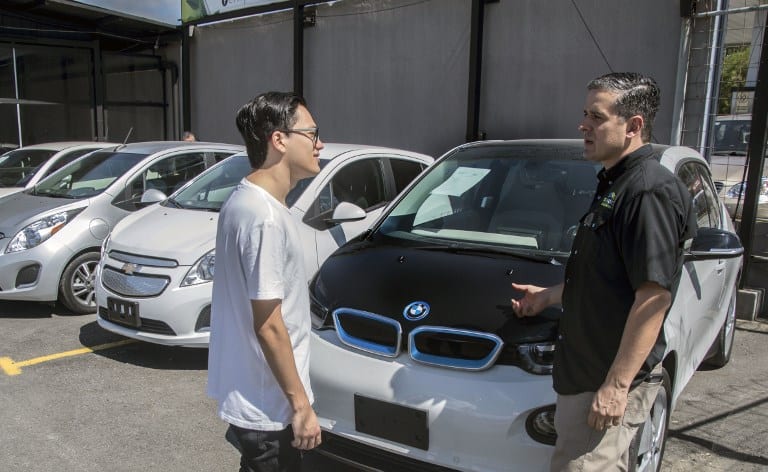
Costa Rica has experienced a boom in the purchase of electric vehicles. This comes as no surprise, given that the prices of electric cars in Costa Rica are practically the same as, or in some cases lower than, those of equivalent gas models.
This is mainly due to the tax exemptions established under the Electric Transportation Incentives and Promotion Act (Law 9518) of 2018, which introduced a series of incentives to promote this technology.
A subsequent reform in 2022 extended the benefits until 2034, enabling many people to purchase these vehicles. In fact, Costa Rica is the country with the most electric cars in Latin America.
However, the law established that these exemptions would begin to decrease in 2025. This year, the value-added tax (VAT) began to be levied at a rate of 3%, which will increase by one percentage point per year until reaching 100% in 2034.
A 25% selective consumption tax and customs duty also began to be applied, with the rate increasing by 25 percentage points every three years until it reaches 100% in 2034. Starting this year, electric vehicles pay 40% of the property tax on license plates, a charge from which they were previously exempt.
The Costa Rican Electric Mobility Association (ASOMOVE) revealed this week the results of a study conducted in 2025 showing that the prices of electric cars are close to, or even lower than, those of some combustion models.
The study compared several electric cars with similar conventional models currently sold in the country, using dealership prices. For the comparison, ASOMOVE took into account factors such as vehicle dimensions and the rotational force generated by the engine or battery to move the car.
The results show that, of the 13 comparisons, in 11 cases the electric model had a lower price than the combustion model. In two cases, the combustion vehicle was cheaper, though with only a small difference.
For example, the Chery iCAR 03 electric car was compared to the Suzuki Jimny; the latter is cheaper, but by only $400. In other comparisons, the differences reached several thousand dollars. The Riddara EV pickup truck sells for $3,000 less than its combustion counterpart, the Mitsubishi L200 Hi Power. In most cases, the differences range between $500 and $3,000.
ASOMOVE uses this data to debunk the myth that electric cars in Costa Rica are still more expensive than gasoline-powered cars.
“We did this exercise to inform people that the idea that electric vehicles are still more expensive at the time of purchase is no longer true, at least not in Costa Rica,” said Silvia Rojas, executive director of the association.
Costa Rica has had the highest market share of electric vehicles in the Americas for three consecutive years. The EV fleet in the country has grown by 2,200% in the last eight years, with 70% of all units coming from China.
One of the main challenges for further EV expansion in Costa Rica is modernizing infrastructure and promoting the installation of more charging stations to support long-distance travel.
According to ASOMOVE, while the growth of the electric vehicle fleet is advancing at a rapid pace, the development of fast-charging stations is progressing much more slowly. The association therefore believes it is necessary for electricity companies to prioritize this effort.





