
I have now spent roughly half my life in Costa Rica. In terms of physical and mental health, I will never regret my decision to leave everything behind and relocate here permanently. I feel great for my age (for those who are counting, I like to say that I reached the finish line—you know, when you fill out a form and it asks your age, and the choices are 18-24, 25-34, etc., up to 65+? That last choice is the finish line).
Like everybody else in my age group, my brain has been shrinking for decades, and no amount of ingesting all those things that are supposed to improve brain function—fatty fish, leafy greens, nuts, and seeds—can change that fact.Recently, I have noticed that my Spanish is slipping. When I arrived, I was an avid student: studying verb charts, listening to voices on the radio, watching the local news, reading the papers, and conversing at bus stops, in line at the bank, and at the local bar.
Comfortably fluent within a year and confidently working jobs that required solid Spanish, I felt I had mastered the language, though I still struggled occasionally with pronunciation and accented syllables. Spanish pronunciation is consistent, but a paragraph of written text has tildes and accent marks for both emphasis and verb tenses, all hovering over the words like a string of tripwires. I dance through the landmines, working to pronounce everything correctly as written, and even on my best days still sound like a total gringo when I speak.
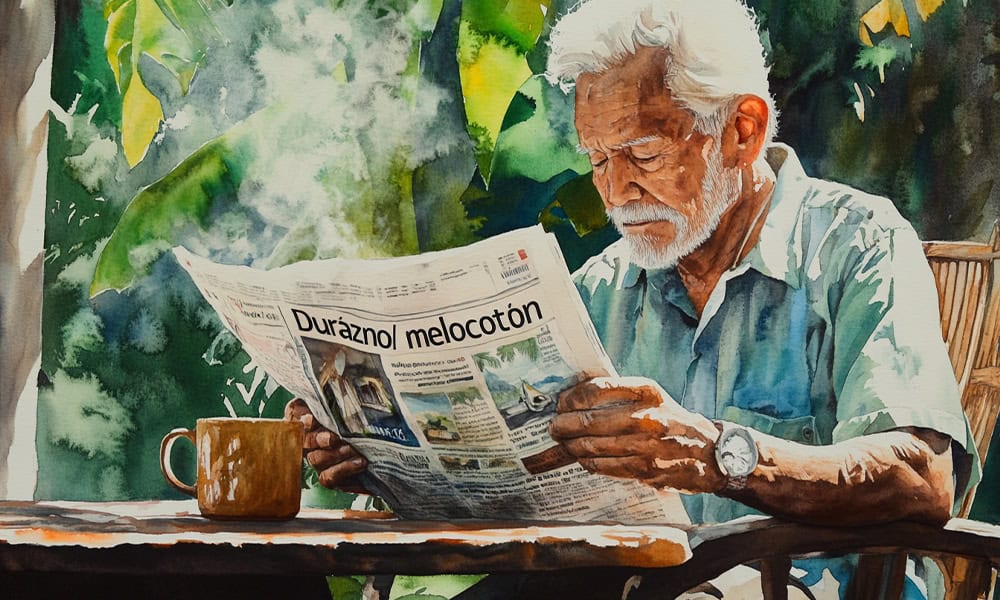
A year or two back, I was in a normal Spanish conversation when I could not come up with the word for peach. Worse yet, there are two words to choose from: melocotón or durazno. I drew a blank. All I could think of was that pera is the word for pear, which did me no good, as peacha is definitely not a word for anything. Both peach terms are back and ingrained in my memory, but other Spanish words have vanished along with my slowly extinguishing brain cells.
I now find myself describing things in roundabout ways because I forget the specific word. Recently, I blanked on estantería (shelving) and instead asked, “¿Cómo se llama la cosa pegada a la pared donde se mantienen vasos y platos?”—What do you call the thing on the wall where you keep glasses and plates? It would have been easier to pull out my phone, open DeepL, and type “shelves.” This happens more often than I’d like. Maybe I’ve gotten lazy; if an international webpage loads in Spanish, I usually check for an English option. I can read it in Spanish but will switch if possible.
Perhaps I’m overreacting. I live in a town where I can pass weeks without speaking a word of English. Maybe temporarily forgetting certain words is normal in any language. Maybe I should be satisfied with what I know and focus on maintaining the vocabulary I still have.
After all, I have reached the age “finish line.” Until next time—¿Cómo es que se dice aquí en Costa Rica? Ah yes… ¡Pura Vida!