

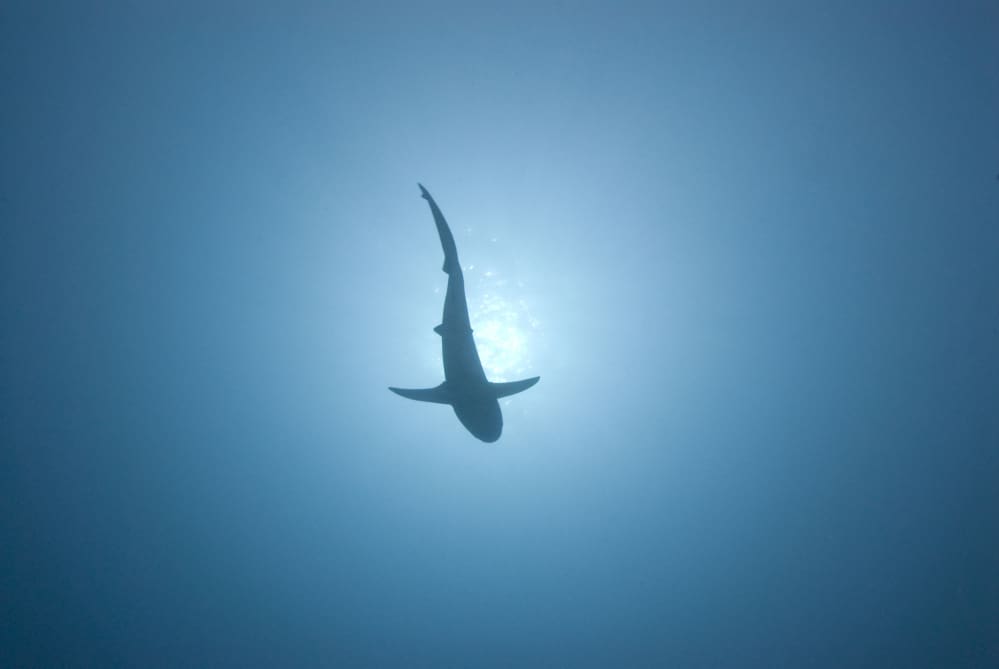
Costa Rica is home to 93 species of sharks and rays, representing 8% of the global diversity of these marine animals. However, over half of these species (56%) are endangered. Locally, they face challenges such as high fishing pressure, lack of information, illegal fishing, and limited resources for monitoring and control.
On Tuesday, December 3, 2024, LCI Veritas University, in collaboration with its BIOMOL Laboratory, hosted a scientific event to address shark conservation in Costa Rica. The event brought together leading experts, students, and the public, highlighting the urgent need to protect endangered shark species and safeguard marine biodiversity.
Mario Espinoza, a biologist and researcher at the Center for Marine Sciences and Limnology Research of the University of Costa Rica (CIMAR UCR), presented an updated overview of the threats facing sharks in the region. He underscored the importance of sharks in maintaining healthy marine ecosystems and the critical need for regional cooperation to conserve migratory species that transcend borders.
“It is essential to improve the conservation status of migratory species that transcend borders,” Espinoza emphasized, urging a shift from identifying problems to finding comprehensive solutions. He also stressed the importance of education, research, environmental awareness campaigns, and engaging decision-makers to influence policies effectively.
Mariana Elizondo Sancho, a researcher at BIOMOL Laboratory, presented her study: “Population Structure and Genetic Connectivity of Hammerhead Sharks (Sphyrna lewini) in Breeding Areas of the Eastern Tropical Pacific (ETP).”
Her findings reveal that hammerhead sharks have low genetic diversity, with pups in nursery areas more closely related than expected. This suggests that females may return to specific areas to reproduce, making the species more vulnerable to fishing activities.
Similarly, marine biologist Allison Centeno, a master’s student at Florida Atlantic University, analyzed shark landing data from longline fishing in the Pacific between 2015 and 2021. She discovered that silky sharks were the most commonly caught species, and over 50% of the landings involved bycatch—species not targeted by fisheries. These findings highlight the need for collaboration among government agencies, fishing communities, and conservation organizations to ensure sustainable fishing practices.
Juan Carlos Delgado, director of BIOMOL Laboratory, concluded the event with his research on “Identification of Species Composition from Shark Products in Costa Rica.” He demonstrated how molecular tools, such as DNA analysis, are revolutionizing marine research.
“In our project to identify species from shark products marketed in Costa Rica, we have been able to use DNA to determine the species we consume when buying products labeled as bolillo, dogfish, or simply shark,” Delgado Carazo explained.
The study revealed that 2.5% of fillets and chops sampled across the country were from hammerhead sharks, a species with special protection under a recent decree prohibiting its capture and commercialization. “Any incidental capture must be released and cannot be sold,” Delgado Carazo reminded attendees.





