
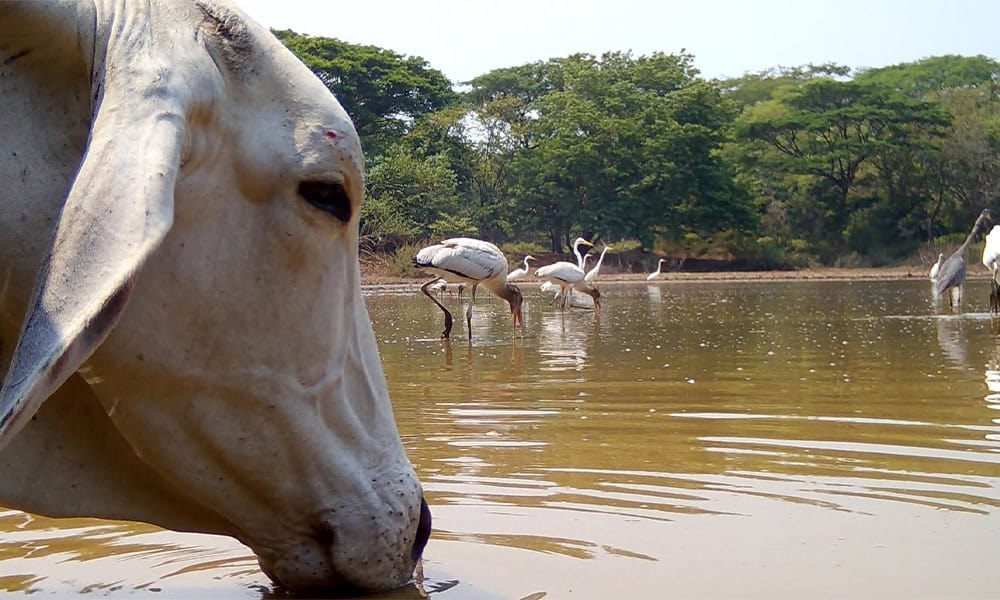
Unless the whole of your Costa Rica experience is confined to downtown San Jose, your travels in Costa Rica are going to involve Ticos of the bovine variety. Cows are an integral part of rural Costa Rican culture. They’re providers of meat and milk, they’re savings accounts on four legs, and their very presence is enough to stop traffic.
Let’s start off with every visitor’s first real experience with cows in Costa Rica. You’re driving down a road, it might be paved, it might not, and as you turn a corner you’re confronted with a two-lane-wide brigade of flappy-necked cattle. As you slow to a stop, the cows on your side of the street ever so slowly migrate to the other lane and you stare out of your window as the lumbering behemoths make their way by.
I venture to guess, in this day and age, it is nearly impossible for all of the occupants of the vehicle to stop themselves from rolling down their windows, shooting a quick video of the passing herd, adding an emoji or two, and posting that gem to social media. I really can’t blame them, after over a decade of living in Guanacaste, I still find a cow-blockade more charming than annoying.
After spending enough time in the country, you’ll start to recognize the different flavors of cow roadblocks based on who is in charge. The classic is a straight-up cowboy on a horse. You have to love that; it completes the picture perfectly. The modern-day version is the cowboy on a motorcycle, slowly putting along behind the herd with a long, thin stick to give the cows a poke, encouraging them to get out of the way of oncoming traffic.
My favorite, because I simply can’t figure out what’s going on, is the leaderless herd of cows. These cows are just making their way down the street, maybe with a dog in tow, but without any form of human involvement. Did they escape? Are they trusted to make their way from one pasture to another via a public street on their own? Who knows?
Through my work in the countryside doing wildlife monitoring projects, I’ve come into contact with many an old farmer who is the proud owner of cattle. I can’t claim to be an expert in raising cattle in Costa Rica, but here’s what I’ve gathered are the basics. You have as many cows as your land can support.
I assumed there was a lot of cow feed being passed out, but that’s not the case. Farmers figure out how many cows per hectare their farms can feed, and that’s how many cows they have. I’ve also learned that there’s money in cows. The main way to convert your cows to dollars is either to have your cows make more baby cows or buy baby cows at auction, fatten up the babies, and then sell them at auction when they’re much bigger.
I’ve had many personal interactions with cows while reviewing camera traps in the field. Many times the properties that I work on allow cattle to enter the forest. Sometimes these cows couldn’t care less about my presence in their domain, sometimes they’re so upset that I’m there that they sprint away from me in a branch-snapping cow stampede.
Once, I climbed a tree to place a camera trap in the branches and while I was up there an enormous bull took up residence next to my backpack below the branch. Due to his terrifying proportions, I was forced to sit in the tree and wait for him to eventually waddle off.
Since cows often share the environment with the wildlife that I’m interested in recording, I often come away with a large number of cows-hanging-out videos. Most of the time I delete them, but every once in a while, there’s one worth keeping. I’ll include a few of those clips in the video below.
About the Author
Vincent Losasso, founder of Guanacaste Wildlife Monitoring, is a biologist who works with camera traps throughout Costa Rica. Learn more about his projects on facebook or instagram. You can also email him at: vincent@guanacastewildlifemonitoring.com