

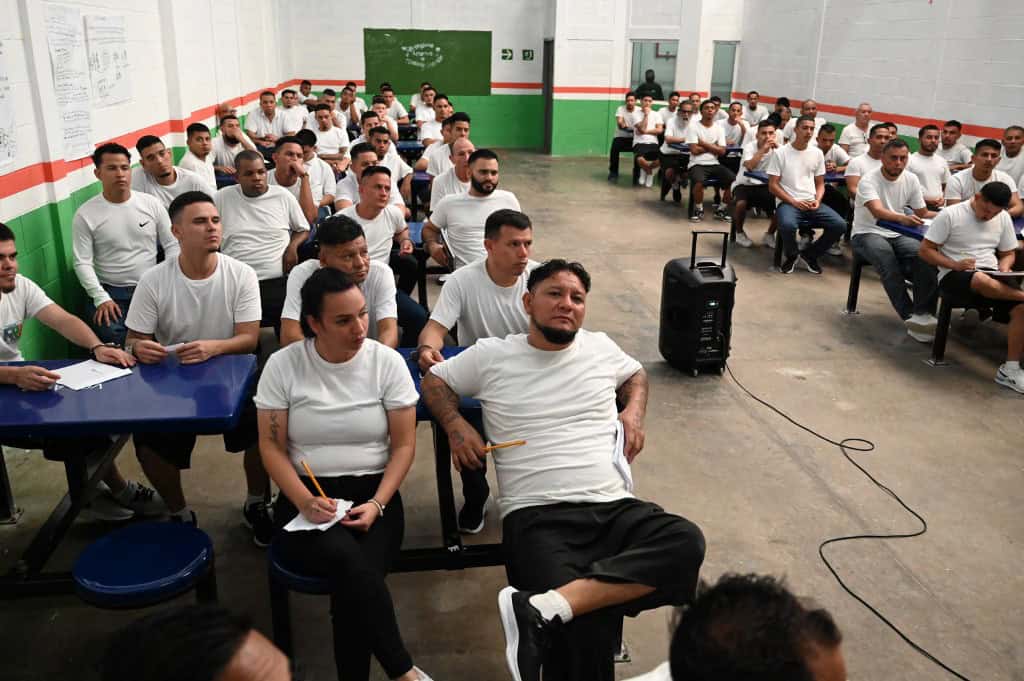
Fights between inmates from different gangs were common at La Tolva prison in Honduras. Now that the government has acted and managed to establish some peace, some prisoners are starting to request job opportunities to “reintegrate into society.” In this maximum-security prison in Morocelí, 50 km east of Tegucigalpa, 1,755 members of the Mara Salvatrucha (MS-13), one of Honduras’ two major gangs, are being held, guarded by 200 soldiers and guards.
“We want to make a direct request to the state, the private sector, and the public sector: we, as prisoners, want an opportunity—an opportunity for employment, for social reintegration,” says Ramiro Oliva, who prefers to use a pseudonym. Peace came to this prison last year after the rival gang, Barrio 18, was transferred to the El Pozo maximum-security prison in Ilama, 200 km northwest of the capital.
Before that, since the prison opened in 2017, several clashes had resulted in 24 deaths, according to the National Human Rights Commissioner.
Celebration Week
To mark the “Week of the Incarcerated,” authorities allowed a team to visit the prison, which consists of gray concrete block buildings surrounded by fences and barbed wire, set on a plain enclosed by hills covered in brush. Each of the eight units at La Tolva houses up to 200 inmates, while the women’s unit holds only 69 inmates.
On a small outdoor soccer field, seven male inmates and one female, who lead the units, greeted the journalists with a handshake. They were impeccably groomed, with trimmed hair, wearing white t-shirts, black or navy pants, and branded sneakers.
These leaders shared a common message: they want job opportunities to reintegrate into society, stating that they desire peaceful lives for their children. For years, gangs have ruled Honduras through bloodshed and violence. To contain them, a state of emergency was declared in December 2022, allowing arrests without a warrant.
Last year, the country recorded 34.5 homicides per 100,000 inhabitants, a slight decrease from 44.7 in 2019 and far from the record 86.5 reached in 2011, according to the National University’s Observatory of Violence.
Direct Request
“Many people today are graduates, from universities and colleges, with clean records, applying for jobs in both public and private companies, but they can’t find work,” says Oliva. The situation is worse for “people like us with tarnished criminal records,” he laments, assuring that the inmates have no ties with the gang members who remain free.
The prison’s director, Lieutenant Colonel Karllthers Medina, explains that La Tolva has a program called the “Three Rs”: rehabilitation, reeducation, and reintegration. It was launched after President Xiomara Castro last year ordered the Military Police of Public Order (PMOP) to impose discipline in the country’s 25 prisons.
With the Three Rs, the goal is for inmates to “learn trades, so that when they are released, they can engage in something to support themselves,” Medina says. The president made the decision after members of the Barrio 18 gang killed and burned 46 MS-13 inmates in their cells at the women’s penitentiary in Támara, 25 km north of Tegucigalpa.
As part of the Three Rs program, nine male and female inmates, dressed in wide orange pants, t-shirts, and cream-colored vests, delivered 16 chairs to a nearby school.
Work, Education, Soccer
Inside the prison, around twenty inmates work on making concrete blocks, which are donated to local schools. Meanwhile, about fifty inmates attend a session on “morality and ethics” in a classroom. As part of the festivities, on the soccer field, a sky-blue team plays against a red and white team in a rough match, but without complaints to the referee. From the stands, the prisoners cheer enthusiastically at the goals.
With the Three Rs, the goal is for inmates to “learn trades, so that when they are released, they can engage in something to support themselves,” Medina explains.





