
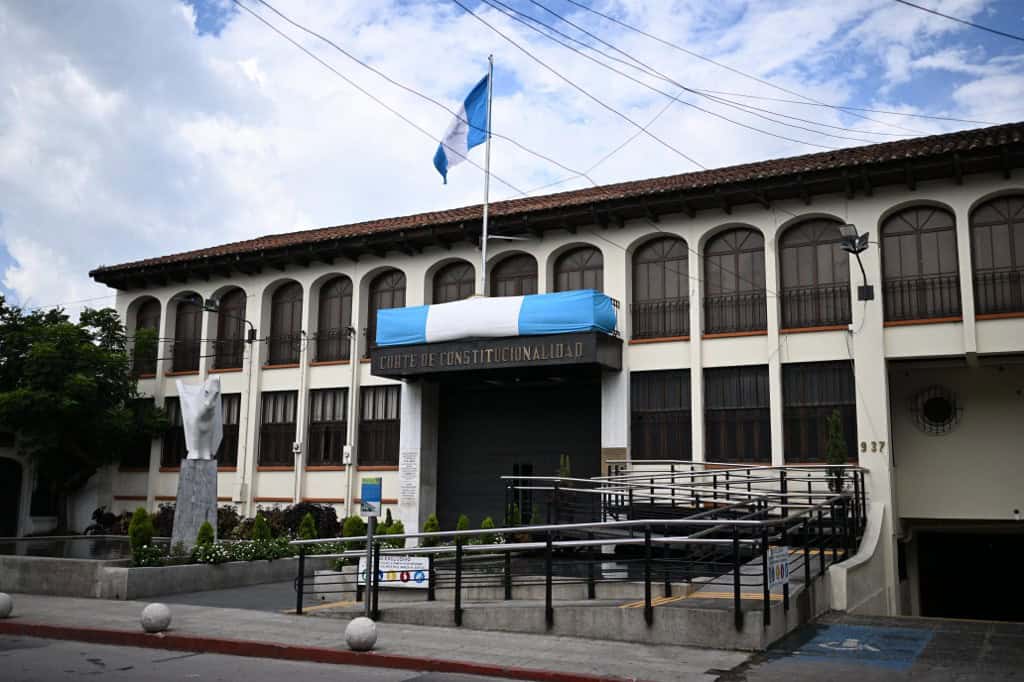
The Guatemalan Congress will elect the new Supreme Court justices starting next week, in a crucial process for the fight against corruption in a country whose judicial system is “held hostage by mafias,” according to President Bernardo Arévalo. Alarms have been raised due to allegations of interference by the so-called “Pact of Corrupts,” a supposed network of politicians, prosecutors, judges, and powerful businessmen who, from the shadows, have pulled the strings of power in the country for years.
Here are five key points about this important process:
1. Deteriorated System
The new 13 members of the Supreme Court and over 300 appellate court judges for the 2024-2029 term must be chosen by the parliament before October 13. “This election is about democracy in Guatemala because it’s about judicial independence,” says Mexican lawyer Ana Delgadillo, a member of an international panel of experts monitoring the process.
The judicial system “has deteriorated to the point that it now serves politicians involved in criminal and corruption networks,” said Carmen Aída Ibarra, director of the NGO ProJusticia. Guatemala ranks 30th in Transparency International’s corruption index out of 180 countries.
According to Arévalo and various NGOs, the most visible face of the “Pact of Corrupts” is Attorney General Consuelo Porras, sanctioned by the United States and the European Union.
2. Challenge to Arévalo
The election takes place amid efforts by the Attorney General’s office to remove Arévalo from power. Several actions by Attorney General Porras against the social-democratic president have been backed by the outgoing Supreme Court. Juan Pablo Muñoz, coordinator of the collective Alianza por las Reformas, points out that the “Pact of Corrupts” seeks to “regain that source of wealth, of phantom jobs, of anomalous contracts.”
“For the government, it would be a stabilizing factor if the Supreme Court of Justice includes individuals who do not support Porras’ coup-like tactics,” says Ibarra.
3. International Monitoring
The deterioration of the judicial system worsened under the right-wing governments of Jimmy Morales (2016-2020) and Alejandro Giammattei (2020-2024), according to Ibarra. The international community is closely watching this process, but observers believe that the “de facto powers” will fight to maintain their influence over the judiciary.
“What we are seeing is a struggle by these de facto powers. They lost the Executive, but they don’t want to lose the Judiciary,” said former Chilean foreign minister Antonia Urrejola, who is also part of the international expert panel.
In a preliminary report released last week, the panel expressed “concern” over signs of “parallel negotiations by corrupt economic-political actors” to favor candidates linked to them. Eleven international NGOs promoting transparency called on Friday for the selection of “ethical, capable, and independent” individuals for the courts.
4. Questionable Candidates
Among the candidates are officials sanctioned for “corruption” by Washington and the European Union, such as prosecutor Rafael Curruchiche, who has pursued cases against Arévalo and critics of Giammattei. Additionally, 12 of the 13 current Supreme Court justices, who have consistently ruled in favor of Porras, are seeking reelection.
Porras’ husband, Gilberto Porres, is also running for the appellate courts. “The fact that candidates sanctioned internationally for their undemocratic and corrupt actions are applying for high judicial positions seems inconceivable,” Urrejola said.
Ibarra believes that Porras’ goal is to “colonize” the judiciary to “consolidate” her persecution of enemies and favor “corruption-accused officials from past governments.” Arévalo has called for the election of professionals committed to justice to prevent the judiciary from continuing to be captured “by corrupt interests.”
“It is shocking that candidates with serious corruption accusations, internationally accused of undermining democracy, continue in the process,” added the foreign NGOs.
5. Previous Election Stalled
Congress, dominated by the opposition, must select the new justices from lists of candidates prepared by a commission of academics, judges, and lawyers. Around 20 activists demonstrated this Friday at the university where the commission is meeting, demanding that Curruchiche and other questioned candidates be excluded from the list.
Arévalo’s Semilla party has suffered setbacks in Congress but has recently managed to reach consensus with opposition forces on some issues, including the budget. The previous magistrate election stalled in 2019 after it was revealed that an influential political operator had manipulated the lists of candidates.
As a result, the Supreme Court functioned for four years, until November 2023, with justices whose terms had expired.