
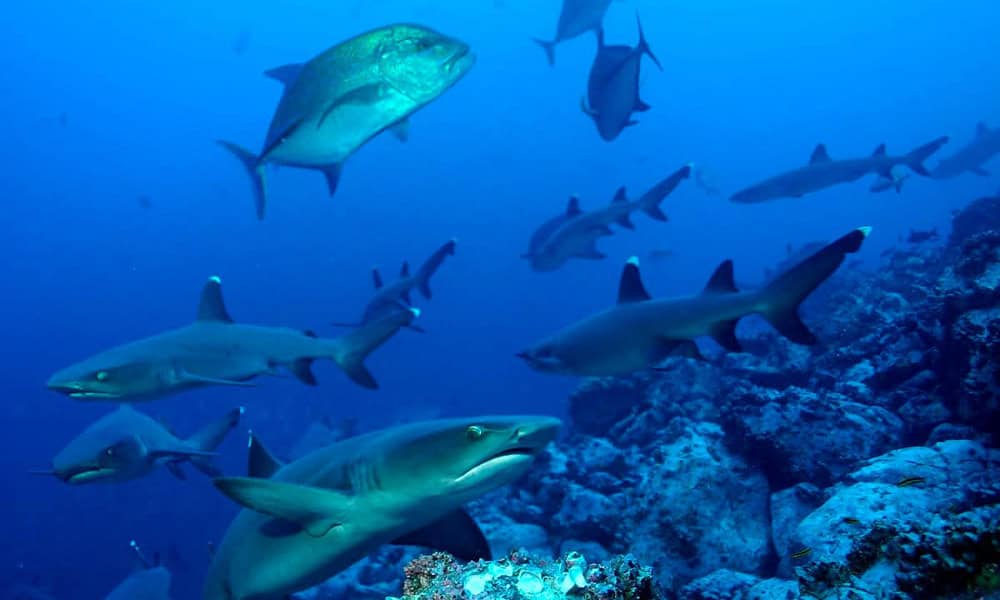
According to experts from the University of Costa Rica (UCR), sharks and rays in Cocos Island National Park could be seriously affected by climate change. Changes in temperatures and weather patterns will influence these marine species. This was revealed in a recent study conducted by the Center for Research in Marine Sciences and Limnology (CIMAR-UCR).
“Due to global warming, the temperature of the ocean surface has increased, forcing rays and sharks to migrate to deeper waters. But there is a limit to how deep these species can dive, because the deeper they go, the less oxygen there is, and rays and sharks require a certain amount of oxygen to survive,” CIMAR explains.
Specialists also point out that global warming is causing a decrease in oxygen in the oceans, which makes the strip of water where rays and sharks can live increasingly narrower. This strip is located between what is known as the minimum oxygen layer and the surface waters warmed by climate change.
“It is very likely that this same phenomenon is occurring in other areas of the Pacific Ocean, affecting other marine species,” said Mario Espinoza, lead researcher.
Regarding the number of specimens of some species, Dr. Espinoza explained that the study found a decrease in the presence of silky sharks. He confirmed this is one of the most important species in Costa Rica’s fishery landings.
Co-author of the study, Dr. Tayler Clarke, warned that these results have serious implications for the conservation of sharks and rays.
“By occupying a smaller space in the water column, their capture is facilitated, and without proper fisheries management, their vulnerability to overexploitation increases,” she stressed.
According to the expert, several measures could be taken to avoid overfishing. These include the expansion of existing marine protected areas, the creation of new protected areas, implementing measures that impose greater limits and control over the fishery, and delimiting the areas, times, and depths where fishing can take place.
The study in Cocos Island indicates that this situation could happen in other areas of the Pacific and the world. This is very worrying because it indicated that climate change could increase their vulnerability.
To conduct this crucial study, CIMAR’s scientific staff monitored the behavior of the animals for 10 years, from 2010 to 2019. These dives allowed the collection of a large amount of data and information, which was then analyzed by CIMAR’s scientific team.