
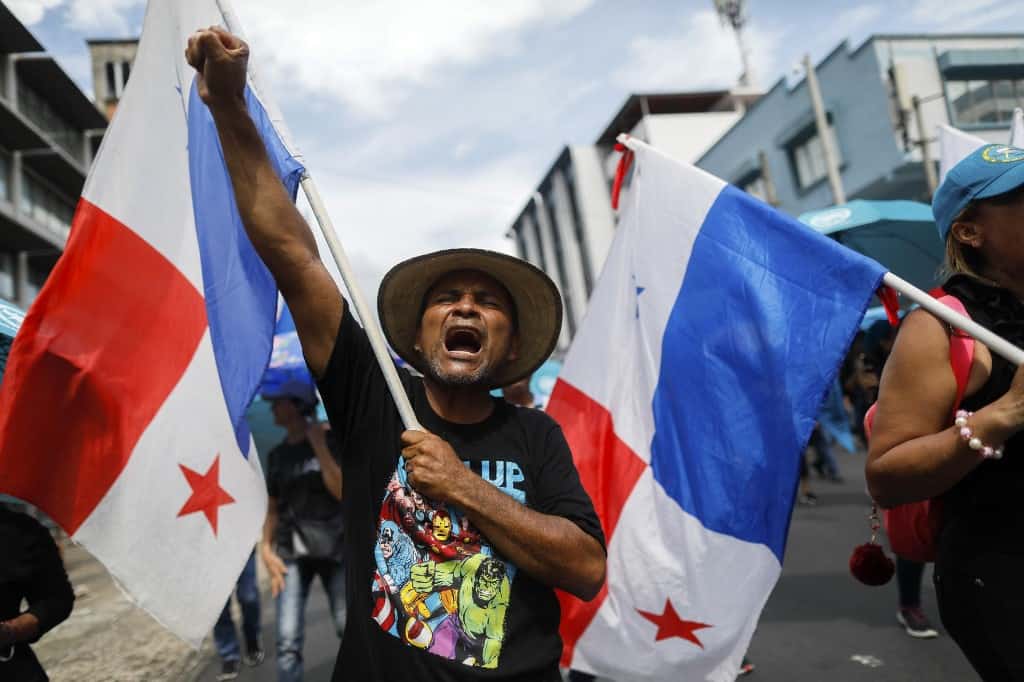
The Panama police announced Thursday that they will use all the “necessary force” to clear blocked routes and restore order, after almost three weeks of protests against a mine that have semi-paralyzed the country.
“We are going to use the necessary force so that the roads are opened, and the well-being of all citizens is achieved,” Commissioner Elmer Caballero told journalists, while roadblocks are causing food, medicine and fuel shortages in several cities.
“We are going to act energetically in order to be able to restore the order that Panama needs,” added Caballero, hours after the business leaders asked President Laurentino Cortizo for a “firm and forceful stance” to end the blockades, which began on October 20.
Panama is completing three weeks of protests this Friday after Congress approved a controversial contract between the State and the Canadian company First Quantum Minerals (FQM), which operates the largest copper mine in Central America in the Panamanian Caribbean.
On Tuesday, an enraged man shot at a blockade on the outskirts of the capital and killed two protesters. Both were teachers.
A vigil march took place Thursday to demand “justice,” while the man accused of shooting the two teachers remains detained. He is a 77-year-old Panamanian lawyer who was born in the former Panama Canal Zone, so he has dual Panamanian and American nationality.
The commissioner made the announcement after protest leaders went to the presidential house and delivered a petition with their demands, according to the Presidency. Their main demand is to repeal the contract with the mining company by law.
Caballero said Thursday that the police lifted the first blockades on the route leading to Merca Panama, the market where 80% of the vegetables in the capital are marketed, and Balboa Avenue, the coastal avenue that crosses the city, where there are daily demonstrations.
Business Demand
Earlier, Cortizo met with business leaders, who demanded “a firm and forceful stance in favor of respect for legality” so that the blockades that have paralyzed passenger and freight transport end. The president has been criticized for his inaction to clear the roads.
“The unsustainable situation of Panamanian companies in the face of street and road closures and blockades was also exposed to President Cortizo,” said the National Council of Private Enterprise (Conep) in a statement.
“Radical groups with political interests have the rest of us Panamanians ‘kidnapped,'” businessmen say.
The blockades have caused food shortages in the capital, as trucks with cargo from the agricultural province of Chiriquí, bordering Costa Rica, which produces 80% of the vegetables consumed in the country, do not arrive.
Thousands of medical appointments lost
Classes are suspended in much of the schools and more than 160,000 medical appointments have also been lost in public health centers, according to health authorities.
To silence the protests, Congress approved a moratorium on metallic mining last Friday, but decided to leave the final decision on the contract in the hands of the Supreme Court of Justice, satisfying environmentalists.
However, the construction union and teachers’ unions continued the protests and blockades to demand that the contract be immediately annulled and replaced by the 1997 concession agreement, which was given without bidding and under unfavorable conditions for the country.
The government and the company argue that the new contract provides minimum annual contributions to the State of $375 million, ten times more than the amount of the initial agreement, and that the mine generates some 50,000 direct and indirect jobs and contributes 5% of GDP.