
Mariela completed her elementary school studies at the Carrillos Alto de Poás School in Alajuela and high school at the Colegio Científico in San Ramón. She obtained a bachelor’s degree in Mechanical Engineering from the University of Costa Rica (UCR) and a master’s degree in Space Engineering from the Technological Institute of Japan. Upon returning to Costa Rica she worked as a lecturer at the UCR and as coordinator of the Aerospace Engineering Group at the School of Mechanical Engineering.
Mariela then had the opportunity to complete an internship at NASA’s Ames Research Center under the supervision of fellow Costa Rican engineer Andres Mora. During this internship she helped deliver the Astrobee program, NASA’s free-flying robotic system aboard the International Space Station.
Mariela currently works for the Japanese company Daikin. For the pioneering work she carried out that put Costa Rica’s first satellite into orbit in 2018, she was selected as Outstanding Person of the San Pedro de Poás canton. In 2019 the graduation ceremony of the National System of Science High Schools of Costa Rica was dedicated to Mariela.
When and how did you realize that you wanted to study Mechanical and Space Engineering?
I remember when I was six years old I saw Franklin Chang-Díaz on the news and told my parents that I wanted to be an astronaut. I think hearing these words from such a small girl must have been very shocking. They told me that I could achieve what I wanted but that I had to work hard. Franklin Chang-Díaz was very inspiring during my childhood. He has been a great personality and a great example for the Costa Rican people.
I chose my career when I was in my last year of high school. Although I already knew before that I wanted to study engineering. From a young age mechanical systems caught my attention. And of course Franklin Chang-Díaz inspired me with his story and his work as a scientist and researcher at NASA.
I wanted to study Mechanical Engineering because it seemed to be a very broad career that would allow me to develop in different fields of engineering, such as fluid mechanics, materials analysis, and especially the design of elements and structures used in Space Engineering.
Physics and mathematics always caught my attention, and when I did an analysis of the study program I realized that it was an engineering field that combined the theoretical part of physics with the practical part of engineering.
What did you have to sacrifice to achieve your professional goals?
When I went to live in Japan, Mexico and the United States, spending time with family and friends was what I sacrificed the most. During high school and university, I had to sacrifice a lot of family time to devote to my studies, even when I was in Costa Rica. Similarly, the time for sports was also reduced.
What values should be promoted to young people?
Perseverance, respect for others, respect for life.
What have been the high and low points of your career?
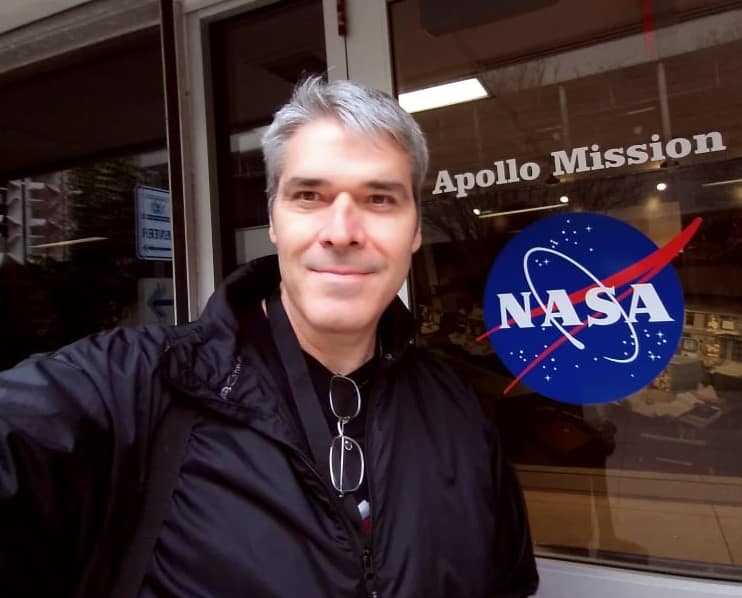
I think the best moments cannot be summed up in one, but without a doubt some of the best have been the day of my graduation in Japan and the day I entered NASA for the first time.
I remember seeing a replica of the shuttle at the entrance and thinking, “Oh my God, where am I?!” Among the worst moments, I can remember a few months in Japan, when I felt extremely lonely and wondered if it was worth making so much sacrifice.
What do you consider to have been the main achievements of your professional career?
Working at NASA has been one of my main accomplishments, and being part of the team of engineers that brought Astrobee to life fills me with pride. During my time at the UCR as a lecturer, the Aerospace group grew and motivated many students with the work that was done.
It included several students that won the Mission Idea Contest in Latin America, which empowered us to participate in the competition worldwide. Working on the vibration analysis and the mechanical structure of the first Costa Rican satellite was also very important to me. Likewise, living in Japan and developing my master’s degree there was without a doubt the best thing I could have done.
What are your hobbies and aspirations?
I like to play sports such as soccer and volleyball and to go to the gym. I love music and playing guitar. I dream of helping my family and I hope that Costa Rican talent will be supported here in the country and that platforms will be developed to promote research and development, especially in the field of space engineering.
What recommendations would you give young people who want to pursue a career like yours?
That they should work hard, that they do not allow themselves to be influenced by what people say about it, and to seek constant improvement and perfection.
Are the contributions of women in the fields of science and technology different from that of men?
Contributions in the field of engineering are equally valuable regardless of whether they were given by a woman or by a man. I think that beyond gender, all people are unique and their contributions are unique.
What do you think are the main challenges facing humanity today?
Respect for different opinions, without neglecting common sense. The conservation of the environment and the adequate distribution of economic resources in the world.
What initiatives would you recommend to encourage female participation in science and technology?
Attending motivational talks of exemplary people from similar backgrounds to learn how they did it. Their realities and achievements need to be more widely disseminated so that other girls can learn how to face their own challenges and how to achieve dreams.
You can learn more about Mariela in the book The Intrepids in Science and Technology published by Editorial Tecnologica de Costa Rica