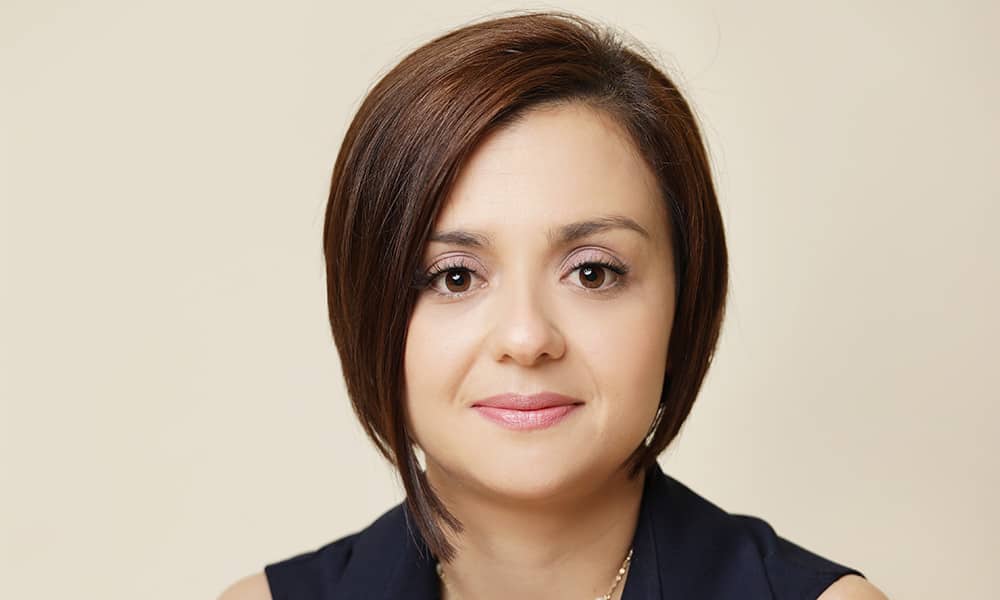
Originally from Turrialba, Adriana Nanne García obtained her bachelor’s degree in Electromedical Engineering from the Universidad Latina de Costa Rica and a master’s degree in Operations Management from ULACIT. She currently works as Quality Manager in the Research and Development Department at Boston Scientific.
Before coming to Boston Scientific, she worked as a Product Specialist in Sterilization and Infection Control at Meditek Services and as a Technical Service coordinator at Eurociencia. The newspaper El Financiero included her in their Most Distinguished 40 people under the age of 40 list.
What motivates you the most about your work?
I am a person of action, I like to make things happen. Working in research and development was one of my dreams when I studied. That is why working in this area is not only a challenge, but a dream come true. The constant growth of the company and the technical challenges have made us increasingly assign projects that entail greater responsibility and visibility.
I work in something I like and with the people I love. I am passionate about spending time on my own professional development plan as well as doing coaching and mentoring. I work with a group of extremely valuable people from whom I learn every day. Together we have marked a before and after in the research and development of Minimally Invasive Medical Devices, within a company that has given me the opportunity to make contributions.
What did you have to sacrifice to achieve your professional goals?
I left my house in Turrialba and came to a place full of concrete, cars and traffic jams. I really miss the stillness of that house. Life teaches us lessons and I have not escaped them. I had my son while I was still in high school which taught me how to handle multiple priorities, how to best distribute time, and how to manage a lot of responsibility.
Right after graduation I found a job and I have been able to continue growing thanks to an important support network composed of my university colleagues and my family members, and especially I have had a wonderful life partner, my husband, who has always supported me.
Who are your role models in the world of science and technology?
Costa Rican scientist Clodomiro Picado Twight is one. He is a role model because of his research skills and for his contributions that demonstrated that we Costa Ricans are a world power and we can achieve great things. Alan Turing, a British mathematician and computer scientist is another, for his ability to see beyond, as well as for his bravery and courage.
I also admire several scientists like Marie Curie, Katherine Johnson, Maria Telkes, Cecilia Payne-Gaposchkin, and Sau Lan Wu, who made their way in worlds traditionally led by men.
When and how did you realize that you wanted to study Electromedical Engineering?
When I graduated from high school I wasn’t sure which career I wanted to study. However, I always knew that science appealed to me. So my mom took me to San Jose to do a vocational test. As it turned out I had an affinity for science and I decided on a relatively new career which combined engineering and medicine.
Which memory do you treasure the most and why?
I see all the moments, good or bad, as part of my journey. I really wanted to be hired in the medical device manufacturing industry, so I studied hard for that first interview. And then when I applied in-house for the Quality in Research and Development position and got it, it was very exciting. Additionally, the collaboration with the Academy, which came as a result of my work in the medical industry.
The first people who worked in research and development knew that the ecosystem was not ready to promote the growth of this type of work. That is why we took it in our hands to create spaces and collaboration between different entities. It gives me satisfaction making contributions to develop the medical industry.
What have been the main achievements of your professional career so far and what are your aspirations for the future?
In 2012, when Boston Scientific opened the Research and Development Department in Costa Rica I was the first woman they hired. The first people who started working there felt a great responsibility because we knew that there were high expectations. Depending on the results we achieved they would continue trusting us.
Thanks to our good performance the department began to grow and the complexity of the tasks it carried out increased. It currently has more than 150 people who support multiple areas of the company, with direct responsibility for the design of the devices. There are strong plans for growth.
Costa Rica must include research and development activities in its medical device manufacturing operations that provide added value to the sector. We are recognized for our talent. We need these types of opportunities to trigger knowledge and experience as well as to provide more people with job opportunities in which their knowledge will be expanded.
What practical recommendations would you give to young people interested in pursuing a career like yours?
Find what you want. I didn’t know what I wanted to study until I took a test. You don’t always have to be so clear. Contrary to what many people think, you don’t have to be outstanding in mathematics or science to choose a career like biomedical engineering. If you study what you really want, then your work will be the best place to develop and contribute to the development of other people.
Do you think that the contributions of women to science and technology are different from that of men?
We contribute in the same way. We are different and we have the ability to complement each other. While we have exemplary women in these fields men have also made exceptional contributions. Regardless of gender, people in science have worked passionately for the purpose of achieving goals for the common good.
What initiatives, public or private, would you recommend to encourage female participation in science and technology?
We must have the appropriate academic preparation and work spaces for women to have more participation in the areas of science and technology. Costa Rica should have attractive incentives for companies that invest in these fields. It is necessary to have greater opportunities from our early stages of education and more contact with these areas, and to find non-traditional forms of learning.
Academic opportunities must be adapted to create increasingly specialized talent, so more companies focus on Costa Rica. We also need to make more investment in laboratories with new technologies that would increase our testing capacity (control or test processes), without the need to use services in other countries. Also we need to change the Biomedical Research Law 9234, which currently obstructs the practice of clinical research in Costa Rica.
This would allow us to continue with the next step, clinical research on medical devices and will provide more development opportunities for female scientists. We need to increase the participation of women in leadership positions, at least in relation to the percentage of women graduating in science and technology careers.
Also matching wages compared to the male population so there will be an opportunity to work under the same conditions and with the same opportunities for growth.
More information about Adriana can be found in the book The Intrepids in Science and Technology published by Editorial Tecnologio.