

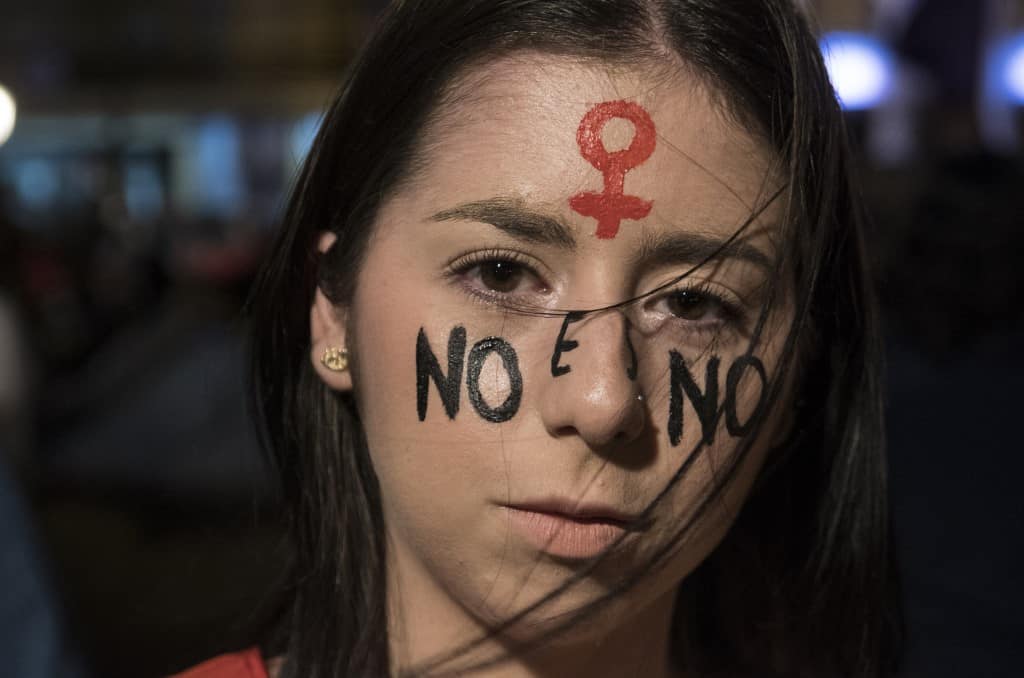
Hundreds of women marched Monday in different countries through Central America, the region that exhibits the highest rates of femicides, to demand a stop to the violence they suffer and that cases not go unpunished.
“We want each other alive,” “We demand a life free of violence,” and “Caresses, not blows,” were some of the slogans written on posters carried by women who gathered in downtown San Salvador.
“Women are victims of violence in all areas, and it is necessary that the whole country get involved to stop violence against girls and women,” said Violeta Artiga, a psychology student who marched in San Salvador with a purple scarf around her neck — a symbol of the movement.
The Economic Commission for Latin America and the Caribbean (ECLAC) placed El Salvador as the most violent in the region against women after it registered in 2018 the highest rate of femicides — 6.8 per 100,000 women, according to figures released Monday.
The executive secretary of the ECLAC, Alicia Bárcena, said that the murder of women for gender reasons “is the extreme end of the continuum of violence experienced by women in the region.”
The agency noted that the five highest rates of feminicide in Latin America were recorded in El Salvador (6.8 per 100,000 women), Honduras (5.1), Bolivia (2.3), Guatemala (2.0) and the Dominican Republic (1.9).
Another report revealed Monday by the Feminist Network Against Violence in El Salvador details that there has been a reduction in cases of violent deaths of women while cases of sexual violence have increased.
That document says that in 2017 there were 469 violent deaths of women, 386 in 2018, and 192 between January and September of this year in the country of about 6.3 million inhabitants.
Regarding cases of sexual violence: in 2017 there were 6,108, in 2018 that figure rose to 6,142, while in the period from January to June 2019, 2,131 cases were counted, the report said.
‘Vivas nos queremos’
On the International Day for the Elimination of Violence Against Women, another march of Salvadoran women left a square in the western sector of San Salvador and headed toward streets near the Presidential House to demand authorities enact measures to reduce gender violence.
But they could not reach the presidency because a contingent of riot police had blocked the access roads with barbed wire fences.
In the Costa Rican capital, San José, hundreds of women marked the back of a blanket with the phrase, “vivas nos queremos” (“We want each other alive”).
Figures from the National Women’s Institute of Costa Rica indicate that the country, with about 5 million inhabitants, registered 26 femicides last year. So far this year there have been 11 cases.
In the Honduran capital, women’s groups also denounced the impunity in which 95% of the more than 6,000 murders of women registered since 2003 remain.
Meanwhile, in Guatemala a vigil was held on Sunday night with portraits of women killed this year.





