

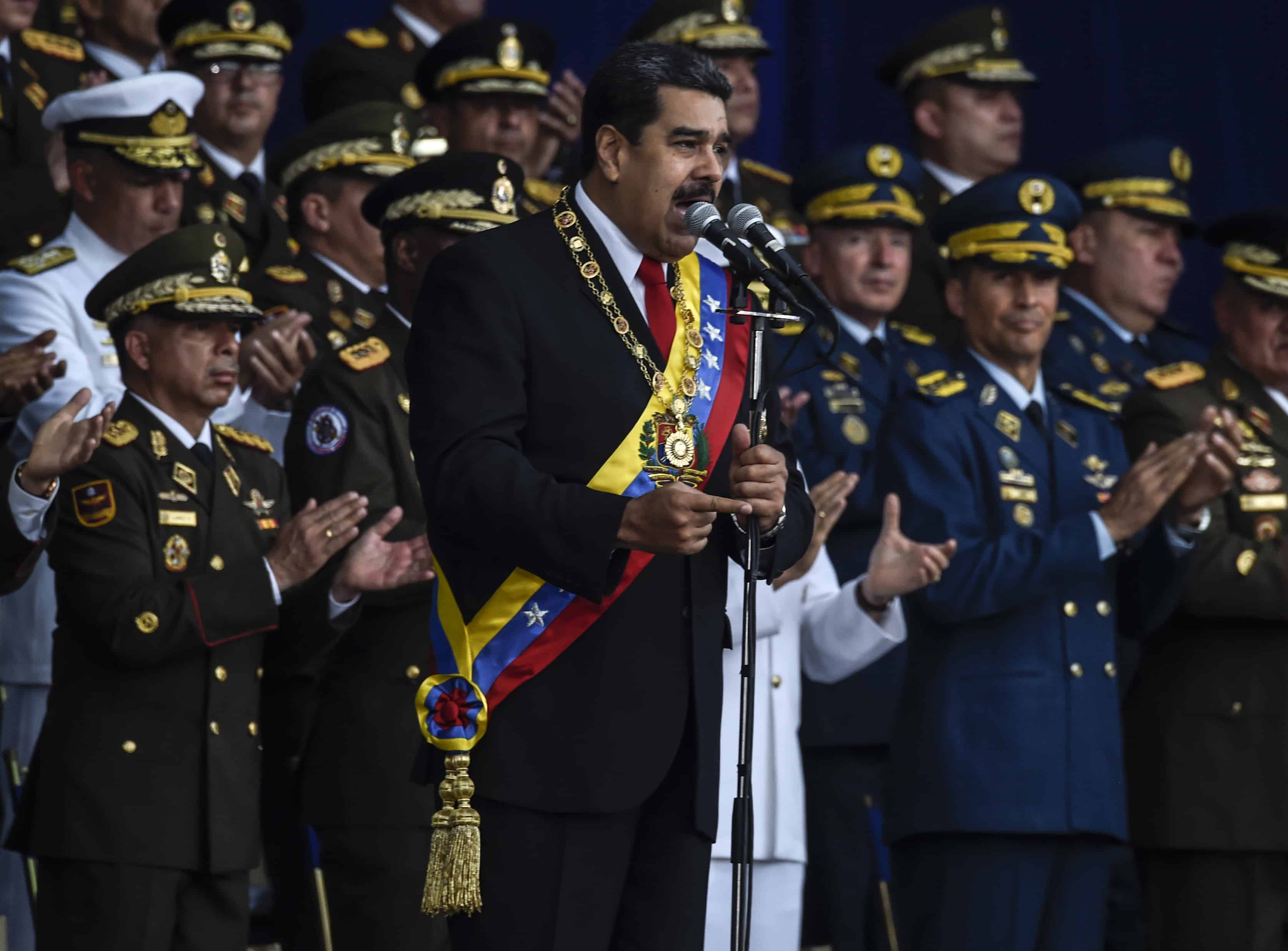
The United States on Thursday invoked the Inter-American Treaty of Reciprocal Assistance (TIAR) in the face of “bellicose” military exercises by the government of Nicolás Maduro on the border with Colombia and after a call from the OAS to its foreign ministers.
“Recent bellicose movements of deployment on the border with Colombia by the Venezuelan military, as well as the presence of illegal armed groups and terrorist organizations in Venezuelan territory, show that Nicolás Maduro is not only a threat to the Venezuelan people, but that their actions threaten the peace and security of the neighbors of Venezuela,” Secretary of State Mike Pompeo said in a statement activating the TIAR.
Colombia and Venezuela share a 2,200 km border where Maduro ordered military exercises until September 28 with the deployment of some 150,000 troops and a missile system against alleged threats from Bogotá in the context of renewed tensions between the two countries.
The government of Colombian President Iván Duque denies any plan against Venezuela and called for “serenity” in the face of escalating tensions.
Venezuelan opposition leader Juan Guaidó, recognized as interim president by some 50 countries, called for the invocation of the TIAR, Pompeo said in a statement that was retweeted by President Donald Trump in the early hours of Thursday.
The U.S. joins 11 partner nations in invoking the Rio Treaty to confront the political, economic, & humanitarian crisis unleashed by Maduro on #Venezuela & the region. Together we will consider multilateral economic & political options to end the havoc. https://t.co/COIIcIEWav
— Secretary Pompeo (@SecPompeo) September 11, 2019
Maduro a ‘destabilizing influence’ in South America
Pompeo said that the invocation of the TIAR is “the recognition of the increasingly destabilizing influence” of the Maduro government in the region.
“Catastrophic economic policies and political repression continue to stir up an unprecedented refugee crisis, depleting the ability of governments to respond,” he said.
According to the UN, some 3.6 million Venezuelans have left their country since 2016 due to the severe economic crisis that plagues the oil country.
“We expect more high-level discussions with the members of the TIAR [to]collectively address the urgent crisis within Venezuela that spills over its borders and consider multilateral economic and political options,” Pompeo said.
Under the TIAR, also known as the Treaty of Rio for its adoption in that city in 1947, the foreign ministers can take measures ranging from the rupture of diplomatic relations to the use of the armed force.
On Wednesday, a session of the Permanent Council of the Organization of American States (OAS) convened the chancellors of the 19 signatory countries of the TIAR to meet in the second half of September to address the “destabilizing impact” of the crisis in Venezuela, which represents “a clear threat to peace and security in the Hemisphere,” according to the resolution.
The United States welcomed the decision as support for Guaidó’s efforts to get Maduro out of power and hold new elections.
During the session, Argentina, Brazil, Chile, Colombia, El Salvador, the United States, Guatemala, Haiti, Honduras, Paraguay, the Dominican Republic and Venezuela voted to activate the TIAR consultation body.
Costa Rica, Panama, Peru, Trinidad and Tobago and Uruguay abstained, while the Bahamas and Cuba – a non-active member of the OAS that never withdrew from TIAR – were absent.
Costa Rica tried unsuccessfully to approve an amendment to the resolution excluding the use of armed force as an alternative, while Uruguay said that the current situation in Venezuela did not give rise to trigger the treaty.
Luz Baños, the Mexican ambassador – who, like Bolivia, Ecuador and Nicaragua, abandoned TIAR in recent years – lamented that “we are dangerously approaching a point of no return.”
Venezuela abandoned this treaty six years ago, but in July, the National Assembly led by Guaido approved its return, a decision that was annulled by the country’s supreme court.
Despite the strong economic sanctions that the United States has imposed on Venezuela and its leaders, Maduro, who enjoys the support of the armed forces, as well as Russia, China and Cuba, has managed to stay in power.





