
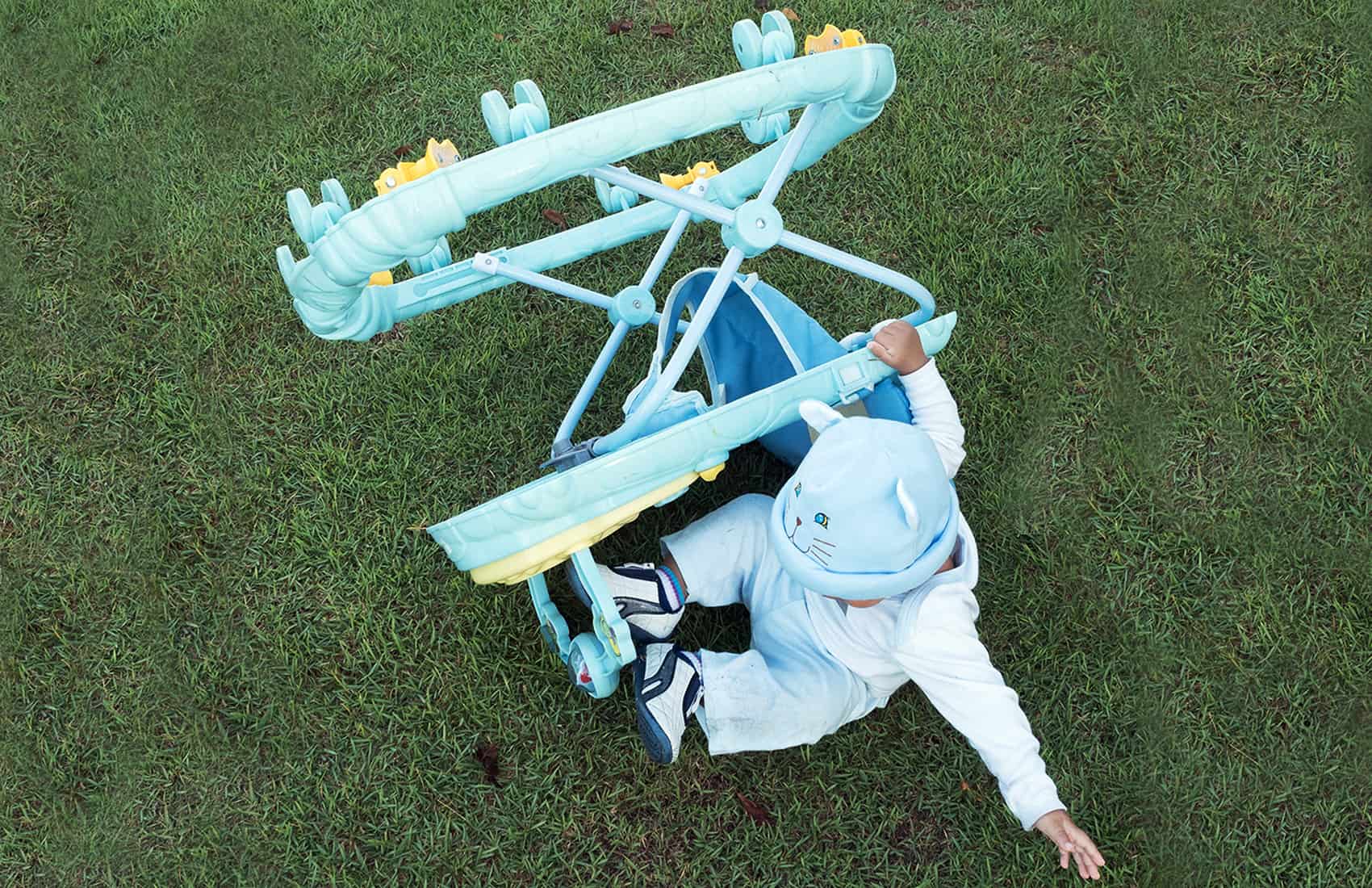
Costa Rica passed a new regulation on the sale of baby walkers that will make them available for purchase only with a medical prescription.
The restriction is part of an Executive Decree signed by the Health Ministry and the Economy Ministry (MEIC). It also states that only pharmacies or medical and orthopedic supplies stores have permission to sell walkers, which have caused controversy in several countries because of their reported negative affect on child development and role in injuries.
Health Minister Fernando Llorca Castro said in a written statement that the initiative came from the recommendations of a large group of specialists from the National Children’s Hospital. Former hospital director Rodolfo Hernández and current director Olga Arguedas coordinated the drafting and approval of the decree with MEIC officials.
The decree (40.229-S-MEIC) appeared in the official newspaper La Gaceta on Friday, and will take effect in six months’ time. The grace period, according to Costa Rican law, grants businesses and public agencies time to take all necessary measures for implementing the new regulation.
Risks
Efforts to regulate the import and sale of baby walkers in Costa Rica began in December 2014, when physicians from the National Children’s Hospital and the Health Ministry published a report that recommended “abandoning the use of baby walkers, as they increase the occurrence of injuries.”
Gabriela Castro, who directs the Ministry’s National Nutrition Department, said at the time that the use of walkers does not improve the process of learning to walk. “Rather, it slows it down, and it can actually have negative repercussions on, the baby’s physical, motor and cognitive development,” she said.
Castro said that babies’ brains get used to associate the device with the ability to walk.
“Therefore, removing the walker from them affects their confidence and their stability,” she said.
The ministry’s report also noted that the use of a walker “before the first birthday can cause musculoskeletal problems in knees and ankles,” as the child is not yet ready to support his own weight.
In figures
Children’s Hospital statistics state that between 2010 and 2016, there were 434 accidents in Costa Rica directly related to the use of walkers.
“Between 85 and 90 percent of walker-related injuries affect the head, and can provoke disability or even death,” adds the report.
Hospital Director Olga Arguedas said that wires of electrical appliances are very attractive for children who start wandering around the house on their walkers. About 90 percent of burns in children occurred in the kitchen, 60 percent of them from accidents with hot liquids, the hospital reported.
Vice Minister María Anchía Angulo said those figures show that walker use increases the risk of injuries to arms, collar bones, ribs, teeth and more.
She noted that while standing up unassisted strengthens a the child’s muscles, legs, motor skills and balance, “walking in a walker isn’t the same. It doesn’t help any of that.”
Few countries
Only a few countries in the world have regulations or bans on baby walkers. Canada was the first to ban the sale, importation and advertisement of baby walkers in 2004. Owners of baby walkers may be fined up to CA $100,000 (some $75,000) or sentenced to six months in jail.
Brazil also banned baby walkers in 2013 and set fines of R$5,000 ($1,595) for disobeying the restriction.
Agencies and organizations in the U.S. have advocated for restrictions or a ban on the device for years. Among them is the American Academy of Pediatrics, which claims baby walkers send thousands of children to hospitals every year.
U.S. pediatrician Alan Greene, in a column in The New York Times, said walkers allow mobility beyond a baby’s natural capability, and faster than a parent’s reaction time. Today’s walkers are safer, but they are still hazardous – and of no benefit to babies, he said.
He also noted that the Consumer Products Safety Commission declared in 1994 that baby walkers were responsible for more injuries than any other children’s product.