
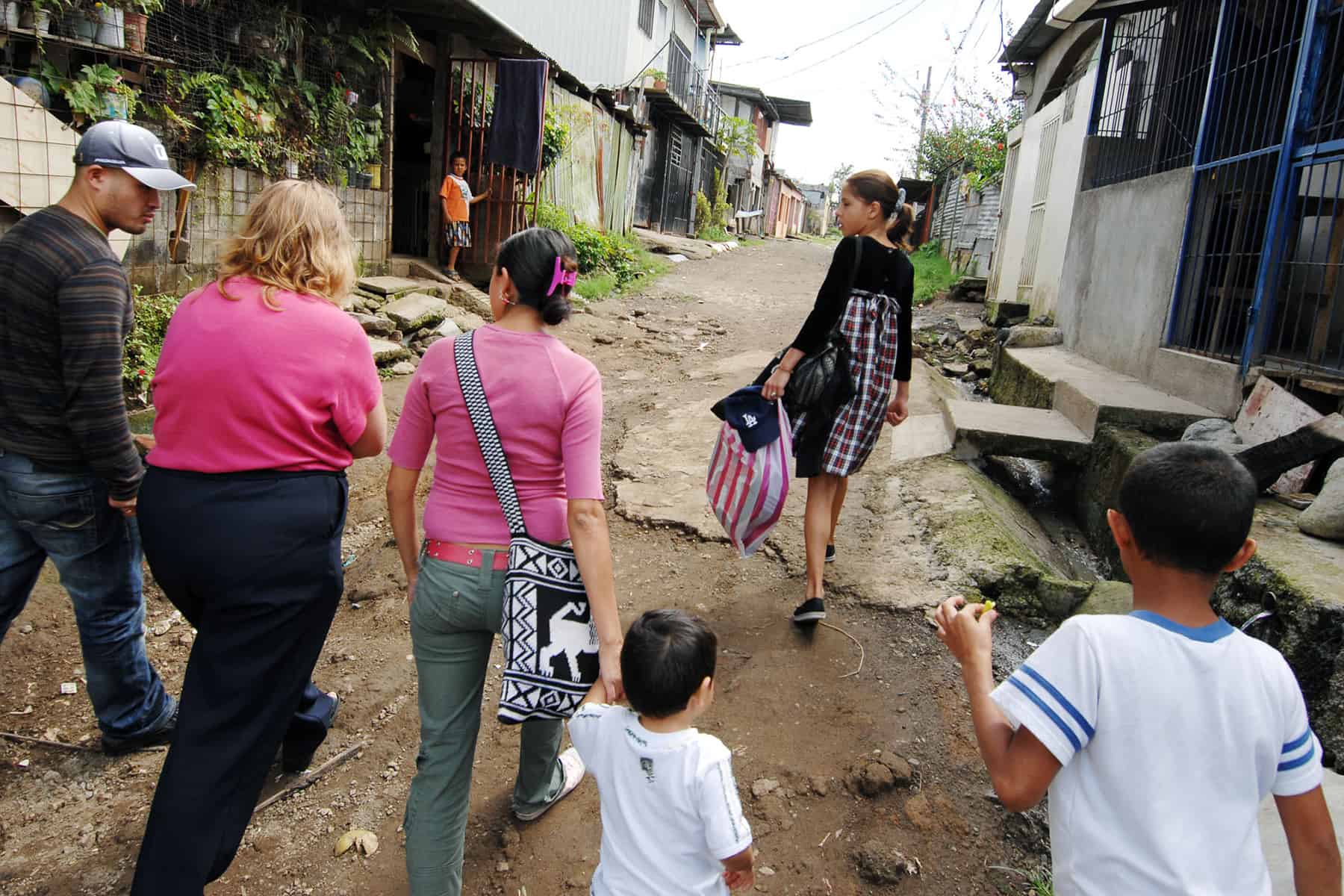
The administration of President Luis Guillermo Solís launched a targeted poverty-reduction plan on Thursday, aimed at pulling at least 54,600 families out of extreme poverty.
The plan, called “Puente al Desarrollo” (Bridge to Development), would combine current welfare programs into a single system, and tailor aid to the needs of each family. Eight public agencies and social aid programs helped develop the plan.
The number of families targeted under the program represents nearly 60 percent of families with a monthly income below ₡70,000 (around $130). At that income level, a family is assumed to be unable to afford a daily meal or a place to live, according to standards set by the National Institute of Statistics and Census.
The Mixed Institute for Social Aid (IMAS), one of the agencies spearheading the plan, appointed 160 officials responsible for selecting the 54,600 families. They’ll also determine the primary needs of each family in order to tailor aid programs. The officials also will be responsible for periodically evaluating the progress of beneficiaries.
The plan aims to unify all government benefits into a single welfare system called the “Unique System of Beneficiaries.” Through the system, beneficiaries will apply for housing and food subsidies, health insurance, pensions, training programs and scholarships, among other types of aid.
Currently, aid is distributed through 30 separate programs, administered by 20 different agencies. This situation complicates aid distribution and obscures the results of individual programs, Human Development Minister Carlos Alvarado Quesada said. Alvarado is also executive president of IMAS.
Personal data from each family member will be stored in a new information system and all aid programs will have access to the system. The aim is to reduce red tape and avoid families getting duplicate funds from the same program.
The government currently does not have a system to detect when separate members of a family apply for the same aid program, a situation which has left room for exploitation, Alvarado said.
Selected families must comply with various requirements, the most important being enrolling in training programs and taking advantage of scholarships for improving their economic and social situation, the plan states.
The government will also give those who stick with the program a monthly stipend of ₡75,000 ($140).
Alvarado said the plan does not represent any increase in spending for social aid programs, as it will be financed using the same resources allocated for the Social Development and Family Allowance Fund, or FODESAF. That fund is currently set at ₡600,000 million ($1.1 billion), equivalent to 2 percent of the country’s Gross Domestic Product.
The minister also announced that starting this year state agencies will begin using the Multidimensional Poverty Index — developed by the Oxford Poverty & Human Development Initiative — as the main instrument for measuring poverty levels. The MPI takes into account 20 indicators, not just a family’s income, therefore providing a much more accurate level of the dimensions of poverty, Alvarado said.
IMAS and the national census institute will be responsible for implementing the poverty index in collaboration with experts from the U.K.-based Oxford University.
According to the census institute’s 2014 National Household Survey, 318,810 Costa Rican households live in poverty, of which 94,810 live in extreme poverty. This number represents 6.7 percent of all homes in the country.
The goal of the government’s Bridge to Development plan is to reduce the number of extremely impoverished families to 40,210 by the end of President Solís’ administration in 2018.