
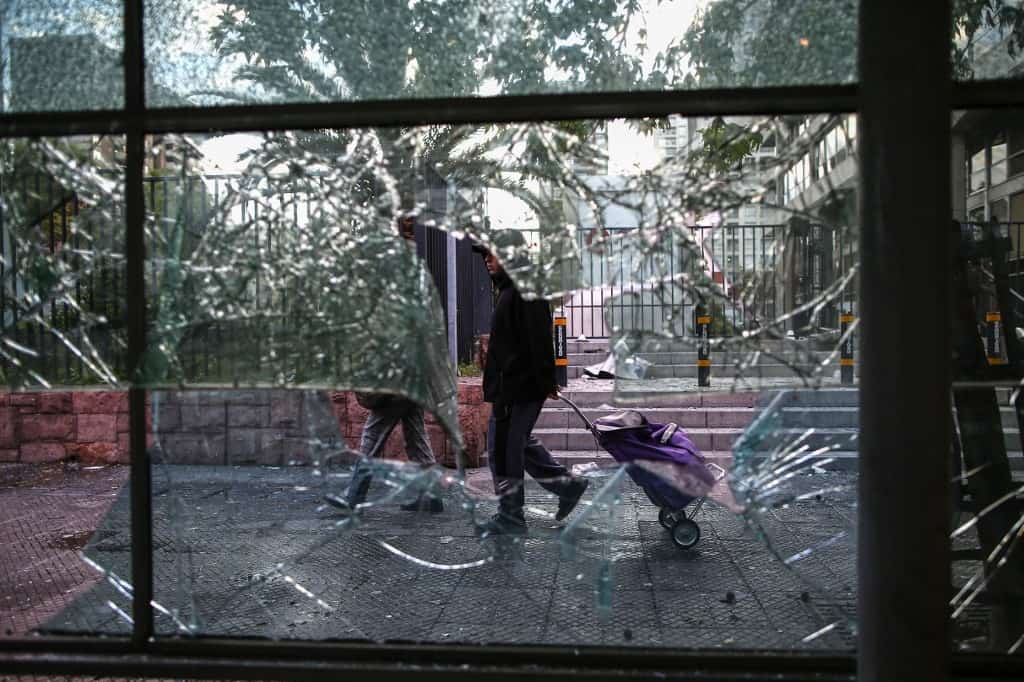
Chileans angry over social and economic woes banged pots and pans Saturday in a noisy but peaceful continuation of violent protests that prompted the government to declare a state of emergency.
A day after the worst violence in Santiago in years, people awoke to a ravaged city as burned-out buses, bikes and garbage littered streets patrolled by soldiers — the first such deployment in decades.
Here and in other cities, people banged together pots and frying pans — a typically Latin American form of protest. In other cities such as Vina del Mar and Valparaiso, people took to the streets and shouted slogans against the conservative government of President Sebastian Pinera. But there was no violence.
The stunning spasm of unrest was triggered by an increase in metro fares but reflected a much broader anger over economic and social conditions, including a yawning gap between rich and poor in a country considered one of the most stable in Latin America.
“It is sad, but this destruction was people’s way of demanding they be heard. Chile was a pressure cooker, and it exploded in the worst way,” said a civil servant who gave her name only as Maria, waiting to catch a bus amid the detritus of Friday’s protests.
Soldiers patrolled some parts of the city Saturday in their first such deployment since Chile returned to democracy in 1990 after the Augusto Pinochet right-wing dictatorship.
In Plaza Italia, which was ground zero of Friday’s violence, police used water cannon to disperse a small group of protesters. The same thing happened outside the presidential palace.
Throughout Friday, rampaging protesters clashed with riot police in several parts of the capital, and the subway system was shut after attacks on stations. A total of 41 stations were destroyed, some completely charred.
The system was closed altogether on Saturday, and no one knows when it will reopen.
The Santiago Metro, at 140 kilometers (90 miles), is the largest and most modern in South America and a source of great pride for Chileans.
The general placed in charge of security, Javier Iturriaga, said some 500 soldiers are patrolling the streets. Things calmed down in Santiago, a city of seven million, overnight, he said.
“This morning, the city is quiet,” he said.
More than 300 people were arrested, and 156 police were injured, as were 11 civilians.
The state of emergency is initially set for 15 days and restricts freedom of movement and assembly. Due to the emergency, the National Football Association has suspended matches this weekend.
Government ‘perplexed and dazed’ at protests
Iturriaga said the military would patrol major trouble spots but would not impose a curfew at present.
Violent clashes escalated as night fell Friday, and the headquarters of the ENEL Chile power company and a Banco Chile branch — both in the city center — were set on fire and heavily damaged.
Barricades were erected in several parts of the city, and masked protestors armed with sticks and stones clashed with riot police, who repelled them with water cannon and tear gas.
The unrest started as a fare-dodging protest mainly by students against the hike in metro ticket prices, which increased from 800 to 830 peso ($1.13 to $1.17) for peak-hour travel, following a 20 peso rise in January.
The fare hike was blamed on rising oil prices and a weaker peso.
There had been several fare-dodging actions in recent days, organized on social media, but the protests escalated Friday, tapping into general discontent among many Chileans.
Chile has the highest per capita income of Latin America at 20,000 dollars, with expected economic growth this year of 2.5 percent and just two percent inflation.
But there is an undercurrent of frustration with rising health care and utility costs, low pensions and social inequality.
The metro fare hike served to wake up a society that was averse to violence after the horrors of the Pinochet dictatorship from 1973-1990, which left more than 3,200 people dead or missing, sociologists say.
However, tech-savvy younger Chileans, who did not live through that dark period, are leading the current protests.
“I think social media explains the coordination and synchronized nature of the actions that destroyed infrastructure yesterday,” said Santiago Marcelo Mella, an analyst at the University of Santiago.
He said the government was “perplexed and dazed” by the eruption of violence, and this “must make us think about the quality of the intelligence services.
“One gets the feeling that the government reacted too slowly,” he said.